Portret van Sol Lewitt

De 40 bekendste schilderijen van Sol Lewitt, een selectie uit de galerie

Bijgewerkt in oktober 2026 · gerangschikt op basis van onze populariteitsscore (zoekopdrachten, bezoeken en bestellingen per kunstwerk) · 42 werken van Sol Lewitt in onze catalogus

Kortom

Van alle originele werken die Sol Lewitt heeft nagelaten, is Serial Project #1 ABCD (1966) het bekendst, in de collectie van het MoMA - Museum of Modern Art, New York City. Direct daarna volgen Wall drawing #1091: arcs, circles and bands (room) (2003) en Distorted Cubes Bozuk Küpler. Onze catalogus bevat 42 werken van Sol Lewitt; de galerie heeft de 40 meest bewonderde werken ter wereld bewaard, elk voorzien van de datum, het museum en het verhaal erachter.

1928 – 2007, Hartford Minimalism Meeste werken: MASS MoCA

De top 10 schilderijen van Sol Lewitt: de selectie van de galerie

1
Serial Project #1 ABCD (1966) door Sol Lewitt

Serial Project #1 ABCD

1966 · Sculpture · MoMA - Museum of Modern Art, New York City

A systematic arrangement of white cubes and rectangular prisms occupies a grid-like base, set against a stark black void. This geometric composition, titled Serial Project #1 ABCD, functions as an architectural exploration of structure and seriality. Rather than representing a specific building, the work investigates the permutations of simple shapes. The arrangement follows a predetermined algorithm, where the placement of each element is dictated by a logical sequence rather than…

2
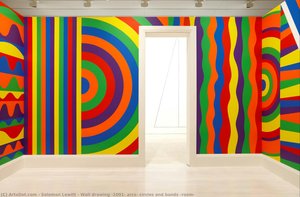
Wall drawing #1091: arcs, circles and bands (room) (2003) door Sol Lewitt

Wall drawing #1091: arcs, circles and bands (room)

2003 · Installation Art · Art Gallery of New South Wales, Sydney

To stand before Wall drawing #1091: arcs, circles and bands (room) is to witness not merely an arrangement of pigment on a surface, but the vibrant echo of artistic reinvention. This monumental piece by Solomon Lewitt captures a moment of profound resurgence in his later career. Where earlier works might have favored a more restrained palette, this drawing explodes with exuberant color—a joyous chromatic symphony applied across the architectural expanse…

3
Distorted Cubes Bozuk Küpler door Sol Lewitt

Distorted Cubes Bozuk Küpler

Painting · Borusan Contemporary, Istanbul

In the realm of conceptual mastery, few works capture the rhythmic pulse of modern abstraction as vibrantly as Sol LeWitt’s Distorted Cubes Bozuk Küpler. This captivating piece serves as a brilliant testament to the artist's ability to transform rigid mathematical precision into a dance of visual delight. At first glance, the viewer is greeted by an intricate mosaic of fourteen distinct colored squares, each meticulously arranged to create a sense…

4
Wall Drawing #391 (1983) door Sol Lewitt

Wall Drawing #391

1983 · Indian Ink · MASS MoCA, Adams

Wall Drawing #391 is an artwork by Solomon Lewitt. Created in April 1983, this two-part drawing occupies a specific space within the MASS MoCA in Adams. The work exists as a structural dialogue between two adjacent surfaces, mapping out a logic that relies on the intersection of planes and the direction of the line.

5
Wall Drawing #831 (1997) door Sol Lewitt

Wall Drawing #831

1997 · Drawing · Guggenheim Museum Bilbao, Bilbao

In the vast landscape of twentieth-century modernism, few names resonate with as much intellectual rigor as Solomon Lewitt. His Wall Drawing #831, created in 1997, serves as a breathtaking testament to the power of the idea over the hand. As a pioneer of both Minimalism and Conceptual Art, Lewitt famously posited that the concept itself is the machine that makes the art. This particular work is not merely a painting…

6
Wall Drawing #915 (1999) door Sol Lewitt

Wall Drawing #915

1999 · Installation Art · MASS MoCA, Adams

Wall Drawing #915 exists as an installation of mathematical precision. Created in 1999, the work utilizes a palette of pastels, anchored by a primary tone of steel blue. The composition relies on geometric patterns and interlocking shapes that transform architectural surfaces into active participants in the art. Through the use of arcs and circles, the piece establishes a rhythmic movement across the wall.

7
Incomplete open cube 5/6 (1974) door Sol Lewitt

Incomplete open cube 5/6

1974 · Metal · Art Gallery of New South Wales, Sydney

Incomplete Open Cube No.5-6 – A Testament to Minimalist Geometry The ‘Incomplete open cubes’ represent a pivotal moment in Sol LeWitt's artistic trajectory, encapsulating the core tenets of his conceptual approach and solidifying his position as one of the pioneers of Minimalism. Created in 1974, this sculpture—a precisely crafted aluminum structure—isn’t merely an object; it’s an embodiment of intellectual rigor distilled into a deceptively simple form. LeWitt himself famously articulated…

8
Kaldor Public Art Project 06: Sol LeWitt 1977 (1977) door Sol Lewitt

Kaldor Public Art Project 06: Sol LeWitt 1977

1977 · Drawing · Kaldor Public Art Projects, Sydney

In the quiet, transformative moment captured in this 1977 photograph, we witness more than just the documentation of a mural; we see the physical manifestation of an idea. Part of the prestigious Kaldor Public Art Project, this work by Solomon LeWitt serves as a profound testament to the power of Conceptualism. The image presents a stark, monochromatic dialogue between two observers and a monumental wall drawing that consumes the architectural…

9
Wall Drawing #146A (2000) door Sol Lewitt

Wall Drawing #146A

2000 · Crayon · MASS MoCA, Adams

In the realm of contemporary minimalism, few names resonate with as much intellectual authority as Solomon LeWitt. His work, particularly the mesmerizing Wall Drawing #14 6A, serves as a profound testament to the power of the concept over the physical object. This particular piece, captured in its striking blue crayon medium, transcends the boundaries of traditional painting to become an immersive environment. As one gazes upon the composition, the distinction…

De selectie van Sol Lewitt gaat verder, van 11 tot 40

11Pyramid (2005) door Sol LewittPyramid2005 · Art Gallery of New South Wales 12Black with White Lines, Vertical Not Touching (1970) door Sol LewittBlack with White Lines, Vertical Not Touching1970 · MoMA - Museum of Modern Art 13Cubo door Sol LewittCuboCAMUSAC Cassino Museum of Contemporary Art 14Vertical Lines, Not Touching (1970) door Sol LewittVertical Lines, Not Touching1970 · MoMA - Museum of Modern Art 15Objectivity (1962) door Sol LewittObjectivity1962 16Irregular Grid door Sol LewittIrregular GridElgiz Museum of Contemporary Art 17Wall Drawing #822 (1997) door Sol LewittWall Drawing #8221997 · MASS MoCA 18Four Color Woodcuts-Curvy Bands I-IV (1996) door Sol LewittFour Color Woodcuts-Curvy Bands I-IV1996 · Borusan Contemporary 19Kaldor Public Art Project 11: Sol LeWitt 1998 (1998) door Sol LewittKaldor Public Art Project 11: Sol LeWitt 19981998 · Kaldor Public Art Projects 20Blue Vertical (2000) door Sol LewittBlue Vertical2000 21Wal Drawing #999 (2001) door Sol LewittWal Drawing #9992001 · MASS MoCA 22Isometric Figures in Five and Six Colors (2002) door Sol LewittIsometric Figures in Five and Six Colors2002 · Borusan Contemporary 23Wall Drawing #1171 (2005) door Sol LewittWall Drawing #11712005 · MASS MoCA 24Wall Drawing #1185 (2005) door Sol LewittWall Drawing #11852005 · MASS MoCA 25brushstrokes 2 door Sol Lewittbrushstrokes 2CAMUSAC Cassino Museum of Contemporary Art 26Lincoln Center Print door Sol LewittLincoln Center PrintBorusan Contemporary 27brushstrokes door Sol LewittbrushstrokesCAMUSAC Cassino Museum of Contemporary Art 28Wall drawing #338: Two part drawing. The wall is divided vertically into two parts. Each part is divided horizontally and vertically into four equal parts. 1st part: Lines in four directions, one direction in each quarter. 2nd part: Lines in four dir.... (1971) door Sol LewittWall drawing #338: Two part drawing. The wall is divided vertically into two parts. Each part is divided horizontally and vertically into four equal parts. 1st part: Lines in four directions, one direction in each quarter. 2nd part: Lines in four dir....1971 · Art Gallery of New South Wales 29Wall Drawing #340 (1980) door Sol LewittWall Drawing #3401980 · MASS MoCA 30Untitled door Sol LewittUntitled 31Untitled from Squares with a Different Line Direction in Each Half Square (3) door Sol LewittUntitled from Squares with a Different Line Direction in Each Half Square (3) 32Untitled from Squares with a Different Line Direction in Each Half Square door Sol LewittUntitled from Squares with a Different Line Direction in Each Half Square 33Untitled from Squares with a Different Line Direction in Each Half Square (2) door Sol LewittUntitled from Squares with a Different Line Direction in Each Half Square (2) 34Wall Drawing #154, #155, #162, #163, #157, #158 door Sol LewittWall Drawing #154, #155, #162, #163, #157, #158Modern Art Oxford 35Distorted Cubes from Distorted Cubes door Sol LewittDistorted Cubes from Distorted Cubes 36Distorted Cubes from Distorted Cubes (2) door Sol LewittDistorted Cubes from Distorted Cubes (2) 37Irregular tower door Sol LewittIrregular towerCAMUSAC Cassino Museum of Contemporary Art 38Irregular tower door Sol LewittIrregular towerCAMUSAC Cassino Museum of Contemporary Art 39Irregular Arcs, Bands and Loops door Sol LewittIrregular Arcs, Bands and LoopsBorusan Contemporary 40Eight-Pointed Stars door Sol LewittEight-Pointed StarsChrysler Museum of Art

De beroemde schilderijen van Sol Lewitt, periode voor periode

De onderwerpen die de aandacht van Sol Lewitt troffen

De vier onderwerpen die het meest voorkomen in deze originelen, elk met zijn mooiste voorbeeld.

De musea waar de originele werken van Sol Lewitt worden bewaard

De 8 musea met de meeste schilderijen op deze pagina.

Museum Stad Werken van Sol Lewitt Schilderijen uit deze lijst
MASS MoCA, AdamsMASS MoCA Adams 9 Wall Drawing #391, Wall Drawing #915, Wall Drawing #146A
Borusan Contemporary, IstanbulBorusan Contemporary Istanbul 5 Distorted Cubes Bozuk Küpler, Four Color Woodcuts-Curvy Bands I-IV, Isometric Figures in Five and Six Colors
CAMUSAC Cassino Museum of Contemporary Art, CassinoCAMUSAC Cassino Museum of Contemporary Art Cassino 5 Cubo, brushstrokes 2, brushstrokes
Art Gallery of New South Wales, SydneyArt Gallery of New South Wales Sydney 4 Wall drawing #1091: arcs, circles and bands (room), Incomplete open cube 5/6, Pyramid
MoMA - Museum of Modern Art, New York CityMoMA - Museum of Modern Art New York City 3 Serial Project #1 ABCD, Black with White Lines, Vertical Not Touching, Vertical Lines, Not Touching
Kaldor Public Art Projects, SydneyKaldor Public Art Projects Sydney 2 Kaldor Public Art Project 06: Sol LeWitt 1977, Kaldor Public Art Project 11: Sol LeWitt 1998
Guggenheim Museum Bilbao, BilbaoGuggenheim Museum Bilbao Bilbao 1 Wall Drawing #831
Elgiz Museum of Contemporary Art, İstanbulElgiz Museum of Contemporary Art İstanbul 1 Irregular Grid

Sol Lewitt decennium voor decennium: het origineel dat elk tijdperk definieert

Werken per decennium

Kies een decennium om het origineel te zien dat dit tijdperk definieert.

Vragen van verzamelaars over de schilderijen van Sol Lewitt

Waar is Sol Lewitt het meest bekend om?Onthul het antwoord

Serial Project #1 ABCD (1966), MoMA - Museum of Modern Art, New York City. Wall drawing #1091: arcs, circles and bands (room) (2003) en Distorted Cubes Bozuk Küpler volgen.

Hoe oud was Sol Lewitt toen Serial Project #1 ABCD werd gemaakt?Onthul het antwoord

38 jaar oud: Serial Project #1 ABCD dateert uit 1966, en Sol Lewitt werd geboren in 1928.

Wat zijn de tien beroemdste schilderijen van Sol Lewitt?Onthul het antwoord

Serial Project #1 ABCD, Wall drawing #1091: arcs, circles and bands (room), Distorted Cubes Bozuk Küpler, Wall Drawing #391, Wall Drawing #831, Wall Drawing #915, Incomplete open cube 5/6, Kaldor Public Art Project 06: Sol LeWitt 1977, Wall Drawing #146A en Wall Drawing #793B Certificate. De bovenstaande ranglijst vermeldt het jaar en het museum van elk werk.

Hoeveel schilderijen heeft Sol Lewitt nagelaten?Onthul het antwoord

Onze catalogus bevat 42 werken van Sol Lewitt, daterend van 1962 tot 2005.

In welke musea hangen de meesterwerken van Sol Lewitt?Onthul het antwoord

Voornamelijk in MASS MoCA (Adams), Borusan Contemporary (Istanbul) en CAMUSAC Cassino Museum of Contemporary Art (Cassino). De bovenstaande museumtabel bevat een volledig overzicht.

In welke jaren schilderde Sol Lewitt de beroemdste werken?Onthul het antwoord

In 2000s: 8 van de 40 werken op deze pagina werden toen gemaakt, waaronder Wall drawing #1091: arcs, circles and bands (room).

Wat zijn de eerste en de laatste beroemde originelen van Sol Lewitt?Onthul het antwoord

Op deze pagina is het vroegste Objectivity (1962) en het laatste Pyramid (2005).

Welke onderwerpen koos Sol Lewitt het vaakst?Onthul het antwoord

Geometric abstraction (8), Conceptual art (7) en Wall drawing (5), verspreid over de 40 werken op deze pagina.

Welke techniek gebruikte Sol Lewitt het meest?Onthul het antwoord

Sculpture, voor 2 van de 40 werken op deze pagina.

Bij welke kunststroming behoort Sol Lewitt?Onthul het antwoord

Minimalism, te oordelen aan de originelen op deze pagina.

Welke werken van Sol Lewitt hangen in het MASS MoCA?Onthul het antwoord

Wall Drawing #391, Wall Drawing #915 en Wall Drawing #146A: het MASS MoCA, Adams herbergt 9 van de werken op deze pagina.

Sol Lewitt: leven en werk

De Architect van Ideeën: Het Leven en de Nalatenschap van Sol LeWitt

In het uitgestrekte landschap van het modernisme van de twintigste eeuw werpt weinig figuren een zo lange of intellectueel diepgaande schaduw als Solomon LeWitt. Geboren op 9 september 1928 in Hartford, Connecticut, in een gezin van Joodse immigranten uit Rusland, werd de reis van LeWitt bepaald door het streven naar pure gedachte boven louter fysieke uitvoering. Zijn vroege jaren werden gevormende door een rigoureuze analytische nieuwsgierigheid, een eigenschap die werd gevoed door zijn studies aan de Syracuse University tussen 1945 en 1949. Deze academische basis in de wiskunde en meetkunde zou later het kloppende hart van zijn artistieke taal worden, waardoor hij de decoratieve excessen van de traditionele kunst kon wegsnijden om de skeletachtige schoonheid van logica en structuur te onthullen.

LeWitts evolutie als kunstenaar was geen plotselinge breuk, maar een bewuste migratie van het tastbare naar het conceptuele. Hoewel zijn vroege verkenningen de tactiele aard van schilderkunst en tekenkunst omvatten, voelde hij zich al snel steeds meer aangetrokken tot het idee achter de lijn, in plaats van de lijn zelf. Deze verschuiving markeerde de geboorte van een pionier die de kloof tussen het minimalisme en de conceptuele kunst zou overbruggen. Hij begon de kunstenaar niet te zien als een ambachtsman die gebonden is aan de hand, maar als een architect van instructies. Door het mentale blauwdruk boven het voltooide object te plaatsen, daagde LeWitt de definitie van auteurschap zelf uit; hij suggereerde dat zodra een idee is vergaard, de fysieke manifestatie ervan slechts een secundair gevolg is.

De Revolutie van de Wandtekening

De late jaren zestig getuigden van een van de meest radicale transformaties in de hedendaagse kunst met de opkomst van LeWitts iconische wandtekeningen. Door de permanentie en kostbaarheid van traditionele sculptuur te verwerpen, introduceerde hij "structuren"—een term die hij de voorkeur gaf boven "sculpturen" om hun wiskundige essentie te benadrukken—en een reeks instructies die door iedereen die getraind was om ze te volgen, uitgevoerd konden worden. Deze werken waren niet louter decoraties, maar geleefde ervaringen, vaak samengesteld uit precieze geometrische patronen, bogen en in elkaar grijpende vormen die leven bliezen in de architecturale ruimtes waarin zij zich bevonden.

Om een wandtekening van LeWitt te aanschouwen, is om logica getransformeerd te zien in poëzie. Of het nu ging om de sobere, ritmische herhaling in Black with White Lines, Vertical Not Touching of de levendige, exuberante energie van Wall Drawing #1091: arcs, circles and bands, zijn werk maakte gebruik van de kracht van de lijn om de ruimte te beheersen. Deze stukken vertrouwden vaak op een systeem van logische, vaak wiskundige instructies die assistenten of museummedewerkers begeleidden bij de productie ervan. Deze methode democratiseerde de daad van het creëren, terwijl het tegelijkertijd het belang van het concept verhoogde, waardoor werd gewaarborgd dat het kunstwerk fundamenteel als een intellectuele vonk bestond nog voordat het ooit een muur raakte.

Een Blijvende Indruk op de Moderniteit

Gedurende zijn productieve carrière, die decennia besloeg en meesterschap in grafiek, fotografie en installatie omvatte, bleef LeWitt standvastig in zijn toewijding aan helderheid en precisie. Zijn vermogen om diepe schoonheid te vinden in de eenvoudigste vormen—zoals de opvallende witte Pyramide of de complexe, kleurrijke ritmes van zijn wandwerken met krijt—herdefinieerde de esthetische grenzen van de late 20e eeuw. Hij bewees dat kunst gestript kon worden van zijn ego en ornamentiek, maar toch een ziel kon behouden die diep resoneert met de menselijke behoefte aan orde en ontdekking.

De historische betekenis van Sol LeWitt kan niet worden overschat. Hij leverde het vocabulaire waarmee generaties kunstenaars de grenzen tussen gedachte en materie konden verkennen. Zijn nalatenschap leeft voort in elk museum en elke galerie waar de lijn tussen de maker en de uitvoerder vervaagt, en waar de kracht van een idee wordt erkend als het ultieme medium. Wanneer we terugkijken op zijn leven, van zijn begin in Hartford tot zijn laatste dagen in New York City in 2007, zien we een man die niet alleen kunst maakte, maar ons leerde hoe we de diepgaande architectuur van de gedachte zelf kunnen waarnemen.