Portret van Paul Huet

De 100 beroemdste schilderijen van Paul Huet, elk uniek

Bijgewerkt in november 2026 · gerangschikt op basis van onze populariteitsscore (zoekopdrachten, bezoeken en bestellingen per kunstwerk) · 104 werken van Paul Huet in onze catalogus

Kortom

Woodland Stream (1840) is het schilderij van Paul Huet dat de meeste aandacht trekt; het origineel bevindt zich in het National Gallery of Art, Washington. Daarna gaat de blik naar La Vallée de Bizanos en FORET DE FONTAINEBLEAU.LES CHASSEURS. Van de 104 werken van Paul Huet in onze catalogus zijn dit de 100 bekendste, elk een uniek origineel gepresenteerd met het jaar, het museum en de reden waarom het blijft voortbestaan.

1803 – 1869, Parijs Romanticism Meeste werken: Louvre

Top 10 schilderijen van Paul Huet, door de ogen van de galerie

1
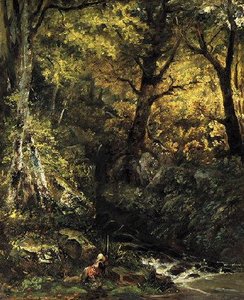
Woodland Stream (1840) door Paul Huet

Woodland Stream

1840 · Oil · National Gallery of Art, Washington

In Paul Huet's Woodland Stream, painted about 1840, a lush wooded area unfolds before the eyes. A stream winds through the heart of the forest, its path interrupted by a waterfall that tumbles amidst a collection of rugged rocks. Trees crowd the banks, their branches reaching into the space above the moving water. The scene feels alive with quiet activity. Several people are scattered throughout the landscape, appearing as small…

2
La Vallée de Bizanos door Paul Huet

La Vallée de Bizanos

Oil On Canvas

The valley unfolds in a series of soft, horizontal layers, drawing the eye through a landscape that feels caught in a moment of profound stillness. In the foreground, life moves at a gentle pace; figures tend to their livestock along a winding path, their presence grounding the vastness of the scene in the rhythms of rural existence. A river snakes through the middle ground, its surface reflecting the muted light…

3
FORET DE FONTAINEBLEAU.LES CHASSEURS door Paul Huet

FORET DE FONTAINEBLEAU.LES CHASSEURS

Oil On Canvas · Louvre, Parijs

The air within the Forest of Fontainebleau feels heavy with the scent of damp earth and ancient bark. In this 1855 scene, the woods are alive with a quiet, restless energy. Large trees anchor the composition, their trunks rising like pillars through a landscape of rugged rocks and tangled foliage. Near the foreground, the sudden movement of hunters and dogs breaks the stillness of the forest floor. A hound leaps,…

4
INONDATION A SAINT CLOUD (PARC DE SAINT CLOUD) door Paul Huet

INONDATION A SAINT CLOUD (PARC DE SAINT CLOUD)

Oil On Canvas · Louvre, Parijs

In the evocative masterpiece INONDATION A SAINT CLOUD (PARC DE SAINT CLOUD), the viewer is transported to a moment of profound atmospheric transformation. The painting captures a landscape in flux, where the tranquil greenery of the Parc de Saint Cloud has been surrendered to the rising floodwaters. This is not merely a depiction of a natural disaster, but an impressionistic study of light, reflection, and the ephemeral boundary between earth…

5
INTERIEUR DE FORET (COMPIEGNE) door Paul Huet

INTERIEUR DE FORET (COMPIEGNE)

Oil On Canvas · Louvre, Parijs

To stand before Paul Huet’s depiction of an interior forest—Intérieur de Forêt (Compiègne)—is not merely to observe a landscape; it is to step through a veil into a moment suspended between light and shadow. The painting immerses the viewer in the profound, almost palpable atmosphere of a dense woodland. Huet masterfully captures the overwhelming presence of nature, where the vertical thrust of countless tree trunks creates an architectural rhythm, guiding…

8
Banks of the Seine at the Barrière de la Cunette, near the Champ-de-Mars (1820) (1820) door Paul Huet

Banks of the Seine at the Barrière de la Cunette, near the Champ-de-Mars (1820)

1820 · Oil · Musée Carnavalet, Parijs

In Banks of the Seine at the Barrière de la Cunette, near the Champ-de-Mars (1820), Paul Huet presents a panoramic view of the riverbank that feels deeply grounded in the reality of the French landscape. This oil painting captures a wide stretch of the Seine, where the terrestrial plane meets a vast, expressive sky. The scene is populated by various figures engaged in the quiet, rhythmic activities of rural life.…

9
Mills near la Glacière, around 1820 (1820) door Paul Huet

Mills near la Glacière, around 1820

1820 · Oil · Musée Carnavalet, Parijs

In Mills near la Glacière, around 1820, Paul Huet organizes a rural landscape dominated by a vast expanse of sky. This celestial area occupies the upper two-thirds of the canvas, creating a sense of openness above the terrestrial plane. The sky is rendered in a palette of cool blues, whites, and soft greys, suggesting a heavy, overcast day. Below this expanse, the composition transitions into a midground where windmills appear…

10
The Elms of Saint-Cloud (1823) door Paul Huet

The Elms of Saint-Cloud

1823 · Oil On Canvas · Petit Palais, Parijs

In The Elms of Saint-Cloud, Paul Huet directs our attention toward the immense, overarching tree canopies that dominate the frame. These branches reach across the composition, creating a sense of enclosure within the grove. The perspective is set from a low vantage point deep within the woods, which establishes a palpable sense of depth. This is achieved through the careful layering of trees, moving from the dark, shadowed foreground toward…

De beroemde schilderijen van Paul Huet, nummer 11 tot 100

11Caretaker's Cottage in the Forest of Compiegne (1826) door Paul HuetCaretaker's Cottage in the Forest of Compiegne1826 · Minneapolis Institute of Art 12Forêt de Compiègne (1830) door Paul HuetForêt de Compiègne1830 · Museum of Fine Arts 13Autumn Evening in the Parc de Saint-Cloud (1835) door Paul HuetAutumn Evening in the Parc de Saint-Cloud1835 14Spoleto near Perugia, sometimes said erroneously: View of the Neapolitan Countryside (1837) door Paul HuetSpoleto near Perugia, sometimes said erroneously: View of the Neapolitan Countryside1837 15Landscape in the South of France (1838) door Paul HuetLandscape in the South of France1838 · Museum of Fine Arts 16Twilight (1842) door Paul HuetTwilight1842 17The Parc de Saint-Cloud (1848) door Paul HuetThe Parc de Saint-Cloud1848 · Musée d'Arts de Nantes 18The Farm (1850) door Paul HuetThe Farm1850 19Morning Calm; Forest Interior (1852) door Paul HuetMorning Calm; Forest Interior1852 20Fontainebleau Forest. The Hunters (1850) door Paul HuetFontainebleau Forest. The Hunters1850 21View Taken Near the Col de Tende (1849) door Paul HuetView Taken Near the Col de Tende1849 · Musée des Beaux-Arts 22Salt marshes in the surroundings of Saint-valèry en Somme, Picardy (1853) door Paul HuetSalt marshes in the surroundings of Saint-valèry en Somme, Picardy1853 23The Rocks of Calvaire in Forest of Fontainebleau (1859) door Paul HuetThe Rocks of Calvaire in Forest of Fontainebleau1859 · Dordrechts Museum 24Landscape (1860) door Paul HuetLandscape1860 · Rhode Island School of Design Museum of Art 25The Gate of the Uriage road to Vizille (Isère) (1864) door Paul HuetThe Gate of the Uriage road to Vizille (Isère)1864 · Museum of the French Revolution 26SOIREE D'AUTOMNE DANS LE PARC DE SAINT CLOUD door Paul HuetSOIREE D'AUTOMNE DANS LE PARC DE SAINT CLOUDLouvre 27A Cottage By A Beach, A Boat In The Distance door Paul HuetA Cottage By A Beach, A Boat In The Distance 28The Bank Of A Pond With A Peasant Woman Resting door Paul HuetThe Bank Of A Pond With A Peasant Woman Resting 29Studies Of Trees In The Forest At Compiegne door Paul HuetStudies Of Trees In The Forest At Compiegne 30A View From The Hills At Mortain door Paul HuetA View From The Hills At Mortain 31Vauquelin Birth House door Paul HuetVauquelin Birth House 32A Wooded Landscape With A Woman Washing Laundry At A Stream door Paul HuetA Wooded Landscape With A Woman Washing Laundry At A Stream 33Intérieur de forêt avec braconniers door Paul HuetIntérieur de forêt avec braconniers 34Vue du château de Pierrefonds restauré door Paul HuetVue du château de Pierrefonds restauré 35Les fabriques La Normandie légendaire (autre titre) door Paul HuetLes fabriques La Normandie légendaire (autre titre) 36VUE DE LA SEINE VERS 1820 door Paul HuetVUE DE LA SEINE VERS 1820 37Les herbages La Normandie légendaire (autre titre) door Paul HuetLes herbages La Normandie légendaire (autre titre) 38La Normandie légendaire La Manche, entrée au port door Paul HuetLa Normandie légendaire La Manche, entrée au port 39Vue des falaises de Houlgate door Paul HuetVue des falaises de Houlgate 40Le ruisseau La Normandie légendaire (autre titre) door Paul HuetLe ruisseau La Normandie légendaire (autre titre) 41Le gué et la chaumière La Normandie légendaire (autre titre) door Paul HuetLe gué et la chaumière La Normandie légendaire (autre titre) 42Marine Falaises au bord de la mer door Paul HuetMarine Falaises au bord de la mer 43La Normandie légendaire Le vieux château féodal door Paul HuetLa Normandie légendaire Le vieux château féodal 44Le déjeuner des chasseurs door Paul HuetLe déjeuner des chasseurs 45Sous bois avec un étang door Paul HuetSous bois avec un étang 46Une allée sous bois door Paul HuetUne allée sous bois 47Vue générale de Rouen, prise du Mont aux Malades door Paul HuetVue générale de Rouen, prise du Mont aux Malades 48La Cascade du Gros Hêtre aux Eaux Bonnes door Paul HuetLa Cascade du Gros Hêtre aux Eaux BonnesMusée des Beaux-Arts de Pau 49La Normandie légendaire door Paul HuetLa Normandie légendaire 50Le retour du grognard (Titre d'usage) door Paul HuetLe retour du grognard (Titre d'usage)Mudo 51FRAICHEUR DES BOIS FOURRE DE LA FORET door Paul HuetFRAICHEUR DES BOIS FOURRE DE LA FORETLouvre 52SOLEIL COUCHANT door Paul HuetSOLEIL COUCHANTLouvre 53SPOLETE dit à tort VUE DE LA CAMPAGNE DE NAPLES door Paul HuetSPOLETE dit à tort VUE DE LA CAMPAGNE DE NAPLESLouvre 54LE PARC DE SAINT CLOUD UN JOUR DE FETE door Paul HuetLE PARC DE SAINT CLOUD UN JOUR DE FETELouvre 55LA FERME door Paul HuetLA FERMELouvre 56LE CREPUSCULE door Paul HuetLE CREPUSCULELouvre 57A Farmyard door Paul HuetA Farmyard 58The Chateau At Follembray door Paul HuetThe Chateau At Follembray 59A Lake In The Mountains door Paul HuetA Lake In The Mountains 60A Rocky Valley With A Stream Near Oisans door Paul HuetA Rocky Valley With A Stream Near Oisans 61A Village In The Mountains Behind Nice door Paul HuetA Village In The Mountains Behind Nice 62A Waterfall At Lydford, Cornwall door Paul HuetA Waterfall At Lydford, Cornwall 63A Woman Walking On A Road In Normandy door Paul HuetA Woman Walking On A Road In Normandy 64A Lake In The Woods door Paul HuetA Lake In The Woods 65A Seascape At Twilight door Paul HuetA Seascape At Twilight 66A Pond In The Forest door Paul HuetA Pond In The Forest 67The Woods At Chaville door Paul HuetThe Woods At Chaville 68Sunset On Vaugirard, A Windmill On The Right door Paul HuetSunset On Vaugirard, A Windmill On The Right 69Study Of Tree Hit By Lightning, In A Forest door Paul HuetStudy Of Tree Hit By Lightning, In A Forest 70A Thatched Cottage In Picardy door Paul HuetA Thatched Cottage In Picardy 71Studies Of Trees, Windmills, Houses door Paul HuetStudies Of Trees, Windmills, Houses 72An Eroded Bank door Paul HuetAn Eroded Bank 73La Laita A Maree Haute door Paul HuetLa Laita A Maree HauteMusée des Beaux-Arts de Quimper 74A Suspension Bridge Over The Rhône door Paul HuetA Suspension Bridge Over The Rhône 75At The Seaside door Paul HuetAt The Seaside 76A Tour Of The Ramparts Of Villeneuve-lès-avignon door Paul HuetA Tour Of The Ramparts Of Villeneuve-lès-avignon 77A View Of Les Andelys door Paul HuetA View Of Les Andelys 78Gave Overwhelmed door Paul HuetGave Overwhelmed 79A Villa Near Rome door Paul HuetA Villa Near Rome 80Rough Sea At Granville door Paul HuetRough Sea At Granville 81A View Of Rocco Bruna, Italy door Paul HuetA View Of Rocco Bruna, Italy 82A View Near Villefranche-sur-le-mer door Paul HuetA View Near Villefranche-sur-le-mer 83View Of Cliffs Houlgatte door Paul HuetView Of Cliffs HoulgatteMusée des Beaux-Arts de Bordeaux 84A Donkey door Paul HuetA Donkey 85A View Of Mont Ussy In The Forest Of Fontainebleau door Paul HuetA View Of Mont Ussy In The Forest Of Fontainebleau 86Landscape In The Forest At Compiègne door Paul HuetLandscape In The Forest At CompiègneBrooklyn Museum 87Fontaine De Vaucluse door Paul HuetFontaine De Vaucluse 88Château de Coucy door Paul HuetChâteau de CoucyFinnish National Gallery 89A View Of Tivoli With An Italian Peasant Resting Near A Cliff door Paul HuetA View Of Tivoli With An Italian Peasant Resting Near A Cliff 90Vue du château de Pierrefonds en ruine door Paul HuetVue du château de Pierrefonds en ruine 91Trees In The Park At Saint-cloud door Paul HuetTrees In The Park At Saint-cloudNational Gallery 92EFFET DU SOIR door Paul HuetEFFET DU SOIR 93Une mare sous bois door Paul HuetUne mare sous bois 94Etude de boeuf normand Etude d'un boeuf avec entrave (autre titre) door Paul HuetEtude de boeuf normand Etude d'un boeuf avec entrave (autre titre) 95The Best Of Friends door Paul HuetThe Best Of Friends 96Le Cirque de Gavarnie door Paul HuetLe Cirque de Gavarnie 97Le torrent (Titre d'usage) door Paul HuetLe torrent (Titre d'usage)Mudo 98Le Val d'Enfer au pied du Sancy door Paul HuetLe Val d'Enfer au pied du Sancy 99CALME DU MATIN INTERIEUR DE FORET door Paul HuetCALME DU MATIN INTERIEUR DE FORETLouvre 100LES BRISANTS A LA POINTE DE GRANVILLE door Paul HuetLES BRISANTS A LA POINTE DE GRANVILLELouvre

De beroemde schilderijen van Paul Huet, periode voor periode

De onderwerpen die de aandacht van Paul Huet troffen

De vier onderwerpen die het meest voorkomen in deze originelen, elk met zijn mooiste voorbeeld.

De musea waar de originele werken van Paul Huet worden bewaard

De 8 musea met de meeste schilderijen op deze pagina.

Museum Stad Werken van Paul Huet Schilderijen uit deze lijst
Louvre, ParijsLouvre Parijs 15 FORET DE FONTAINEBLEAU.LES CHASSEURS, INONDATION A SAINT CLOUD (PARC DE SAINT CLOUD), INTERIEUR DE FORET (COMPIEGNE)
Musée Carnavalet, ParijsMusée Carnavalet Parijs 3 A Pond near La Glacière, at Twilight (1821), Banks of the Seine at the Barrière de la Cunette, near the Champ-de-Mars (1820), Mills near la Glacière, around 1820
Museum of Fine Arts, BostonMuseum of Fine Arts Boston 2 Forêt de Compiègne, Landscape in the South of France
Mudo, BeauvaisMudo Beauvais 2 Le retour du grognard (Titre d'usage), Le torrent (Titre d'usage)
National Gallery of Art, WashingtonNational Gallery of Art Washington 1 Woodland Stream
Petit Palais, ParijsPetit Palais Parijs 1 The Elms of Saint-Cloud
Minneapolis Institute of Art, MinneapolisMinneapolis Institute of Art Minneapolis 1 Caretaker's Cottage in the Forest of Compiegne
Musée d'Arts de Nantes, NantesMusée d'Arts de Nantes Nantes 1 The Parc de Saint-Cloud

Paul Huet door de decennia heen: elk een uniek origineel

Werken per decennium

Kies een decennium om het origineel te zien dat dit tijdperk definieert.

Schilderijen van Paul Huet: vragen voor de galerie

Wat is het bekendste werk van Paul Huet?Onthul het antwoord

Woodland Stream (1840), National Gallery of Art, Washington. La Vallée de Bizanos en FORET DE FONTAINEBLEAU.LES CHASSEURS volgen.

Op welke leeftijd creëerde Paul Huet Woodland Stream?Onthul het antwoord

37 jaar oud: Woodland Stream dateert uit 1840, en Paul Huet werd geboren in 1803.

Welke tien schilderijen van Paul Huet zijn het meest bekend?Onthul het antwoord

Woodland Stream, La Vallée de Bizanos, FORET DE FONTAINEBLEAU.LES CHASSEURS, INONDATION A SAINT CLOUD (PARC DE SAINT CLOUD), INTERIEUR DE FORET (COMPIEGNE), GRANDE MAREE D'EQUINOXE AUX ENVIRONS DE HONFLEUR, A Pond near La Glacière, at Twilight (1821), Banks of the Seine at the Barrière de la Cunette, near the Champ-de-Mars (1820), Mills near la Glacière, around 1820 en The Elms of Saint-Cloud. De bovenstaande ranglijst vermeldt het jaar en het museum van elk werk.

Hoeveel werken van Paul Huet zijn er bekend?Onthul het antwoord

Onze catalogus bevat 104 werken van Paul Huet, daterend van 1820 tot 1864.

Waar kunnen de beroemdste originelen van Paul Huet worden bekeken?Onthul het antwoord

Voornamelijk in Louvre (Parijs), Musée Carnavalet (Parijs) en Museum of Fine Arts (Boston). De bovenstaande museumtabel bevat een volledig overzicht.

In welke periode creëerde Paul Huet de bekendste schilderijen?Onthul het antwoord

In 1820s: 5 van de 100 werken op deze pagina werden toen gemaakt, waaronder A Pond near La Glacière, at Twilight (1821).

Welk beroemd schilderij van Paul Huet is de vroegste, en welke de laatste?Onthul het antwoord

Op deze pagina is het vroegste Banks of the Seine at the Barrière de la Cunette, near the Champ-de-Mars (1820) (1820) en het laatste The Gate of the Uriage road to Vizille (Isère) (1864).

Welke onderwerpen had Paul Huet de voorkeur?Onthul het antwoord

Trees (18), Sky (14) en Landscape (12), verspreid over de 100 werken op deze pagina.

Met welke materialen schilderde Paul Huet het meest?Onthul het antwoord

Oil On Canvas, voor 25 van de 100 werken op deze pagina.

Bij welke stroming behoort het werk van Paul Huet?Onthul het antwoord

Romanticism, te oordelen aan de originelen op deze pagina.

Welke originele werken van Paul Huet kan ik zien in het Louvre?Onthul het antwoord

FORET DE FONTAINEBLEAU.LES CHASSEURS, INONDATION A SAINT CLOUD (PARC DE SAINT CLOUD) en INTERIEUR DE FORET (COMPIEGNE): het Louvre, Parijs herbergt 13 van de werken op deze pagina.

Paul Huet: een portret van de kunstenaar

Paul Huet: Een Pionier van het Romantische Landschap

Paul Huet (1803-1869) staat te boek als een cruciale, maar vaak onderbelichte figuur in de 19e-eeuwse Franse kunst – een landschapsschilder die zowel de School van Barbizon als de opkomende impressionisten diepgaand heeft beïnvloed. Geboren in Parijs te midden van een bloeiend artistiek klimaat, was de reis van Huet er een van onvermoeibare observatie, een diepe verbondenheid met de natuur en een bewuste afwijzing van de heersende neoclassicistische trends. Zijn werk was niet louter een weergave van het landschap; het was een poging om de essentie van licht, atmosfeer en de vluchtige schoonheid van de natuurlijke wereld te vangen, een streven dat zijn plaats als een sleutelinnovator in de Franse schilderkunst definitief vestigde.

Vroege Invloeden en Artistieke Vorming

De artistieke ontwikkeling van Huet begon met een stevige basis in traditionele technieken. Hij ontving zijn eerste instructies van Jean-Julien Deltil, een voormalig leerling van Jacques-Louis David, gevolgd door studies aan de École des Beaux-Arts onder leiding van Pierre Guérin en Antoine-Jean Gros. Cruciaal was het moment waarop zijn pad kruiste met dat van Richard Parkes Bonington, een medestudent in het atelier van Gros. Deze ontmoeting bleek transformatief. Boningtons benadering van en plein air schilderen – direct werken vanuit de natuur – fascineerde Huet en leidde ertoe dat hij de rigide formaliteit van het neoclassicisme losliet om een meer spontane en observerende stijl te omarmen. De Britse landschappen die in de Salon van 1824 werden tentoongesteld, werkten als een openbaring; het vermogen van John Constable om frisheid en weelderige schoonheid weer te geven zonder terug te vallen op donkere schaduwen of kunstmatigheid, resoneerde diep met Huet en vormde zijn eigen artistieke filosofie. Hij beschreef het werk van Constable beroemd als “misschien wel de eerste keer dat men de frisheid voelde, dat men een weelderige, groene natuur zag, zonder zwartheid, ruwheid of maniërisme.”

De Barbizon-stijl en de Nederlandse Meesters

Huets stijl evolueerde door een fascinerende synthese van invloeden. Aanvankelijk imiteerde hij de aquareltechniek van Bonington, maar zijn artistieke gevoeligheid reikte veel verder dan louter nabootsing. Hij putte inspiratie uit de atmosferische landschappen van Nederlandse meesters zoals Jacob van Ruysdael en Meindert Hobbema, in het bijzonder hun meesterlijke gebruik van licht en kleur om stemming en atmosfeer over te brengen. Deze bewondering voor de Oude Meesters voedde zijn eigen benadering, wat resulteerde in schilderijen die een stille waardigheid en een opmerkelijk gevoel van realisme bezaten – niet fotografisch, maar diep gevoeld. Zijn werk uit deze periode werd gekenmerkt door een bewuste afwijzing van academische conventies, waarbij hij de voorkeur gaf aan losse penseelstreken, levendige kleuren en een nadruk op het vastleggen van de directe impressie van de natuur.

Erkenning in de Salon en Politieke Betrokkenheid

De artistieke carrière van Huet kreeg vaart met zijn debuut in de Salon van 1827, waar een van zijn acht ingezonden werken werd geaccepteerd. Hij bleef gedurende de jaren 1830 en 40 regelmatig exposeren in de Salon, waarmee hij gestaag een reputatie opbouwde onder critici en verzamelaars. Eugène Delacroix, een medeartiest en goede vriend, steunde het werk van Huet en herkende de unieke kwaliteiten ervan. Daarentegen bood Étienne-Jean Delécluze een kritischer perspectief; hij zag Huet als iemand die te toegewijd was aan Constable en Turner, waardoor hij soms fundamentele ontwerpprincipes verwaarloosde. Naast zijn artistieke ambities was Huet een actieve deelnemer aan de Julirevolutie van 1830 en raakte hij later betrokken bij de republikeinse politiek, wat het turbulente sociale en politieke klimaat van het Frankrijk van die tijd weerspiegelde. Zijn toewijding aan deze idealen leverde hem erkenning op van koning Lodewijk Filips, die hem in 1844 een paar Sèvres porseleinen vazen schonk, en een gouden medaille op de Salon van 1848.

Nalatenschap en Artistieke Betekenis

De impact van Paul Huet op de Franse landschapsschilderkunst is aanzienlijk. Zijn innovatieve gebruik van aquarel – niet alleen voor schetsen, maar als primair medium voor voltooide werken – toonde het potentieel aan om een opmerkelijke diepte en rijkdom te bereiken, die vaak aan olieverfschilderijen deed denken. Hij was een vroege voorstander van de plein-air schilderkunst, waarbij hij directe observatie van de natuur boven atelierwerk stelde. Belangrijker nog is dat Huets nadruk op het vastleggen van de vluchtige effecten van licht en atmosfeer een diepgaande invloed had op de School van Barbizon en later op de impressionisten. Kunstenaars als Théodore Rousseau en Jean-François Millet, die streefden naar het schilderen rechtstreeks vanuit de natuur met een focus op het landelijke leven en landschappen, hebben een schuld aan Huets pionierswerk. Zijn oeuvre staat als een testament voor de kracht van observatie, de schoonheid van eenvoud en de blijvende aantrekkingskracht van het vangen van de essentie van de natuurlijke wereld. Hij stierf in 1869 in Parijs, en liet een substantiële collectie werken na die kijkers tot op de dag van vandaag blijven boeien met hun evocatieve atmosfeer en diepe verbondenheid met de natuur.