Schakel over naar print
 Lees meer







































 Voor kunstwerken of reproducties die aan één zijde groter zijn dan 105 cm (ongeveer 41 inch), wordt de lijst als een losse set verzonden. Deze methode garandeert een veilige levering en voorkomt schade tijdens het transport.


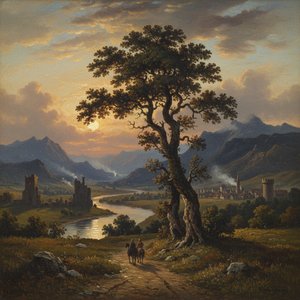
A Rustic Symphony: Paul Huet’s “La Ferme”
Paul Huet's "La Ferme," painted in 1856, isn’t merely a depiction of a rural landscape; it’s an immersion into the quiet dignity and profound connection between humanity and nature. This oil on canvas, now housed within the Louvre Museum, captures a fleeting moment in the French countryside – a solitary figure traversing a winding path towards distant, hazy mountains. Huet, a pivotal yet often understated figure of the Barbizon School and a significant influence on the nascent Impressionists, masterfully employed light, color, and texture to evoke not just what he saw, but how it *felt* to be present in that space.
The painting’s strength lies in its deliberate rejection of academic formality. Huet, deeply influenced by the English landscape painters like Constable and Turner, moved away from the rigid structures and idealized forms prevalent in earlier French art. Instead, he embraced a more direct observation of nature, prioritizing atmospheric perspective and the subtle shifts in light and shadow. This commitment to truthfulness is immediately apparent; the scene feels utterly authentic, as if captured during a spontaneous moment of contemplation.
Composition and Color – A Dance of Earth Tones
The composition of “La Ferme” is remarkably balanced, guiding the viewer’s eye along the meandering path that dominates the foreground. The solitary figure, positioned slightly off-center, acts as an anchor, drawing us into the scene's quiet drama. To the right, a modest farmhouse – likely a symbol of rural life and sustenance – provides a grounding element, partially obscured by the lush vegetation. The distant mountains, rendered in delicate blues and purples, create a sense of depth and vastness, while the trees and shrubs in the midground offer a tactile richness.
Huet’s color palette is deliberately restrained, dominated by earthy tones – browns, greens, ochres, and muted yellows. These colors aren't vibrant or saturated; rather, they are subtly blended to create a sense of atmospheric depth and realism. The diffused lighting, characteristic of the Barbizon School, further enhances this effect, softening edges and lending an air of tranquility to the scene. Notice how the light catches on the foliage, creating subtle variations in tone that suggest texture and volume.
Technique and Texture – A Painterly Approach
Huet’s technique is distinctly painterly, characterized by visible brushstrokes and a layered approach to application. He didn't strive for smooth, blended surfaces; instead, he embraced the materiality of paint itself, allowing the individual strokes to contribute to the overall image. This creates a sense of immediacy and spontaneity, as if the painting were created in a single, uninterrupted session. The texture is particularly evident in the depiction of the trees – rough bark, uneven branches, and the suggestion of foliage all contribute to a remarkably tactile quality.
The use of atmospheric perspective—the gradual fading of detail and color with distance—is expertly executed. The mountains in the background appear paler and less distinct than those closer to the viewer, creating an illusion of depth and space. This technique, borrowed from the Old Masters, is crucial to the painting’s overall effect, lending it a sense of realism and grandeur.
Symbolism and Emotional Resonance
“La Ferme” transcends a simple landscape depiction; it carries profound symbolic weight. The solitary figure represents humanity's connection to nature, a theme central to Romantic art. The path itself can be interpreted as a journey – both literal and metaphorical – suggesting a search for meaning or perhaps simply the quiet pleasure of being present in the natural world. The farmhouse symbolizes stability and community, while the distant mountains evoke a sense of aspiration and possibility.
Ultimately, “La Ferme” is a painting that invites contemplation. It’s a reminder of the beauty and serenity to be found in the simple things – the warmth of the sun, the scent of the earth, and the quiet dignity of rural life. Huet's masterful use of light, color, and texture creates an emotional resonance that lingers long after the viewer has turned away, offering a glimpse into a timeless connection between humanity and the natural world.
Veelgestelde vragen
Wat is de reden voor de auteursrechtelijke status van "LA FERME" door Paul Huet?
"LA FERME" van Paul Huet is bevindt zich in het publiek domein - de auteursrechten zijn verlopen. De auteursrechten worden berekend vanaf het jaar van overlijden van de kunstenaar; Paul Huet is overleden in 1869.
Wordt "LA FERME" door Paul Huet bewaard in het land van herkomst van de kunstenaar?
Nee - het kunstwerk wordt in het buitenland bewaard. Paul Huet werd geboren in Frankrijk, en het originele werk "LA FERME" wordt bewaard in een museum in France.
Welk gebruik en welke ruimte worden aanbevolen voor "LA FERME" door Paul Huet?
Aanbevolen gebruik (Harmony) en ruimte (Living Room) zijn de twee aanbevelingen voor "LA FERME" door Paul Huet.
 Voorvertoning
 Verstuur
 Delen
Delen
 Details bekijken
 Gids
Gids

 Download
 Vergelijkbare items
 Röntgenonderzoek
 Diavoorstelling
 Vraag & antwoord
 Statistieken