Portret van Léon Bakst

De 100 bekendste schilderijen van Léon Bakst, een selectie uit de galerie

Bijgewerkt in november 2026 · gerangschikt op basis van onze populariteitsscore (zoekopdrachten, bezoeken en bestellingen per kunstwerk) · 154 werken van Léon Bakst in onze catalogus

Kortom

Van alle originele werken die Léon Bakst heeft nagelaten, is Ontwerp met bloemen in raster het bekendst, in de collectie van het The Baltimore Museum of Art, Baltimore. Direct daarna volgen Costume design for the ballet ''Cleopatra'' (1909) en Operatic costume designs (1911). Onze catalogus bevat 154 werken van Léon Bakst; de galerie heeft de 100 meest bewonderde werken ter wereld bewaard, elk voorzien van de datum, het museum en het verhaal erachter.

1866 – 1924, Hrodna Art nouveau Meeste werken: The Baltimore Museum of Art

De top 10 schilderijen van Léon Bakst: de selectie van de galerie

1
Ontwerp met bloemen in raster door Léon Bakst

Ontwerp met bloemen in raster

Schilderkunst · The Baltimore Museum of Art, Baltimore

Design with Flowers in Grid – Een Symfonie van Kleur en Patronen door Léon Bakst Léon Bakst (1866-1924), een Russische kunstenaar en designer die een belangrijke rol speelde bij het vormgeven van de Russische avantgarde, staat bekend om zijn opvallende decoraties voor Sergei Diaghilev’s Ballets Russes. Zijn werk vertegenwoordigt een prachtige fusie tussen Art Nouveau en Orientalisme, waardoor hij niet alleen nieuwe grenzen verkende binnen het theater maar ook een…

2
Costume design for the ballet ''Cleopatra'' (1909) door Léon Bakst

Costume design for the ballet ''Cleopatra''

1909 · Painting

This work, titled Costume design for the ballet ''Cleopatra'', was created by the artist Léon Bakst. It represents a significant moment in the history of theatrical aesthetics, specifically designed for the ballet Cleopatra. The piece dates to 1909, a period when the artist was establishing a new visual language for the stage.

3
Operatic costume designs (1911) door Léon Bakst

Operatic costume designs

1911 · Painting

Operatic costume designs, created by Léon Bakst in 1911, captures a moment of theatrical movement. The work features two women in elaborate attire; one is dressed in a blue garment accented with green circles, while the other wears red. Their poses suggest a choreographed interaction, with one figure appearing to dance while holding the arm of her companion.

4
Drawing young divinity Narcisse costume, ballet Diaghilev (1911) door Léon Bakst

Drawing young divinity Narcisse costume, ballet Diaghilev

1911 · Watercolor

The scene unfolds through Drawing young divinity Narcisse costume, ballet Diaghilev, a vision conceived by the artist Léon Bakst. This work captures a specific moment of theatrical creation from 1911. It exists as a design for the set of the ballet Narcisse, a production that first met its audience at the Théâtre de Monte Carlo in 1911. The atmosphere of the stage is shaped by the creative energy of the…

5
Portrait of Boris Nikolayevich Bugaev (Andrey Bely) (1905) door Léon Bakst

Portrait of Boris Nikolayevich Bugaev (Andrey Bely)

1905 · Charcoal

The artwork is titled Portrait of Boris Nikolayevich Bugaev (Andrey Bely), a work created by the artist Léon Bakst. This portrait, executed in 1905, presents a head-and-shoulders view of the subject. The sitter is a prominent Russian Symbolist writer, captured in a moment of quietude. The gaze of the man meets the viewer from a position of stillness.

6
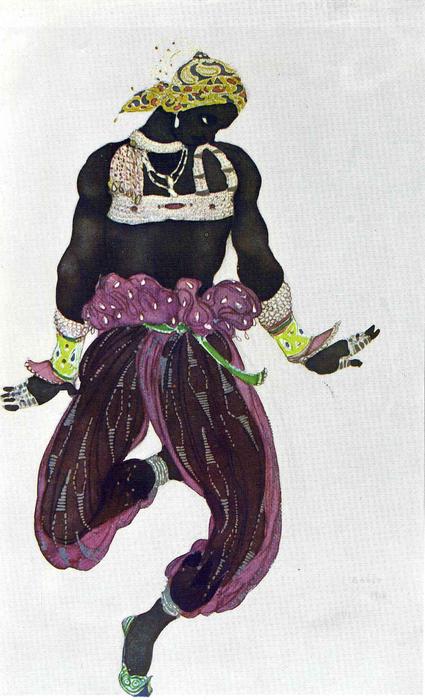
Scheherazade negre argent (1910) door Léon Bakst

Scheherazade negre argent

1910 · Watercolor

A solitary male figure commands the space, frozen in a moment of theatrical tension. He leans into a stylized pose, his body elongated to emphasize a sense of rhythmic movement that seems to pulse even in stillness. The silhouette is defined by sharp, geometric lines—the triangular peak of a headpiece and the rectangular weight of his garments—which create a striking contrast against the dark, somber atmosphere. Every muscle and fold…

7
Scheherezade odalisque (1910) door Léon Bakst

Scheherezade odalisque

1910 · Watercolor

The artwork titled Scheherezade odalisque was created by the artist Léon Bakst. This specific piece is a watercolor illustration produced in 1910. The work originates from a period when the artist was actively involved in the visual development of the Ballets Russes, contributing to the aesthetic language of theatrical productions such as Scheherazade.

8
The Butterfly (Costume Design for Anna Pavlova) (1913) door Léon Bakst

The Butterfly (Costume Design for Anna Pavlova)

1913 · Gouache · Museum of Fine Arts, Boston

The Butterfly (Costume Design for Anna Pavlova) is a dynamic costume design illustration created in 1913. The composition features a central female figure captured in a mid-stride or dancing pose. She is surrounded by expansive, swirling fabric elements that suggest the wings of a butterfly. The color palette is dominated by primary colors, specifically bright yellow and deep cobalt blue, accented with orange and white.

9
Portrait of Miss Paoloff (1916) door Léon Bakst

Portrait of Miss Paoloff

1916 · Oil

The Portrait of Miss Paoloff by Léon Bakst captures a fleeting moment of grace. In this work, the ballerina Miss Paoloff appears mid-movement, her body caught in a dynamic pose that suggests the energy of a live performance. She wears her performance attire, a tutu that seems to catch the light as she moves through the space. The scene feels suspended in time, as if the dancer has just pivoted…

10
Portrait of the Marchesa Casati (1912) door Léon Bakst

Portrait of the Marchesa Casati

1912 · Charcoal

This work, titled Portrait of the Marchesa Casati, is a striking study by the artist Léon Bakst. Created about 1912, the portrait captures the likeness of the Marchesa Casati in a moment of quiet contemplation. It is a piece that reflects the artist's ability to translate a specific presence onto paper through a focused, intimate lens.

De selectie van Léon Bakst gaat verder, van 11 tot 100

11Portrait of the Marchesa Casati (1912) door Léon BakstPortrait of the Marchesa Casati1912 12fantasy on modern costume (atalanta) (1912) door Léon Bakstfantasy on modern costume (atalanta)1912 13The sleeping beauty eastern prince and his page (1916) door Léon BakstThe sleeping beauty eastern prince and his page1916 14Portrait of a Lady (1917) door Léon BakstPortrait of a Lady1917 15Mme Ida Rubinstein (1917) door Léon BakstMme Ida Rubinstein1917 · Metropolitan Museum of Art 16Samarkand Sultan (1922) door Léon BakstSamarkand Sultan1922 17russian peasant woman (1922) door Léon Bakstrussian peasant woman1922 18Dmitry Filosof portrait (1897) door Léon BakstDmitry Filosof portrait1897 19Art open letter of Red Cross (1904) door Léon BakstArt open letter of Red Cross1904 20supper (1902) door Léon Bakstsupper1902 21cleopatre danse juive (1910) door Léon Bakstcleopatre danse juive1910 22helene de sparte ida rubinstein in act iv (1912) door Léon Baksthelene de sparte ida rubinstein in act iv1912 23The Supper (1902) door Léon BakstThe Supper1902 24Big Philanthropic Puppet Bazaar, St. Petersburg (1899) door Léon BakstBig Philanthropic Puppet Bazaar, St. Petersburg1899 25Medee (Jean Anouilh) door Léon BakstMedee (Jean Anouilh) 26Leonid Massine door Léon BakstLeonid Massine 27Portrait of Jean Cocteau door Léon BakstPortrait of Jean Cocteau 28Ida Rubinstein door Léon BakstIda Rubinstein 29untitled (4764) door Léon Bakstuntitled (4764) 30untitled (1211) door Léon Bakstuntitled (1211) 31untitled (1495) door Léon Bakstuntitled (1495) 32Costume Design For 'la Fée De Richesse' door Léon BakstCostume Design For 'la Fée De Richesse' 33St. Sebastian, from ''The Martyr of St. Sebastian'' door Léon BakstSt. Sebastian, from ''The Martyr of St. Sebastian'' 34helene de sparte costume for ida rubinstein as helene door Léon Baksthelene de sparte costume for ida rubinstein as helene 35Ballet Music - Introduction (Humphrey Searle) door Léon BakstBallet Music - Introduction (Humphrey Searle) 36untitled (4724) door Léon Bakstuntitled (4724) 37untitled (9134) door Léon Bakstuntitled (9134) 38Costume for Nijinsky (1910) door Léon BakstCostume for Nijinsky1910 39scheherezade odalisque (1910) door Léon Bakstscheherezade odalisque1910 40le dieu bleu a young rajah (1911) door Léon Bakstle dieu bleu a young rajah1911 41narcisse the nymph echo (1911) door Léon Bakstnarcisse the nymph echo1911 42Le dieu bleu a young rajah (1911) door Léon BakstLe dieu bleu a young rajah1911 43fantasie sur le costume moderne (1910) door Léon Bakstfantasie sur le costume moderne1910 44Vase (self-portrait) (1906) door Léon BakstVase (self-portrait)1906 45Scheherezade odalisque (1910) door Léon BakstScheherezade odalisque1910 46Narcisse a youth (1911) door Léon BakstNarcisse a youth1911 47Le dieu bleu Nijinsky in title role (1911) door Léon BakstLe dieu bleu Nijinsky in title role1911 48loiseau de feu costume pour tamara karsavina (1910) door Léon Bakstloiseau de feu costume pour tamara karsavina1910 49Fantasy on modern costume (1910) door Léon BakstFantasy on modern costume1910 50scheherazade negre argent (1910) door Léon Bakstscheherazade negre argent1910 51The Firebird, the tsarevna (1910) door Léon BakstThe Firebird, the tsarevna1910 52loiseau de feu the firebird (1910) door Léon Bakstloiseau de feu the firebird1910 53Narcisse -Boeotian (1911) door Léon BakstNarcisse -Boeotian1911 54Portrait of Russian painter Filipp Andreevich Maljawin door Léon BakstPortrait of Russian painter Filipp Andreevich Maljawin 55scheherezade scenery (1910) door Léon Bakstscheherezade scenery1910 56le martyre de saint sebastien ida rubinstein as st sebastian (1911) door Léon Bakstle martyre de saint sebastien ida rubinstein as st sebastian1911 57Costume Design for 'Scheherazade' (1910) door Léon BakstCostume Design for 'Scheherazade'1910 58The Firebird, costume for Tamara Karsavina (1910) door Léon BakstThe Firebird, costume for Tamara Karsavina1910 59scheherazade la sultane bleue (1910) door Léon Bakstscheherazade la sultane bleue1910 60narcisse a youth (1911) door Léon Bakstnarcisse a youth1911 61Sketch for the ballet 'La Peri', by Paul Dukas (1911) door Léon BakstSketch for the ballet 'La Peri', by Paul Dukas1911 62Scheherazade shah shahriar (1910) door Léon BakstScheherazade shah shahriar1910 63cleopatre greek dancer (1910) door Léon Bakstcleopatre greek dancer1910 64Front cover of Comoedia (1909) door Léon BakstFront cover of Comoedia1909 65loiseau de feu michel fokine as tsarevitch (1910) door Léon Bakstloiseau de feu michel fokine as tsarevitch1910 66Scheherazade la sultane bleue (1910) door Léon BakstScheherazade la sultane bleue1910 67cleopatre syrian dance (1909) door Léon Bakstcleopatre syrian dance1909 68narcisse a nymph (1911) door Léon Bakstnarcisse a nymph1911 69Le martyre de Saint Sebastien act I set design (1911) door Léon BakstLe martyre de Saint Sebastien act I set design1911 70Le martyre de Saint Sebastien act IV set design (1911) door Léon BakstLe martyre de Saint Sebastien act IV set design1911 71The carnival Chiarina (1910) door Léon BakstThe carnival Chiarina1910 72narcisse bacchante (1911) door Léon Bakstnarcisse bacchante1911 73la peri natasha trouhanova as the peri (1911) door Léon Bakstla peri natasha trouhanova as the peri1911 74In the artist's studio (1908) door Léon BakstIn the artist's studio1908 75la peri iksander (1911) door Léon Bakstla peri iksander1911 76The .arnival - Estrella (1910) door Léon BakstThe .arnival - Estrella1910 77Cleopatre danse juive (1910) door Léon BakstCleopatre danse juive1910 78le dieu bleu nijinsky in title role (1911) door Léon Bakstle dieu bleu nijinsky in title role1911 79Downpour (1906) door Léon BakstDownpour1906 80Scheherazade the chief eunuch (1910) door Léon BakstScheherazade the chief eunuch1910 81Costume design for a bacchante in 'Narcisse' by Tcherepnin (1911) door Léon BakstCostume design for a bacchante in 'Narcisse' by Tcherepnin1911 82le dieu bleu the bride (1912) door Léon Bakstle dieu bleu the bride1912 83Nijinsky's Faun Costume in 'L'Apres Midi d'un Faune' by Claude Debussy from the front cover of the programme for the 7th season of the 'Ballets Russes' (1912) door Léon BakstNijinsky's Faun Costume in 'L'Apres Midi d'un Faune' by Claude Debussy from the front cover of the programme for the 7th season of the 'Ballets Russes'1912 84Design for a lady's dress (1912) door Léon BakstDesign for a lady's dress1912 85sadko one of the chorus (1917) door Léon Bakstsadko one of the chorus1917 86L'apres midi d'un faune, another nymph (1912) door Léon BakstL'apres midi d'un faune, another nymph1912 87lapres midi dun faune another nymph (1912) door Léon Bakstlapres midi dun faune another nymph1912 88le dieu bleu a pilgrim (1912) door Léon Bakstle dieu bleu a pilgrim1912 89le dieu bleu bayadere (1912) door Léon Bakstle dieu bleu bayadere1912 90lapres midi dun faune nijinsky as the faun (1912) door Léon Bakstlapres midi dun faune nijinsky as the faun1912 91Le dieu bleu bayadere with peacock (1912) door Léon BakstLe dieu bleu bayadere with peacock1912 92Daphnis and Chloe scenery for act II (1912) door Léon BakstDaphnis and Chloe scenery for act II1912 93daphnis et chloe set design act ii (1912) door Léon Bakstdaphnis et chloe set design act ii1912 94Les femmes de bonne humeur - set design (1917) door Léon BakstLes femmes de bonne humeur - set design1917 95sadko the green monster (1917) door Léon Bakstsadko the green monster1917 96le dieu bleu setting (1912) door Léon Bakstle dieu bleu setting1912 97loiseau de feu costume (1913) door Léon Bakstloiseau de feu costume1913 98helene de sparte act ii set design (1912) door Léon Baksthelene de sparte act ii set design1912 99La legende de Joseph Potiphar (1914) door Léon BakstLa legende de Joseph Potiphar1914 100daphnis et chloe costume (1912) door Léon Bakstdaphnis et chloe costume1912

De beroemde schilderijen van Léon Bakst, periode voor periode

De onderwerpen die de aandacht van Léon Bakst troffen

De vier onderwerpen die het meest voorkomen in deze originelen, elk met zijn mooiste voorbeeld.

De musea waar de originele werken van Léon Bakst worden bewaard

De 3 musea met de meeste schilderijen op deze pagina.

Museum Stad Werken van Léon Bakst Schilderijen uit deze lijst
The Baltimore Museum of Art, BaltimoreThe Baltimore Museum of Art Baltimore 1 Ontwerp met bloemen in raster
Museum of Fine Arts, BostonMuseum of Fine Arts Boston 1 The Butterfly (Costume Design for Anna Pavlova)
Metropolitan Museum of Art, New YorkMetropolitan Museum of Art New York 1 Mme Ida Rubinstein

Léon Bakst decennium voor decennium: het origineel dat elk tijdperk definieert

Werken per decennium

Kies een decennium om het origineel te zien dat dit tijdperk definieert.

Vragen van verzamelaars over de schilderijen van Léon Bakst

Waar is Léon Bakst het meest bekend om?Onthul het antwoord

Ontwerp met bloemen in raster, The Baltimore Museum of Art, Baltimore. Costume design for the ballet ''Cleopatra'' (1909) en Operatic costume designs (1911) volgen.

Wat zijn de tien beroemdste schilderijen van Léon Bakst?Onthul het antwoord

Ontwerp met bloemen in raster, Costume design for the ballet ''Cleopatra'', Operatic costume designs, Drawing young divinity Narcisse costume, ballet Diaghilev, Portrait of Boris Nikolayevich Bugaev (Andrey Bely), Scheherazade negre argent, Scheherezade odalisque, The Butterfly (Costume Design for Anna Pavlova), Portrait of Miss Paoloff en Portrait of the Marchesa Casati. De bovenstaande ranglijst vermeldt het jaar en het museum van elk werk.

Hoeveel schilderijen heeft Léon Bakst nagelaten?Onthul het antwoord

Onze catalogus bevat 154 werken van Léon Bakst, daterend van 1897 tot 1922.

In welke musea hangen de meesterwerken van Léon Bakst?Onthul het antwoord

Voornamelijk in The Baltimore Museum of Art (Baltimore), Museum of Fine Arts (Boston) en Metropolitan Museum of Art (New York). De bovenstaande museumtabel bevat een volledig overzicht.

In welke jaren schilderde Léon Bakst de beroemdste werken?Onthul het antwoord

In 1910s: 71 van de 100 werken op deze pagina werden toen gemaakt, waaronder Operatic costume designs.

Wat zijn de eerste en de laatste beroemde originelen van Léon Bakst?Onthul het antwoord

Op deze pagina is het vroegste Dmitry Filosof portrait (1897) en het laatste Samarkand Sultan (1922).

Welke onderwerpen koos Léon Bakst het vaakst?Onthul het antwoord

Designs and sketches (28), Clothing (26) en Woman (9), verspreid over de 100 werken op deze pagina.

Welke techniek gebruikte Léon Bakst het meest?Onthul het antwoord

Watercolor, voor 5 van de 100 werken op deze pagina.

Bij welke kunststroming behoort Léon Bakst?Onthul het antwoord

Art nouveau, te oordelen aan de originelen op deze pagina.

Léon Bakst: leven en werk

Early Life and the Seeds of Artistic Rebellion

Léon Bakst, a name synonymous with the dazzling spectacle of Sergei Diaghilev’s Ballets Russes, began his life far from the glittering world of Parisian stages. Born Leyb-Khaim Izrailevich Rosenberg in 1866 within the confines of Grodno—a city then part of the Russian Empire and now located in modern-day Belarus—his early years were shaped by the constraints of Jewish identity and the societal prejudices prevalent at the time. His family, though comfortably middle class and possessing connections to the imperial court through his grandfather’s role as a celebrated tailor, nonetheless faced the realities of living within the “pale of settlement,” a designated area for Jews in Russia. This environment instilled in young Leyb a keen awareness of cultural nuances alongside an early, undeniable passion for drawing—a talent so evident that he won a contest at just twelve years old. However, this burgeoning artistic inclination initially encountered resistance from his parents, who were hesitant to embrace such an unconventional path, preferring instead a more traditional future. Despite their reservations, Bakst persevered, demonstrating remarkable determination and ultimately securing admission to the prestigious St. Petersburg Academy of Arts as a non-credit student while simultaneously supplementing his education by working as a book illustrator—a practical necessity that honed his skills and provided much-needed financial independence. It was in 1889 that he adopted the name “Bakst,” a pragmatic decision reportedly motivated by concerns that his birth name might hinder career advancement within a society often prejudiced against Jewish individuals, revealing the subtle yet pervasive challenges faced by artists from marginalized communities during that era. This deliberate shift reflected not only a desire for professional success but also a strategic maneuver in navigating a world riddled with social barriers.

The World of Art and Embracing Modernity

Bakst’s artistic development truly blossomed within the vibrant context of the “World of Art” movement, or *Mir Iskusstva* as it was known in Russian. He quickly became an integral figure alongside luminaries such as Sergei Diaghilev and Alexandre Benois, contributing significantly to the group's eponymous periodical through his striking graphics and innovative designs. This association brought him widespread recognition and firmly established him as a rising star within Russia’s burgeoning artistic circles—a world characterized by experimentation, intellectual discourse, and a rejection of traditional academic constraints. The *Mir Iskusstva* movement sought to elevate art beyond mere decoration, aiming instead to engage with broader cultural themes and challenge conventional notions of beauty. Bakst's early works reflected this ethos, encompassing compelling portraits of prominent figures such as Filipp Malyavin, Vasily Rozanov, Andrei Bely, and Zinaida Gippius—each portrait capturing not only the physical likeness of the subject but also their intellectual and emotional essence. His style during this period was a fascinating synthesis of Russian artistic traditions with burgeoning European influences—particularly Orientalism and early Modernism. He embraced vibrant colors, exotic motifs, and stylized forms, foreshadowing the revolutionary aesthetic he would later bring to the stage. This willingness to experiment and synthesize diverse influences marked him as an artist attuned to the rapidly changing currents of his time – a period of intense social and artistic transformation.

Revolutionizing Ballet with the Ballets Russes

The pivotal moment in Bakst’s career arrived in 1908 when he began collaborating with Sergei Diaghilev's newly formed Ballets Russes—a company that would irrevocably alter the landscape of theatrical design and dance. This partnership proved transformative, propelling both artists to international fame and establishing a new standard for artistic innovation. Bakst’s designs were groundbreaking; they moved decisively away from realistic depictions, embracing stylized forms, bold colors, and a sense of opulent fantasy—a departure from the traditional ballet aesthetic that emphasized narrative clarity and precise representation. Productions like *Cleopatra* (1909), *Scheherazade* (1910)—arguably his most iconic work—*Carnaval* (1910), *Narcissus* (1911), and particularly *L’Après-midi d’un Faune* (1912) became legendary for their visual splendor, captivating audiences with their sheer extravagance and imaginative power. *L’Après-midi d’un Faune*, in particular, stands as a seminal work—a ballet that profoundly influenced the development of stage design, establishing a new aesthetic language characterized by dreamlike imagery, fluid movement, and an exploration of primal emotions. Bakst didn't merely create backdrops; he constructed immersive worlds that heightened the emotional impact of the choreography and music, transforming the theater into a realm of pure sensation. The costumes were equally innovative, often incorporating exotic fabrics, shimmering embellishments, and daring silhouettes—challenging conventional notions of theatrical attire and reflecting the spirit of modernity. His designs weren’t simply decorative; they actively contributed to the narrative and emotional core of each production.

Legacy and Enduring Influence

Léon Bakst's legacy extends far beyond his contributions to ballet. He is rightfully considered one of the most important figures in the history of theatrical design, profoundly influencing both set and costume creation for generations to come. His designs also played a significant role in shaping the development of Art Deco aesthetics—characterized by stylized forms, rich colors, and exotic motifs—a testament to his far-reaching influence on visual culture. Despite facing some criticism during his lifetime for perceived extravagance, Bakst’s work was widely celebrated, and his funeral in 1924 was attended by a remarkable gathering of prominent artists, poets, musicians, dancers, and critics—a poignant demonstration of the esteem in which he was held. Today, his artwork can be found in museums worldwide, ensuring that his innovative spirit and artistic vision endure for audiences around the globe. Bakst’s ability to synthesize diverse influences, embrace experimentation, and create visually stunning worlds cemented his place as a true visionary of the 20th century—a testament to the power of art to transcend boundaries and inspire generations.
  • A master of color and composition.
  • Pioneered new approaches to theatrical design.
  • Influenced Art Deco aesthetics.