Russian Modernism · 1922
Samarkand Sultan (Léon Bakst, 1922)
Léon Bakst (1866–1924) maakte Samarkand Sultan. Het dateert uit 1922. Het behoort tot de Russian Modernism-stroming. Het is gemaakt van Ink On Paper.
- 1922
- Ink On Paper

 Voorvertoning

 Met de hand geschilderd olieverfwerk
 Verstuur
 Delen
 Informatieblad


 Download
 Vergelijkbare items
 Röntgenonderzoek
 Diavoorstelling
 Vraag & antwoord

 Statistieken
Samarkand Sultan, in het kort
- Titel
- Samarkand Sultan
- Kunstenaar
- Léon Bakst (1866–1924)
- Geboren in [jaar]
- Hrodna, Wit-Rusland
- Datum
- 1922
- Medium
- Ink On Paper
- Beweging
- Russian Modernism
- Periode
- Modern
- Onderwerp
- eastern costume, ornate design, theatrical figure, stylized portrait, vibrant colors, russian culture
Wat stelt Samarkand Sultan voor?
A Study in Grandeur
In this 1922 work, we encounter a figure of quiet authority, a Samarkand Sultan rendered with a graphic precision that feels both ancient and modern. The subject is centered, filling the frame with a verticality that commands attention without needing to shout. He is draped in a robe of deep reds and blues, a garment defined by its intricate geometric patterns—triangles, diamonds, and stripes that dance across the fabric. There is a certain stillness in his expression, a tranquil gaze that suggests a man accustomed to the weight of his own status. His dark beard is long and neatly kept, providing a sharp contrast to the luminous colors of his attire.
The composition relies on a sophisticated layering of shapes and colors to create a sense of presence. While the perspective remains somewhat flattened, reminiscent of theatrical sketches or costume studies, the use of shading gives the figure a tangible, sculptural quality. The light appears to fall from above, catching the edges of his elaborate headwear and the subtle folds of his sleeves.
The Language of Ornament
The detail in the Sultan's attire reveals a meticulous approach to pattern and texture. The artist uses line and color to suggest materials that one can almost feel through the visual surface:
- A large turban adorned with blue and white beads and a singular, striking white feather.
- Sleeves and hems lined with a soft, heavy fur that adds a sense of tactile luxury.
- A complex arrangement of geometric motifs that break up the saturated fields of color.
This work belongs to the Art Nouveau movement, a period where the boundaries between fine art and decorative design often blurred. The influence of Orientalism is palpable here, not as a mere imitation of the East, but as a way to explore new visual languages through exotic silhouettes and intense color palettes. The use of ink and watercolor allows for a certain fluidity, where bold outlines meet softer, shaded transitions.
A Vision of the Stage
There is an inherent theatricality to this piece, as if we are catching a glimpse of a character just before the curtain rises. The stylized forms and exaggerated features move away from photographic realism, opting instead for a heightened sense of character. It feels less like a portrait of a specific historical individual and more like an exploration of an idea—the idea of power, of ceremony, and of the exotic. The emotional weight of the piece lies in this tension between the graphic, almost two-dimensional quality of the illustration and the profound sense of dignity held in the subject's eyes.
Hoogwaardige afbeeldingen van Samarkand Sultan
Publiek domein: de kunstenaar is overleden in 1924.
Léon Bakst, Samarkand Sultan (1922). Publiek domein
Vragen over Samarkand Sultan, beantwoord
In welk jaar werd "Samarkand Sultan" door Léon Bakst gemaakt?
"Samarkand Sultan" dateert uit 1922. Deze datum plaatst het werk binnen de carrière van Léon Bakst en het betreffende tijdperk.
Met welke techniek is "Samarkand Sultan" door Léon Bakst vervaardigd?
Léon Bakst gebruikte de Ink On Paper-techniek voor "Samarkand Sultan". De techniek bepaalt de materiële aard van het originele werk.
Wat stelt "Samarkand Sultan" voor?
"Samarkand Sultan" door Léon Bakst toont: eastern costume, ornate design, theatrical figure, stylized portrait, vibrant colors, russian culture, decorative art.
Is "Samarkand Sultan" vrij van auteursrecht?
De auteursrechtelijke status van "Samarkand Sultan" door Léon Bakst: het werk is bevindt zich in het publiek domein - de auteursrechten zijn verlopen. Dit bepaalt of reproducties van de afbeelding vrijelijk mogen worden gemaakt.
Wie is de kunstenaar achter "Samarkand Sultan"?
De kunstenaar achter "Samarkand Sultan" is Léon Bakst. Het werk is gecatalogiseerd onder de naam van Léon Bakst.
Bij welke kunststroming behoort "Samarkand Sultan" door Léon Bakst?
"Samarkand Sultan" is een werk uit de Russian Modernism. De stroming geeft de artistieke traditie aan waartoe het werk behoort.
In welke periode van de carrière van Léon Bakst valt "Samarkand Sultan"?
"Samarkand Sultan" vertegenwoordigt de Early Modernism van Léon Bakst.
Hoe oud was Léon Bakst bij het creëren van "Samarkand Sultan" in 1922?
Toen "Samarkand Sultan" werd gemaakt in 1922, was Léon Bakst - geboren in 1866 - 56 jaar oud.
Behoort "Samarkand Sultan" van Léon Bakst tot het publiek domein, en zo ja, waarom?
De auteursrechtstatus van "Samarkand Sultan" - bevindt zich in het publiek domein - de auteursrechten zijn verlopen - is gebaseerd op het overlijden van de kunstenaar in 1924.
Over de kunstenaar, Léon Bakst
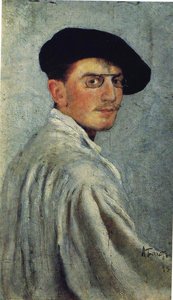
1866–1924, Wit-Rusland
Léon Bakst
Early Life and the Seeds of Artistic Rebellion Léon Bakst, a name synonymous with the dazzling spectacle of Sergei Diaghilev’s Ballets Russes, began his life far from the glittering world of Parisian stages. Born Leyb-Khaim Izrailevich Rosenberg in 1866 within the confines of Grodno—a city then part of the Russian Empire and now located in modern-day Belarus—his early years were shaped by the constraints of Jewish identity and the societal prejudices prevalent at the time. His family, though comfortably middle class and possessing connections to the imperial court through his grandfather’s role as a celebrated tailor, nonetheless faced the realities of living within the “pale of settlement,” a designated area for Jews in Russia. This environment instilled in young Leyb a keen awareness of cultural nuances alongside an early, undeniable passion for drawing—a talent so evident that he won a contest at just twelve years old.
Ook van Léon Bakst
 Ontwerp met bloemen in raster
 Operatic costume designs1911
 Costume design for the ballet ''Cleopatra''1909
 Drawing young divinity Narcisse costume, ballet Diaghilev1911
Essays over Samarkand Sultan
 The Soft Soul of Art: Exploring the Tactile Beauty and Timeless Narrative of Textile MasterpiecesEmbark on a sensory journey through the tactile beauty of textile art. Explore how thread, silk, and loom weave human history, from ancient…
 French artworks of the 1860s1860s French masterpieces by Édouard Manet, Claude Monet, and Gustave Courbet. View the full collection online at OriginalUniqueArt.com.
 Masterpieces of Emotion: The Top 25 Artworks by Théodore GéricaultExplore 25 iconic works by Théodore Géricault, from Romanticism to his greatest masterpieces. Discover the full collection on OriginalUniqu…