Menu

() ·

A painting made for you, by hand

Untitled An oil painting, painted by hand for you alone

Handgemaakte olieverfreproductie

Met de hand geschilderd in olieverf op canvas in uw gewenste maat en lijst, op bestelling gemaakt door onze kunstenaars. ( Schakel over naar print Schakel over naar digitale afbeeldingen)

Beschrijving verzamelobject

Experience Wassily Kandinsky's 'Untitled,' a vibrant 1944 abstract watercolor brimming with symbolic shapes and dynamic energy. Explore its unique composition and the artist’s revolutionary approach to art.

Biografie kunstenaar

Ontdek Wassily Kandinsky (1866-1944), de pionier van abstracte kunst! Verken zijn levendige expressionisme, spirituele thema's & Bauhaus erfenis via prachtige reproducties.

from ·

Chapter 1

How large should it be?

Slide to change the size; the picture on the left shows the frame at its real width. The proportions of the original are kept.

Standaardformaat
op maat gemaakt
CM
INCH

Kies uit onze vooraf ingestelde maten die overeenkomen met de originele verhoudingen van het kunstwerk.

breedte
hoogte

Voer de breedte en hoogte in die u nodig heeft, passend bij uw lijst of uw muur. Omdat dit handgeschilderd is, kan de kunstenaar bij een afmeting met een andere beeldverhouding iets meer rondom het schilderij schilderen of juist iets meer weglaten — u kiest zelf. Wij sturen u een digitaal mockup ter goedkeuring voordat het schilderwerk begint. De afbeelding die op deze pagina wordt getoond, is niet het uiteindelijke resultaat — alleen de mockup geeft dit weer.


Chapter 2

How should it arrive?

Choose the edges of the stretched canvas

Choose your frame

Corner sample of the WhiteWrap canvas edge finish, stretched on massief hout bars
White €1
Corner sample of the BlurSideWrap canvas edge finish, stretched on massief hout bars
Blurside €1
Corner sample of the ExtendedWrap canvas edge finish, stretched on massief hout bars
Extended €1
Corner sample of the P118B picture frame: gegoten polystyreen, 5 cm wide and 3 cm thick
P118B €10
Corner sample of the P118H picture frame: gegoten polystyreen, 5 cm wide and 3 cm thick
P118H €10
Corner sample of the P118W picture frame: gegoten polystyreen, 5 cm wide and 3 cm thick
P118W €10
Corner sample of the P438Z picture frame: gegoten polystyreen, 5.5 cm wide and 3.5 cm thick
P438Z €10
Corner sample of the P508JH picture frame: gegoten polystyreen, 7 cm wide and 3.5 cm thick
P508JH €12
Corner sample of the P508YH picture frame: gegoten polystyreen, 7 cm wide and 3.5 cm thick
P508YH €12
Corner sample of the P805H picture frame: gegoten polystyreen, 5 cm wide and 3.5 cm thick
P805H €10
Corner sample of the P805Z picture frame: gegoten polystyreen, 5 cm wide and 3.5 cm thick
P805Z €10
Corner sample of the P919BZ picture frame: gegoten polystyreen, 7 cm wide and 3.5 cm thick
P919BZ €10
Corner sample of the P919G picture frame: gegoten polystyreen, 7 cm wide and 3.5 cm thick
P919G €10
Corner sample of the P919XJ picture frame: gegoten polystyreen, 7 cm wide and 3.5 cm thick
P919XJ €10
Corner sample of the P959ZH picture frame: gegoten polystyreen, 5 cm wide and 3 cm thick
P959ZH €10
Corner sample of the P968JZ picture frame: gegoten polystyreen, 6 cm wide and 4 cm thick
P968JZ €12
Corner sample of the W106C picture frame: massief hout, 5 cm wide and 3 cm thick
W106C €8
Corner sample of the W218G picture frame: massief hout, 5 cm wide and 3 cm thick
W218G €10
Corner sample of the W218JH picture frame: massief hout, 5 cm wide and 3 cm thick
W218JH €8
Corner sample of the W218Y picture frame: massief hout, 5 cm wide and 3 cm thick
W218Y €10
Corner sample of the W307PJ picture frame: massief hout, 6 cm wide and 3 cm thick
W307PJ €10
Corner sample of the W316G picture frame: massief hout, 6 cm wide and 3 cm thick
W316G €10
Corner sample of the W316PJ picture frame: massief hout, 6 cm wide and 3 cm thick
W316PJ €8
Corner sample of the W316Y picture frame: massief hout, 6 cm wide and 3 cm thick
W316Y €10
Corner sample of the W398PJ picture frame: massief hout, 5 cm wide and 3 cm thick
W398PJ €8
Corner sample of the W4111J picture frame: massief hout, 6.5 cm wide and 3.5 cm thick
W4111J €10
Corner sample of the W500HY picture frame: massief hout, 7 cm wide and 5 cm thick
W500HY €15
Corner sample of the W500JH picture frame: massief hout, 7 cm wide and 5 cm thick
W500JH €15
Corner sample of the W692G picture frame: massief hout, 8 cm wide and 4 cm thick
W692G €12
Corner sample of the W849H picture frame: massief hout, 5 cm wide and 3 cm thick
W849H €8
Corner sample of the W940BG picture frame: massief hout, 7.5 cm wide and 4.5 cm thick
W940BG €15
Corner sample of the W953PJ picture frame: massief hout, 6 cm wide and 3.5 cm thick
W953PJ €8
Corner sample of the H24-GOLD picture frame: gesneden hout met gesso, 10 cm wide and 6 cm thick
H24-GOLD €30
Corner sample of the H24-SILVER picture frame: gesneden hout met gesso, 10 cm wide and 6 cm thick
H24-SILVER €30
Corner sample of the H36-GOLD picture frame: gesneden hout met gesso, 15 cm wide and 6.5 cm thick
H36-GOLD €45
Corner sample of the H36-SILVER picture frame: gesneden hout met gesso, 15 cm wide and 6.5 cm thick
H36-SILVER €45
Lijstvoorbeeld
Ingelijst

Moulding: . Overall size with the frame: .

Chapter 3

Who paints it, and should anything change?

Examples of what can be changed: Replace face with customer photo; Add pet (e.g., replace cat with dog); Include hidden message in background; Change background landscape or elements.
After order, OriginalUniqueArt.com team will email client for instructions and provide a mockup preview

Wereldwijde levering () binnen 3 tot 4 weken in plaats van de standaard 5 weken. (29 oktober). Zonder concessies aan de kwaliteit.

Chapter 4

The finishing touches

A nameplate, as in a museum?

Details van de gegraveerde bronzen plaat

This elegant plaque features the artist's name and the title of the artwork, finely engraved for a timeless presentation.

It is made from bronze with a refined, elegant finish. The text is precisely laser-engraved for a sharp and permanent result. Measuring 9x2 cm, the plaque is compact yet easy to read. It's built to be durable and scratch-resistant, offering a professional, museum-quality look. Mounting is simple thanks to the included adhesive backing.

Details transparante acrylplaat

The plaque includes essential engraved details such as the artist's name, the title of the artwork, the date it was created, the type of media used-like oil on canvas or watercolor-a brief description of the piece, and a QR code that links to the complete artwork information.

It is crafted from clear acrylic, offering a sleek, modern appearance. The text is UV-engraved in black to ensure strong visual contrast. With a size of 10x15 cm, it ensures optimal readability. It comes equipped with two metal hooks for secure wall mounting. The plaque is designed to be weather-resistant, making it suitable for various environments, and it includes interactive features that work seamlessly with smartphone scanning.

Details zwarte acrylplaat

This elegant plaque includes engraved information such as the artist's name, the title of the artwork, the date it was created, the type of media used (like oil on canvas or watercolor), a short description of the artwork, and a QR code for quick access to more information.

The plaque itself is made from refined black acrylic with a premium finish. The text is laser-engraved in white for high contrast and readability. Its size is 10x15 cm, designed to be easy to read. It comes with two metal hooks for professional mounting. The design is sleek and fits any interior style. It is also weather-resistant and durable, with built-in digital integration for mobile compatibility.

A protective varnish?

When do you need it?

Chapter 5

Your painting, as you ordered it

Untitled

Druktechniek

Afmetingen reproductie

-

Geselecteerde topkunstenaars

Meer detail, verfijning en extra productietijd

-

Lijst voor reproductie

-

-

Voor kunstwerken of reproducties die aan één zijde groter zijn dan 105 cm (ongeveer 41 inch), wordt de lijst als een losse set verzonden. Deze methode garandeert een veilige levering en voorkomt schade tijdens het transport.

Professionele montage vereist - dit is geen doe-het-zelfproduct.
De set moet worden gemonteerd en het canvas moet worden gespannen door een ervaren professionele lijstenmaker, met gebruik van houtlijm (niet inbegrepen), een doekspanter en klemmen om de sponningen recht te houden terwijl de lijm droogt. Onjuiste montage of een ongelijkmatige spanning op het canvas kan het kunstwerk permanent beschadigen en wordt niet gedekt door onze garantie.

  • Alle massief houten onderdelen zijn inbegrepen, nauwkeurig op maat gesneden voor montage.

  • Te monteren met de meegeleverde schroeven, plus houtlijm voor de hoekverbindingen, die niet wordt meegeleverd en door uw lijstenmaker moet worden aangeschaft.

  • Professioneel gereedschap is vereist en niet inbegrepen: een spanner voor canvas en klemmen om de latten recht te houden terwijl de lijm droogt.

Belangrijk:
De hoekverbindingen vereisen houtlijm, de latten moeten met lijmklemmen worden vastgehouden tot de lijm volledig is opgedroogd, en het spannen van het canvas op het samengestelde frame vereist een doekspanter. Geen van deze artikelen is inbegrepen in de set. Wij adviseren u om een ervaren professionele lijstenmaker te raadplegen voordat u deze maat bestelt.

Naamplaatje

-

-

Beschermende vernislaag

Glanzende vernis (versterkt de kleuren en biedt bescherming tegen licht en vocht)

-

Mijn kunstwerk aanpassen

Voorbeelden van aanpassingen: vervang het gezicht door een eigen foto; voeg een huisdier toe (bijv. vervang de kat door een hond); verwerk een verborgen boodschap in de achtergrond; wijzig het landschap of andere elementen op de achtergrond.

-

Spoedlevering

Wereldwijde levering () binnen 3 tot 4 weken in plaats van de standaard 5 weken. (29 oktober). Geen concessies aan de kwaliteit.

-

Spoedlevering

Wereldwijde levering naar binnen 5 weken. (5 november).

Inbegrepen

Eindtotaal

€ 265

Totaalprijs € 265

De optie voor glas is alleen beschikbaar bij een formaat kleiner dan 110 cm.

Included with every order

  • Gratis wereldwijde expressverzending
  • Hoogwaardig linnen canvas
  • Volledige verzendverzekering
  • Garantie op terugbetaling van invoerrechten
  • Garantie op exacte kleurweergave
  • Retourbeleid van 100 dagen (alleen bij defecten)
  • 100% Geld-terug-garantie
  • Korting bij meerdere afnames

Wassily Kandinsky’s “Picture With A White Border”: A Journey Into Inner Space

The year 1944 marked a pivotal moment in the trajectory of Wassily Kandinsky, a Russian painter and theorist whose work profoundly shaped the course of modern art. “Picture With A White Border,” a seemingly simple composition rendered in watercolor on paper, is far more than a mere depiction; it’s an invitation into the artist's intensely personal and spiritual world. This piece, housed within a striking white border – a detail that immediately draws the eye and elevates its significance – embodies Kandinsky’s late-career exploration of abstract forms as conduits for emotional expression and symbolic resonance. It represents a culmination of decades spent refining his unique approach to art, moving beyond representational imagery towards a purely subjective language of color and shape.

Kandinsky's artistic evolution is inextricably linked to his belief that art should transcend the limitations of objective reality and tap directly into the viewer’s subconscious. He envisioned painting as a means of communicating spiritual truths, utilizing geometric forms – circles, lines, triangles – not for their literal representation but for their inherent vibrational qualities. “Picture With A White Border” exemplifies this philosophy perfectly. The dominant presence of circles, arranged with deliberate asymmetry and varying sizes, evokes a sense of dynamic equilibrium, suggesting the interplay between order and chaos, stability and movement. These aren’t simply decorative elements; they are carefully considered building blocks in a visual symphony.

Decoding the Symbolism Within

The strategic placement of two small figures within the composition adds another layer of complexity to the artwork's meaning. These ambiguous forms – often interpreted as male and female, or perhaps simply representing humanity – appear to be observing, interacting with, or even being absorbed by the swirling patterns of color and shape. Their presence isn’t about depicting a specific scene; rather, they serve as anchors for the viewer, inviting us to contemplate our own relationship to the abstract forms surrounding them. Some scholars suggest these figures represent the artist's own soul engaging with his creative process, while others see them as symbols of introspection and self-awareness.

The white border itself is a crucial element, acting as both a frame and a symbolic barrier. It isolates the artwork from the surrounding environment, creating a sense of intimacy and encouraging focused contemplation. It also subtly echoes the circular forms within the painting, reinforcing the overall feeling of wholeness and unity. Kandinsky frequently employed borders in his work to emphasize the importance of the image itself, separating it from the mundane world and elevating its spiritual significance.

Technique and Late-Career Style

“Picture With A White Border” is a quintessential example of Kandinsky’s late-career style. He favored watercolor as his medium of choice during this period, appreciating its fluidity and ability to capture subtle tonal variations. The loose brushstrokes and washes of color create a sense of spontaneity and immediacy, reflecting the artist's intuitive approach to painting. Unlike earlier works characterized by more structured compositions, this piece feels remarkably free-flowing, almost improvisational – a testament to Kandinsky’s willingness to embrace chance and allow his emotions to guide his hand.

The color palette is deliberately restrained, dominated by muted blues, greens, and yellows. These colors are not used in a representational manner; instead, they evoke specific emotional responses—a sense of tranquility, introspection, or perhaps even melancholy. Kandinsky believed that color possessed inherent psychological qualities, and he meticulously studied the effects of different hues on the human psyche. The careful selection of these tones contributes significantly to the painting’s overall mood and resonance.

A Legacy of Inner Vision

“Picture With A White Border” stands as a powerful testament to Kandinsky's pioneering role in abstract art. It is not merely a beautiful image; it’s an invitation to engage with the inner landscape of the human soul, a journey into the realm of pure feeling and spiritual expression. Reproductions of this artwork offer a remarkable opportunity to experience firsthand the depth and complexity of Kandinsky’s vision—a vision that continues to inspire artists and viewers alike.

Veelgestelde vragen

Waar kan ik een gids vinden voor "Untitled"?

Er is een Informatieblad pagina beschikbaar voor "Untitled" door Wassily Wassilyevich Kandinsky: een printbaar informatieblad over het kunstwerk, ontworpen voor studenten en gebruik in de klas.

In welke fase van de carrière van Wassily Wassilyevich Kandinsky valt "Untitled", gezien de datum?

De datum uit 1944 plaatst "Untitled" in de Mature Period van de ontwikkeling van Wassily Wassilyevich Kandinsky.

Wat zijn de werkelijke afmetingen van "Untitled" door Wassily Wassilyevich Kandinsky?

De afmetingen van "Untitled" door Wassily Wassilyevich Kandinsky zijn 2 x 46 cm. Reproducties kunnen in andere formaten worden besteld met behoud van dezelfde verhoudingen.

In numbers

  • 1944the year it was painted
  • 29frames to choose from
  • standard sizes, in its own proportions
  • 5weeks to paint and deliver it
Wassily Wassilyevich Kandinsky

Wassily Wassilyevich Kandinsky

1866 - 1944, Rusland

Quick facts about Wassily Wassilyevich Kandinsky

  • Artistic Movement Or Style: Abstract kunst, Expressionisme
  • Artists Or Movements Influenced By This Artist:
    • Expressionisme
    • Der Blaue Reiter
  • Artists Who Influenced This Artist:
    • Claude Monet
    • Richard Wagner
  • Date Of Birth: 1866
  • Full Name: Wassily Wassilyevich Kandinsky
  • Nationality: Russisch, Frans
  • Notable Artworks:
    • Murnau met Regenboog
    • Tempered Elan
    • An Intieme Party
    • Meerdere Cirkels
  • Place Of Birth: Moskou, Rusland

Biografie kunstenaar

A Life Immersed in Color and Spirit

Wassily Wassilyevich Kandinsky, geboren in Moskou in 1866, was een revolutionaire figuur die de koers van moderne kunst onherstelbaar heeft veranderd. Zijn reis was geen directe artistieke roeping; aanvankelijk was hij bestemd voor een carrière in de rechten en economie aan de Universiteit van Moskou, maar het was een diepgaande ontmoeting met impressionistische schilderkunst – specifiek Claude Monet’s “Haystacks” – en een aangrijpend ervaring tijdens het bijwonen van Wagners opera "Lohengrin" die in hem een onweerstaanbare drang ontstond om kunst te beoefenen. Dit cruciale moment, rond de leeftijd van dertig, markeerde niet alleen een carrièreverandering, maar ook een complete verschuiving in perspectief, waardoor hij op weg werd gesteld naar het pionierswerk van abstractie. Kort daarna verhuisde hij naar München en meldde zich aan bij de prestigieuze Academie voor Beeldende Kunsten en studeerde daar onder Franz von Stuck, hoewel zelfs binnen formele training Kandinsky’s geest hunkerde naar exploratie buiten conventionele grenzen.

Vroege invloeden omvatten Russische volkskunst, verkregen tijdens een etnografische expeditie naar de Vologda-regio in 1889, wat een fascinatie wekte voor levendige kleurenpaletten en symbolische beelden. Deze basis zou cruciaal blijken te zijn terwijl hij begon zijn unieke artistieke taal te ontwikkelen. Deze vroege verkenningsreizen waren niet alleen gebaseerd op esthetische voorkeuren; ze waren geworteld in een diepe culturele verbinding en een groeiend begrip van hoe kunst kan communiceren buiten de letterlijke betekenis. De invloed van Wagner’s opera's was bijzonder belangrijk, omdat het Kandinsky’s verlangen naar expressie en spiritualiteit stimuleerde.

The Dawn of Abstraction: From Expressionism to Inner Necessity

Kandinsky’s vroege werken tonen een sterke expressionistische neiging, gekenmerkt door felle kleuren en emotionele intensiteit – schilderijen zoals “Papeln (Poplars)” uit 1902 illustreren deze periode. Echter, hij was niet tevreden om de buitenwereld te representeren; hij zocht naar het uiten van innerlijke realiteiten, spirituele waarheden die verder gingen dan eenvoudige visuele weergave. Deze zoektocht leidde hem geleidelijk weg van representatiekunst en richting een revolutionaire verkenning van kleur, vorm en hun emotionele resonans. Hij geloofde dat kleuren inherent psychologische effecten hadden, in staat om specifieke gevoelens en zintuiglijke ervaringen bij de kijker op te roepen.

Hij begon te geloven dat kleuren een intrinsieke betekenis hadden, die verband hield met zijn toenemende interesse in de Theosophie, een spirituele beweging die esoterische kennis en universele broederschap benadrukte. Door zich verder te verdiepen in deze ideeën, werden Kandinsky’s schilderijen steeds meer niet-objectief, waarbij herkenbare vormen werden losgelaten ten gunste van abstracte composities gedreven door een “innerlijke noodzaak”. Dit was niet alleen het opgeven van representatie; het was het ontdekken van een nieuwe visuele taal die in staat was om de ongrijpbare rijkdommen van emotie en spiritualiteit uit te drukken. Hij streefde ernaar om een visueel equivalent te creëren voor muziek, waarbij kleur en vorm harmonieerden om diepgaande emotionele reacties op te wekken.

Geometric Harmony and Spiritual Resonance

De periode na zijn betrokkenheid bij de invloedrijke kunstenaarsgroep Der Blaue Reiter (De Blauwe Reiter), die hij in 1911 in München mede-stigde, zag een verdere evolutie in Kandinsky’s stijl. Hoewel eerdere werken vaak vloeiende, organische vormen vertoonden, begon hij te experimenteren met abstracte geometrie, waarbij de nadruk lag op het samenspel van cirkels, driehoeken en vierkanten. “Several Circles” (140 x 140 cm) is een voorbeeld van deze fase – een dynamische compositie waarin kleur en vorm in een harmonieus maar energiek dansje interageren. De kleuren werden zorgvuldig gekozen om specifieke emoties en ideeën te oproepen, wat de essentie van Kandinsky’s artistieke visie weerspiegelt.

Deze geometrie was niet koud of steril; het was doordrenkt met spirituele betekenis. Kandinsky geloofde dat geometrische vormen inherente symbolische betekenissen hadden, en hun arrangement binnen de doek kon specifieke emotionele reacties oproepen. Zijn theoretische geschriften, waaronder “Concerning the Spiritual in Art” (1911), legden deze overtuigingen vast, waardoor een nieuwe benadering van abstracte kunst als een middel tot expressie van diepgaande spirituele waarheden werd gecreëerd. Hij betoogde dat kunst niet de bedoeling had om de natuur na te bootsen, maar eerder om de innerlijke wereld van de kunstenaar te onthullen en verbinding te maken met de kijker op een dieper, intuïtiever niveau.

Bauhaus Influence and Lasting Legacy

De uitbraak van de Eerste Wereldoorlog dwingde Kandinsky in 1914 terug naar Rusland, maar na de Russische Revolutie bevond hij zich steeds meer op tegenstrijdige wijze met het heersende artistieke klimaat. In 1920 accepteerde hij een lespost aan de Bauhaus school in Duitsland, waar hij generaties kunstenaars beïnvloedde met zijn theorieën over kleur, vorm en abstractie. De Bauhaus bood een ideale omgeving voor Kandinsky om zijn ideeën verder te ontwikkelen en nieuwe creatieve paden te verkennen.

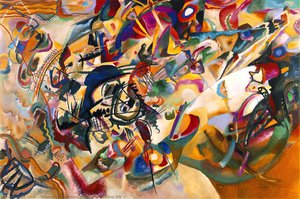
Hij bleef experimenteren met geometrische vormen en levendige kleuren, waarbij hij vaak ingewikkelde impasto-technieken gebruikte om texturen te creëren die de diepte en complexiteit van zijn composities verhoogden – zoals blijkt uit latere werken zoals “An Intimate Party” (1942). Na het sluiten van de Bauhaus door het Nazi-regime in 1933, verhuisde Kandinsky naar Frankrijk, waar hij zijn leven beëindigde. Zijn impact op moderne kunst is onmiskenbaar; hij wordt algemeen beschouwd als een pionier van abstract expressionisme en een sleutelfiguur in de ontwikkeling van niet-representatieve schilderkunst. Zijn werken worden in belangrijke musea over de hele wereld tentoongesteld, waaronder de Tretyakov Gallery in Moskou, die zijn monumentale “Composition VII” herbergt – een getuigenis van zijn artistieke visie en blijvende nalatenschap.

Kandinsky’s verkenning van kleur, vorm en spiritualiteit inspireert kunstenaars tot op de dag van vandaag, waardoor hij zijn plaats als een van de meest belangrijke figuren in de 20e-eeuwse kunstgeschiedenis wordt bevestigd. Hij schilderde niet alleen plaatjes; hij schilderde emoties, ideeën en de essentie van het menselijk spirituele.

More about this painting

Voorvertoning Bekijk in AR Schakel over naar print Schakel over naar digitale afbeeldingen Verstuur
Details bekijken Gids Toevoegen aan favorieten Download Vergelijkbare items Röntgenonderzoek Diavoorstelling Q&A Statistieken