Cubism
Interior (Stuart Davis)
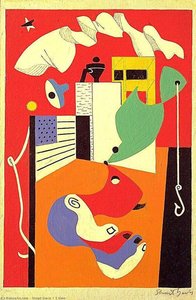
Stuart Davis (1892–1964) maakte Interior. Het behoort tot de Cubism-stroming.

 Voorvertoning

 Met de hand geschilderd olieverfwerk
 Verstuur
 Delen
 Gids


 Download
 Vergelijkbare items
 Röntgenonderzoek
 Diavoorstelling
 Vraag & antwoord

 Statistieken
Interior: de essentie
- Titel
- Interior
- Kunstenaar
- Stuart Davis (1892–1964)
- Geboren in [jaar]
- Philadelphia, Verenigde Staten
- Beweging
- Cubism
- Onderwerp
- abstract, geometric, modernism, composition, lines, forms
Wat stelt Interior voor?
A Dynamic Vision of Modernity: Exploring Stuart Davis’s “Interior”
Stuart Davis's “Interior” is a captivating example of American Modernism, pulsating with energy and reflecting the artist’s unique response to the burgeoning urban landscape and the rhythms of jazz. Created sometime during his prolific career (1892-1964), this work embodies Davis’s commitment to developing a distinctly American visual language, moving beyond European influences towards a bold, independent style.
Deconstructing Space: Style & Technique
- The artwork is immediately striking for its geometric abstraction. Davis employs fragmented forms and flattened perspectives – hallmarks of both Cubism and Constructivism – but infuses them with a uniquely American sensibility.
- A vibrant palette dominates, anchored by the stark contrast between the white background, bold reds, blues, and greys, and punctuated by energetic black lines. The orange border further intensifies this visual impact.
- Davis’s technique is evident in the visible brushstrokes and layering of paint, creating a subtle texture that adds depth despite the overall flattened composition. This suggests an active process of building up form and color on the canvas, likely using oil paints as his primary medium.
- The arrangement isn't simply random; it’s carefully orchestrated into distinct zones – a tower-like structure in blue-grey, a dynamic red section with a vertical ‘sail’ or flag element, and a central area of interwoven geometric shapes. This zoning creates a sense of controlled chaos.
Echoes of Jazz & the Machine Age: Context & Symbolism
Davis was deeply influenced by jazz music, which he saw as embodying the spirit of modern America – improvisational, energetic, and uniquely its own. While “Interior” isn’t a direct representation of musical notes, the dynamic interplay of shapes and colors evokes the same sense of rhythm and syncopation found in jazz compositions.
- The architectural elements, particularly the stylized tower, could be interpreted as representing aspiration or the burgeoning skyscrapers of American cities. Davis frequently engaged with urban themes throughout his career.
- The ‘sail’ or flag-like form introduces a sense of movement and direction, perhaps symbolizing progress or the forward momentum of modern life.
- His early exposure to the Armory Show in 1913 was pivotal. While his initial works reflected the Ashcan School style, he quickly absorbed and transformed European avant-garde ideas into something distinctly American.
Emotional Resonance & Lasting Impact
“Interior” is not a tranquil scene; it’s charged with energy and tension. The fragmented forms and bold colors create a sense of dynamism, while the lack of traditional perspective can be slightly unsettling. This emotional complexity reflects the anxieties and excitements of a rapidly changing world.
- The artwork invites viewers to actively engage with its abstract language, prompting individual interpretations and fostering a personal connection.
- As a pioneering figure in American Modernism, Stuart Davis paved the way for subsequent generations of artists. His work continues to inspire those seeking to break free from convention and explore new forms of visual expression.
Interior in hoge resolutie
Beschermd door auteursrecht: de afbeelding is uitsluitend ter referentie getoond.
Meer formaten, uitsneden & citatiegegevens →Stuart Davis, Interior.
Vragen over Interior
Welk palet en welke hoofdkleur bepalen "Interior"?
"Interior" door Stuart Davis maakt gebruik van een Metallics palet, met Steel Blue (#5c7ba9) als dominante kleur.
Kan ik "Interior" bekijken als een diavoorstelling op volledig scherm?
De diaporama van "Interior" is te bekijken op de Diavoorstelling-pagina van het kunstwerk.
Wat is de reden voor de auteursrechtelijke status van "Interior" door Stuart Davis?
"Interior" door Stuart Davis is nog steeds auteursrechtelijk beschermd. De auteursrechtelijke bescherming loopt vanaf het overlijden van de kunstenaar, dat plaatsvond in 1964.
Welk kleurenpalet wordt gebruikt in "Interior"?
"Interior" door Stuart Davis maakt gebruik van een Metallics kleurenpalet. Dit palet vat het algemene kleurkarakter van het werk samen.
Zijn er werken die lijken op "Interior"?
Ontdek vergelijkbare werken voor "Interior" op de Vergelijkbare werken-pagina van dit kunstwerk.
Welke kleur domineert de compositie van "Interior" door Stuart Davis?
Steel Blue (#5c7ba9) is de dominante kleur van "Interior" door Stuart Davis.
Wie is de kunstenaar achter "Interior"?
"Interior" wordt toegeschreven aan Stuart Davis.
Bij welke kunststroming behoort "Interior" door Stuart Davis?
De kunststroming die verbonden is aan "Interior" door Stuart Davis is Cubism. Deze classificatie plaatst het werk binnen een context van verwante kunstenaars en kunstwerken.
Hoe is de kleurcompositie van "Interior" door Stuart Davis opgebouwd?
In "Interior" wordt een Statement contrast gecombineerd met een Strong Color Unity harmonie.
Over de kunstenaar, Stuart Davis

1892–1964, Verenigde Staten
Stuart Davis
Stuart Davis: Een Pionier van Amerikaanse Modernisme Stuart Davis werd geboren Edward Stuart Davis op december 7, 1892, in Philadelphia aan ouders Edward Wyatt Davis en Helen Stuart Davis. Zijn beide ouders waren kunstenaar. Zijn vader was de art editor van *De Philadelphia Press*, terwijl zijn moeder een beeldhouwer was. Deze familiale achtergrond voedde onmiskenbaar zijn vroegste interesse voor kunst.
Ook van Stuart Davis
 Odol
 Lucky Strike1924
 T View1951
 Blue Café1928
Essays over Interior
 Stuart Davis: Modernist Abstraction & the Vibrant Spirit of the Jazz AgeExplore the vibrant world of Stuart Davis, a pioneer of American Modernism. Discover his jazz-inspired paintings, signature style & investm…
 The Geometry of Elegance: Elevating Modern Villa Interiors with Cubist-Inspired ArtDiscover how Cubist-inspired art elevates modern villa interiors. Explore the intersection of geometric precision and luxury design through…
 Steel & Soul: The Rhythmic Geometry and Industrial Resonance of the Machine AgeExplore the rhythmic geometry of Fernand Leger and the Machine Age. Discover the power of industrial art today.