

 Voorvertoning
 Verstuur
 Delen
Delen
 Details bekijken
 Gids
Gids

 Download
 Vergelijkbare items
 Röntgenonderzoek
 Diavoorstelling
 Q&A
Q&A Statistieken
St Jerome
 Oil On Panel
- WallArt
- Northern Renaissance
 81.0 x 109.0 cm
 Rijksmuseum
 Lees meer
Ontvang een bestand dat klaar is voor drukwerk en de kwaliteit van het online voorbeeld ver overstijgt. Elke digitale afbeelding die wij verkopen, is afkomstig van een high-resolution master uit onze database — meestal tussen de 5.000 en 15.000 pixels breed — zodat u met vertrouwen groot kunt afdrukken, nauwkeurig kunt bijsnijden of fijne details kunt reproduceren.
Geen enkel bestand verlaat ons atelier onbewerkt. Een digitaal expert controleert de kleuren aan de hand van het originele schilderij en corrigeert deze indien nodig, om vervolgens de helderheid en details te verbeteren met professionele retoucheertechnieken — waarbij de penseelstreek en stijl van de kunstenaar altijd strikt worden gerespecteerd. Het resultaat is een afbeelding die oogt als het schilderij zelf, en niet als een gescande foto met een filter.
U keurt de afbeelding goed voordat de bestelling wordt afgerond: onze expert stuurt u binnen 72 uur een e-mail ter beoordeling. Niet tevreden? Vraag om aanpassingen of correcties, of vraag een terugbetaling aan als de kwaliteit niet aan de verwachtingen voldoet.
Dit is de kwaliteit waarop uitgevers, designstudio's, galeries en drukkerijen vertrouwen.
Digitale afbeeldingen
Download een bestand met hoge resolutie voor persoonlijke weergave, afdrukken en creatieve projecten. ( Schakel over naar print Bestel handgeschilderde reproductie)
Inbegrepen bij elke bestelling van een digitale afbeelding
Professionele digitale levering, gegarandeerd
Wanneer u kiest voor OriginalUniqueArt.com, ontvangt u niet alleen een afbeelding – u krijgt een professioneel verbeterd digitaal kunstwerk, met precisie vervaardigd en voorzien van een tevredenheidsgarantie. Dit is alles wat automatisch bij uw bestelling is inbegrepen:

Snelle levering per e-mail
Uw hoogwaardige digitale afbeeldingsbestand wordt binnen 72 uur na bestelling naar u gemaild – klaar voor direct gebruik.

AI-verbeterd digitaal bestand
Uw kunstwerk wordt professioneel geoptimaliseerd met behulp van geavanceerde AI-tools en handmatige bewerkingen, waardoor maximale details, helderheid en kleurnauwkeurigheid worden gegarandeerd.

Gratis levenslange herlevering van digitale bestanden
Je bestand per ongeluk verwijderd of kwijtgeraakt? Geen zorgen – we sturen het u op elk gewenst moment gratis opnieuw toe.

Geen invoerkosten – nooit
Geniet direct van uw kunstwerk zonder invoerrechten, belastingen of verzendkosten – digitale downloads zijn altijd belastingvrij.

Garantie op kleurgetrouwheid
Met behulp van professionele hulpmiddelen en kleurbeheer zorgen wij ervoor dat uw digitale afbeelding de originele kleuren zo nauwkeurig mogelijk weergeeft.

100 dagen tevredenheidsgarantie
Mocht u niet tevreden zijn met uw digitale afbeelding, dan passen wij deze aan of storten wij 100% terug binnen 100 dagen – zonder vragen te stellen.

100% Geld-terug-garantie
Niet tevreden? Ontvang een volledige terugbetaling binnen 100 dagen na ontvangst van uw digitale bestand – zonder vragen te stellen.

Korting bij grote bestellingen
Koop 3 afbeeldingen, bespaar 10% - Koop 5, bespaar 15% - Koop 10+, bespaar 20%. Ideaal voor creatieve projecten, galerieën en bureaus.
The Scholar’s Sanctuary: Marinus van Reymerswaele's St. Jerome
Marinus van Reymerswaele’s “St. Jerome in His Study,” housed within the venerable halls of the Museo Nacional del Prado, is more than a mere depiction of a biblical figure; it’s a meticulously crafted window into the mind and world of a 16th-century Dutch artist grappling with faith, scholarship, and mortality. Painted around 1545, this oil-on-panel masterpiece offers a profound glimpse into the contemplative life of the saint, revealing a complex interplay of religious devotion, humanist learning, and the ever-present awareness of human frailty.
The scene unfolds within a modestly appointed study—a space deliberately devoid of ostentation. Jerome, rendered with remarkable realism for his time, is seated at a sturdy wooden desk, its surface laden with the paraphernalia of intellectual pursuit: open books, scattered parchment, and a meticulously crafted quill pen. His posture suggests both diligence and weariness, reflecting the arduous task of translating scripture and engaging in theological reflection. The artist’s choice to portray Jerome not as an ascetic hermit but as a learned scholar subtly shifts the focus from monastic seclusion to the intellectual life of faith – a prevalent theme within Northern Renaissance art.
A Symphony of Detail: Technique and Materials
Reymerswaele's mastery lies in his ability to imbue this seemingly simple scene with an astonishing level of detail. The artist’s meticulous observation is evident in the textures of the fabrics, the worn wood of the desk, and the subtle nuances of Jerome’s face—the furrowed brow, the deep-set eyes, and the carefully rendered lines of his beard. The use of oil paint allowed for a remarkable degree of luminosity and depth, capturing the play of light across the surfaces and creating a sense of tangible reality within the painted space.
Notably, the panel itself—oak wood treated with multiple layers of gesso and primer—contributes to the painting’s rich texture and durability. The artist skillfully employed glazing techniques to build up layers of color, achieving a remarkable depth and richness of tone. The careful attention to detail extends even to the background, where a partially drawn curtain reveals a glimpse of daylight filtering through a window, suggesting both the natural world and the potential for divine illumination.
Symbolism and Mortality
Beyond its technical brilliance, “St. Jerome in His Study” is laden with symbolic meaning. The prominent skull positioned beside the quill—a direct reference to mortality—serves as a constant reminder of the fleeting nature of earthly existence. It’s a stark contrast to the saint's intellectual pursuits, highlighting the tension between worldly concerns and spiritual aspirations. The inclusion of spectacles further emphasizes Jerome’s role as a scholar, while the open book suggests his dedication to biblical study.
Furthermore, the statue of Christ on the cross visible in the background—a deliberate inclusion by Reymerswaele—underscores the saint's devotion and his connection to the broader Christian narrative. It elevates the scene beyond a mere portrait of an individual, transforming it into a meditation on faith, knowledge, and redemption. The placement of the statue is carefully considered, drawing the viewer’s eye towards the central theme of sacrifice and salvation.
A Window into a Renaissance Mind
“St. Jerome in His Study” offers a compelling glimpse into the intellectual and spiritual landscape of 16th-century Europe. It reflects the burgeoning interest in classical learning, the rise of humanism, and the ongoing debate between faith and reason. Reymerswaele’s masterful execution—his meticulous attention to detail, his skillful use of color and light, and his profound understanding of symbolism—elevates this painting beyond a simple depiction of a biblical figure; it becomes a timeless meditation on the complexities of the human condition.
Reproductions of this captivating artwork capture much of its original power. Consider commissioning a high-quality hand-painted reproduction to bring this evocative scene into your home or office—a testament to the enduring legacy of Marinus van Reymerswaele and his profound exploration of faith, knowledge, and mortality.
Veelgestelde vragen
Tot welke periode in de carrière van Marinus Van Reymerswaele behoort "St Jerome"?
"St Jerome" behoort tot de Mature Period in de carrière van Marinus Van Reymerswaele. Deze classificatie plaatst het werk in de context van de ontwikkeling van de kunstenaar.
Maakt "St Jerome" door Marinus Van Reymerswaele gebruik van sterke contrasten of zachte harmonieën?
De kleuranalyse van "St Jerome" door Marinus Van Reymerswaele legt een Bold contrast en een Balanced Harmony harmonie vast.
Is een download met hoge resolutie van "St Jerome" beschikbaar?
Om een digitale afbeelding van "St Jerome" door Marinus Van Reymerswaele te verkrijgen, kunt u een digitale afbeelding in hoge resolutie om te downloaden bestellen op de Digitale afbeelding pagina.
Kunstenaarsbiografie
The Enigmatic Master of Antwerp's Shadows
In the bustling, mercantile heart of the sixteenth-century Low Countries, a painter emerged whose brush captured the profound tension between spiritual devotion and worldly greed. Marinus van Reymerswaele, an artist whose very name evokes the coastal town of Reimerswaal where he was born, remains one of the most fascinating enigmas of the Dutch Renaissance. His life followed the typical trajectory of a skilled craftsman; after studying in Leuven, he found professional footing within the prestigious Antwerp Guild of Saint Luke. Registered as a pupil of the glass painter Symon van Daele, Reymerswaele possessed an eye for detail and light that would later define his mastery of texture and atmosphere.
As he established himself in Antwerp, the epicenter of European trade, his work began to mirror the city's own complex identity. He operated a prolific workshop, a bustling studio capable of producing numerous versions of his most celebrated themes. This industriousness allowed his specific visual language—a blend of meticulous realism and biting social commentary—to permeate the collections of the era. His paintings did not merely depict scenes; they staged moral dramas that reflected the anxieties of an era caught between medieval piety and the rising tide of capitalism.
A Gallery of Greed and Grace
To look upon a work attributed to Reymerswaele is to enter a space where the sacred and the profane collide. He was a master of a very specific, recurring iconography that captured the imagination of the sixteenth-century public. His compositions often centered on four pivotal themes that explored the human condition through various lenses:
- The intense study of St. Jerome, representing scholarly devotion and religious contemplation.
- The bustling activity of tax collectors, serving as a satirical commentary on greed and corruption.
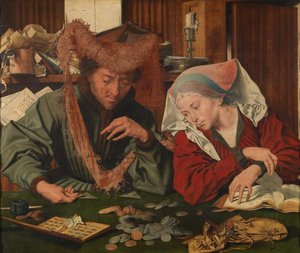
- A money changer and his wife, capturing the intersection of domestic life and commerce.
- The legal world, such as a lawyer in his office, reflecting the growing complexity of civic bureaucracy.
His masterpiece, Two Tax Gatherers, stands as a striking example of Northern Renaissance art. Through the use of oil on oak wood, he achieved a sense of depth and texture that brought his subjects to life. The painting serves as a vivid commentary on the corruption of tax officials, using the detailed depiction of clothing and surroundings to ground his satire in a recognizable reality. In these works, the heavy, old-fashioned garments of his characters add a layer of social critique, reminding the viewer of the era's shifting moral landscape.
Legacy and Artistic Influence
The stylistic development of Marinus van Reymerswaele shows the profound influence of the Antwerp painter Quentin Matsys. This connection helped shape his ability to blend elements of realism with a sharp, often caricatural sense of humor. His work is characterized by an attention to detail that allows the viewer to witness the minute textures of manuscripts, legal documents, and coins, all of which serve as symbols of the era's preoccupation with wealth and law.
While he worked extensively in Antwerp, his journey eventually led him back to the Northern Netherlands. After working in Antwerp until at least 1540, he moved to Goes, where his life reached its conclusion. Though many of his panels are known through attribution rather than signature, his impact on the genre scene remains undeniable. He left behind a visual legacy that continues to captivate, offering a profound glimpse into the mind of an artist grappling with faith, scholarship, and the ever-present shadows of human avarice.
Marinus Van Reymerswaele
1490 - 1546 , Nederland