
 Voorvertoning
 Verstuur
 Delen
Delen
 Details bekijken
 Gids
Gids

 Download
 Vergelijkbare items
 Röntgenonderzoek
 Diavoorstelling
 Vraag & antwoord
 Statistieken
Portrait of Anna Codde

- 86.0 x 66.0 cm


 Lees meer
Giclée / Kunstafdrukken
Giclée- of canvasafdruk van museumkwaliteit met een snelle productie en flexibele afwerkingsmogelijkheden. ( Bestel handgeschilderde reproductie Schakel over naar digitale afbeeldingen)




P118B €10

P118H €10

P118W €10

P438Z €10

P508JH €12

P508YH €12

P805H €10

P805Z €10

P919BZ €10

P919G €10

P919XJ €10

P959ZH €10

P968JZ €12

W106C €8

W218G €10

W218JH €8

W218Y €10

W307PJ €10

W316G €10

W316PJ €8

W316Y €10

W398PJ €8

W4111J €10

W500HY €15

W500JH €15

W692G €12

W849H €8

W940BG €15

W953PJ €8




Kies uit onze vooraf ingestelde maten die overeenkomen met de originele verhoudingen van het kunstwerk.

Voer de gewenste breedte en hoogte in, passend bij uw lijst of muur. Een afdruk kan alleen worden ingekort en nooit groter worden gemaakt dan het origineel; een formaat met andere verhoudingen zal daarom een deel van de afbeelding verliezen. Wij sturen u een digitaal mockup ter goedkeuring voordat we tot drukwerk overgaan. De afbeelding op deze pagina toont niet de werkelijke uitsnede — dit is alleen te zien op het mockup.
Wereldwijde levering () binnen 2 weken in plaats van de standaard 4/5 weken. (6 november)

Gratis wereldwijde expressverzending

Hoogwaardig linnen canvas

Volledige verzendverzekering

Garantie op terugbetaling van invoerrechten

Garantie op exacte kleurweergave

Retourbeleid van 100 dagen (alleen bij defecten)

100% Geld-terug-garantie

Korting bij meerdere afnames
 De optie voor glas is alleen beschikbaar bij een formaat kleiner dan 110 cm.

Portrait of Anna Codde
Giclée / Kunstafdrukken
Afmetingen reproductie
-


Eindtotaal
€ 72
A Window into the Dutch Renaissance: The Portrait of Anna Codde
Maerten van Heemskerck’s “Portrait of Anna Codde,” painted in 1529, isn't merely a likeness; it’s a meticulously crafted tableau vivant – a snapshot of life within the burgeoning world of early Dutch Renaissance society. More than just a portrait, this work offers a rare glimpse into the domestic sphere, revealing a woman engaged in a timeless activity: spinning wool. The scene unfolds with quiet dignity and understated elegance, capturing not only Anna’s physical appearance but also her role as a skilled artisan and devoted wife – a common yet increasingly valued ideal within the Dutch merchant class of the era.
The painting immediately draws the eye to Anna herself, seated comfortably in a simple chair. Her long, flowing hair is partially arranged, suggesting a deliberate effort towards presentation, while her gaze is direct and engaging, inviting the viewer into her world. The spindle she holds isn’t just an object of craft; it's a symbol of domesticity, industry, and the woman’s vital contribution to the household economy. Her dress, though modest in style, speaks volumes about her status – a subtle indication of wealth and refinement. Notice the careful attention to detail in the rendering of her hands, demonstrating Heemskerck’s mastery of capturing texture and form.
The Painter's Palette: Technique and Style
Heemskerck’s style is immediately recognizable as a masterful blend of Italian Renaissance ideals with distinctly Dutch sensibilities. The influence of Jan van Scorel, his former teacher, is evident in the use of light and shadow – a technique known as *chiaroscuro* – which creates a sense of depth and volume within the composition. However, Heemskerck departs from the purely idealized forms often found in Italian portraits, opting for a more naturalistic approach that reflects the growing interest in portraying individuals with greater realism.
The painting’s color palette is restrained yet sophisticated, dominated by earthy tones – browns, ochres, and muted greens – which evoke the textures of the wool and the surrounding domestic environment. The background, featuring a chair and a clock on the wall, provides context without overwhelming the central figure. Heemskerck's skill lies not just in depicting individual features but also in creating a harmonious whole, where every element contributes to the overall narrative.
A Portrait of an Era: Historical Context
“Portrait of Anna Codde” was painted during a period of significant social and economic transformation in the Netherlands. The rise of merchant families like the Coddes fueled a burgeoning economy and a growing emphasis on wealth, status, and family lineage. Portraits became increasingly important as a means of documenting these achievements and solidifying one’s place within society. The inclusion of domestic scenes like this one was not uncommon; it served to portray the subject as both a successful businesswoman and a devoted wife – qualities highly valued in 16th-century Dutch culture.
Furthermore, the painting reflects the growing interest in secular portraiture during this time. While religious subjects remained important, artists began experimenting with depicting everyday life and capturing the personalities of their patrons. The meticulous detail and realistic portrayal of Anna Codde demonstrate Heemskerck’s commitment to portraying his subject with honesty and dignity.
Symbolism and Emotional Resonance
Beyond its technical merits, “Portrait of Anna Codde” is rich in symbolism. The spinning wheel represents not only her craft but also the woman's role as a provider for her household – a vital contribution to the family’s well-being. The clock on the wall serves as a reminder of time and the passage of life, subtly emphasizing the importance of cherishing each moment. The birds in the background, one near the top right corner and another towards the bottom left of the painting, may represent good fortune or simply add to the idyllic scene.
Ultimately, “Portrait of Anna Codde” is a poignant reminder of a bygone era – a time when domesticity was intertwined with prosperity and artistry. It’s a testament to Heemskerck's skill as a painter and his ability to capture not just a likeness but also the essence of a human being within her historical context. Reproductions of this captivating work offer a beautiful window into the heart of the Dutch Renaissance.
Veelgestelde vragen
Is "Portrait of Anna Codde" door Maerten Van Heemskerck een schilderij, een tekening of een prent?
"Portrait of Anna Codde" door Maerten Van Heemskerck wordt geclassificeerd als WallArt. Deze categorie beschrijft het type kunstwerk dat het origineel is.
Waar kan ik het originele werk "Portrait of Anna Codde" door Maerten Van Heemskerck bewonderen?
Het originele werk "Portrait of Anna Codde" is te bewonderen in Rijksmuseum, Amsterdam, Netherlands.
Behoort "Portrait of Anna Codde" door Maerten Van Heemskerck tot het publiek domein?
"Portrait of Anna Codde" door Maerten Van Heemskerck valt onder bevindt zich in het publiek domein - de auteursrechten zijn verlopen. Deze status bepaalt hoe de afbeelding van het werk mag worden gereproduceerd.
Biografie kunstenaar
vroege jaren en opleiding
maerten van heemskerck, een vooraanstaand Nederlands portret- en religieus schilder, werd op 1 juni 1498 geboren in het dorp Heemskerk, Noord-Holland. Zijn artistieke reis begon onder de begeleiding van cornelius willemsz in haarlem, gevolgd door een korte periode in delft bij jan lucasz. Uiteindelijk werd hij een leerling van jan van scorel, waarbij hij de door zijn meester beïnvloede Italiaanse stijl adopteerde.hoogtepunten uit zijn carrière
- het werk van maerten van heemskerck wordt gekenmerkt door zijn innovatieve versmelting van Nederlandse en Italiaanse invloeden, zoals te zien is in zijn beroemde familieportret, dat wordt beschouwd als de eerste in een lange traditie van Nederlandse familieportretten.
- zijn samenwerking met antonio da sangallo de jongere, battista franco en francesco de' rossi (il salviati) aan de herdecoratie van de porta san sebastiano in rome, een triomfboog ter ere van keizer charles v, getuigt van zijn vermogen tot snelle uitvoering als decoratieschilder.
- de tekeningen van heemskerck van klassieke sculptuur en architectuur, die nu bewaard worden in twee schetsboeken in het kupferstichkabinett berlin, demonstreren zijn vaardigheid in het vastleggen van de essentie van de Italiaanse kunst.
opmerkelijke werken en nalatenschap
- de schenker en heilige maria magdalena (bekijk op OriginalUniqueArt)
- de maagd en heilige johannes de evangelist (bekijk op OriginalUniqueArt)
- samson die de pilaren van de tempel verbrijzelt, maarten van heemskerck (bekijk op OriginalUniqueArt)
conclusie
maerten van heemskerck heeft een onmiskenbare, diepgaande impact gehad op de kunstwereld. zijn werken, die nu deel uitmaken van diverse museumcollecties, waaronder het rijksmuseum, blijven kunstenaars en kunstliefhebbers inspireren. om meer van zijn meesterwerken te ontdekken, bezoek
Maerten Van Heemskerck
1498 - 1574 , Nederland
Belangrijkste feiten
- Artistic Movement Or Style: Maniërisme
- Artists Who Influenced This Artist:
- Jan van Scorel
- Antonio da Sangallo de Jongere
- Date Of Birth: 1 juni 1498
- Date Of Death: 1 oktober 1574
- Full Name: Maerten Jacobsz van Heemskerck
- Nationality: Nederlands
- Notable Artworks:
- Lamentatie over de dode Christus
- Pieter Jan Foppeszoon en zijn gezin
- Christus als de Man van Smarten
- Place Of Birth: Heemskerk, Nederland
Gerelateerde artikelen

Maerten van Heemskerck: Bridging Mannerism & Renaissance Ideals
Explore the captivating world of Maerten van Heemskerck, a pivotal Dutch Renaissance painter bridging Mannerism & Italian influence. Discover his masterpieces and legacy with OriginalUniqueArt.

Willem van de Velde the Elder: Master of Maritime Painting & Chronicler of the Dutch Golden Age
Discover the captivating maritime paintings of Willem van de Velde the Elder, a master chronicler of the Dutch Golden Age. Explore his unparalleled realism and lasting influence on naval art history.

Jan van Goyen: Master of Dutch Landscape & Atmospheric Perspective
Discover Jan van Goyen, the master of Dutch landscape painting. Explore his subtle technique, atmospheric realism & lasting influence on art history. Learn about this 17th-century pioneer at OriginalUniqueArt.
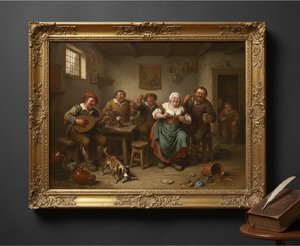
Adriaen van Ostade: A Master of Dutch Genre Painting & Social Commentary
Explore the life & work of Adriaen van Ostade, a leading Dutch Golden Age painter. Discover his realistic genre scenes, social commentary, and lasting influence on art history. Learn more at OriginalUniqueArt.

Rembrandt's Meesterwerken: De Top 25 – Kunst voor uw Interieur | OriginalUniqueArt
Ontdek de 25 meest iconische schilderijen van Rembrandt van Rijn! Duik in de Gouden Eeuw, bewonder zijn portretten & zelfportretten. Museumkwaliteit reproducties voor uw interieur op OriginalUniqueArt.com. Bekijk de collectie!
