Schakel over naar print
 Lees meer







































 Voor kunstwerken of reproducties die aan één zijde groter zijn dan 105 cm (ongeveer 41 inch), wordt de lijst als een losse set verzonden. Deze methode garandeert een veilige levering en voorkomt schade tijdens het transport.


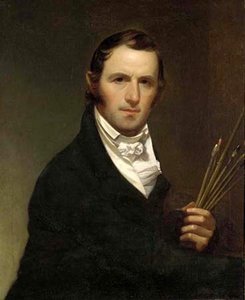
A Window into Pennsylvania Society: Examining Jacob Eichholtz’s Portrait of Samuel Humes
Jacob Eichholtz's "Samuel Humes" stands as a testament to the burgeoning artistic spirit of early 19th-century America, specifically within the context of Lancaster County. Born in 1776, Eichholtz wasn’t formally trained at an academy; his artistic journey began organically—rooted in the practical realities of his upbringing alongside Leonard Eichholtz, whose Bull’s Head Tavern served as a cornerstone of Lancaster's social and economic life. This formative experience instilled in him not merely an understanding of commerce but also a profound appreciation for human interaction – a sensibility that would permeate his oeuvre. Recognizing his innate talent, Eichholtz’s family skillfully channeled this inclination toward the craft of coppersmithing, securing a stable profession while simultaneously nurturing his artistic aspirations.- Subject Matter: The portrait depicts Samuel Humes, an affluent gentleman from Lancaster County, presenting him in a dignified pose against a subtly textured background.
- Style: Eichholtz’s style aligns with the Romantic Victorian movement, characterized by its emphasis on realism and psychological depth—a departure from earlier Neoclassical conventions.
Technique & Materials – Capturing Light and Texture
Executed in oil paint on canvas measuring 74 x 61 cm, Eichholtz employed a meticulous technique that prioritized capturing the nuances of light and texture. He skillfully blended brushstrokes to achieve a velvety surface finish—a hallmark of Victorian portraiture—allowing for subtle gradations of color and creating an illusion of three-dimensionality. The artist’s careful observation of anatomy and drapery contributes to the painting's remarkable accuracy, reflecting the prevailing scientific interest in studying human form during this period.Historical Context – Pennsylvania’s Artistic Renaissance
“Samuel Humes” emerged during a period of significant artistic growth within Pennsylvania—often referred to as Pennsylvania’s Artistic Renaissance. The burgeoning middle class embraced portraiture as a means of commemorating achievements and establishing social status, fostering a demand for skilled artists like Eichholtz. Lancaster County itself was experiencing rapid industrialization and urbanization, attracting individuals from across the nation eager to build lives and reputations. Eichholtz's work embodies this spirit—a celebration of both individual identity and the broader cultural landscape of his time.Symbolism & Emotional Impact – Apples and Classical Influence
The inclusion of apples within Humes’s attire is laden with symbolic significance, referencing biblical references to Adam and Eve and representing fertility and prosperity—themes prevalent in Victorian art. Furthermore, Eichholtz's stylistic choices draw inspiration from classical ideals of beauty and harmony, mirroring the broader revival of Greco-Roman culture during the Romantic era. The painting evokes a sense of quiet dignity and contemplative reflection, inviting viewers to contemplate Humes’s character and place within his community—a testament to Eichholtz’s ability to convey emotion through visual representation.Provenance & Legacy – A Masterpiece Preserved
Currently housed at the Metropolitan Museum of Art in New York City, “Samuel Humes” remains a captivating example of American Romantic portraiture. Its meticulous execution and evocative composition continue to inspire admiration among art historians and collectors alike—a lasting legacy of Jacob Eichholtz’s artistic vision.Veelgestelde vragen
Hoe komen medium en beweging samen in "Samuel Humes"?
"Samuel Humes" door Jacob Eichholtz combineert de Oil On Canvas-techniek met de Romantic Victorian Portrait-stijl. Techniek en stroming beschrijven de vervaardiging en de stijl van het werk.
Hoe groot is het contrast in "Samuel Humes" door Jacob Eichholtz?
"Samuel Humes" door Jacob Eichholtz vertoont een Statement contrast tussen de lichte en donkere partijen.
Hoe harmonieus is het kleurgebruik in "Samuel Humes" door Jacob Eichholtz?
De kleuren van "Samuel Humes" door Jacob Eichholtz vertonen een Discordant Palette harmonie. Harmonie beschrijft de onderlinge relatie tussen de kleuren.
 Voorvertoning
 Verstuur
 Delen
Delen
 Details bekijken
 Gids
Gids

 Download
 Vergelijkbare items
 Röntgenonderzoek
 Diavoorstelling
 Vraag & antwoord
 Statistieken