Contemporary Realism · 1957
Falling Warrior (Henry Moore, 1957)
Henry Moore (1898–1986) maakte Falling Warrior. Het dateert uit 1957. Het behoort tot de Contemporary Realism-stroming. Het is gemaakt van Bronze. Het is te vinden in National Museums Liverpool in Liverpool, Verenigd Koninkrijk. De afmetingen zijn 48 × 147 cm.
- 1957
- Bronze
- 48 × 147 cm
- National Museums Liverpool

 Met de hand geschilderd olieverfwerk
 Verstuur
 Delen
 Informatieblad


 Download
 Vergelijkbare items
 Diavoorstelling
 Vraag & antwoord

 Statistieken
Falling Warrior, in het kort
- Titel
- Falling Warrior
- Kunstenaar
- Henry Moore (1898–1986)
- Geboren in [jaar]
- Castleford, Verenigd Koninkrijk
- Datum
- 1957
- Medium
- Bronze
- Afmetingen
- 48 × 147 cm
- Te zien in
- National Museums Liverpool, Liverpool, Verenigd Koninkrijk
- Beweging
- Contemporary Realism
- Periode
- Modern
- Onderwerp
- bronze sculpture, female figure, reclining pose, minimalism, organic form, tranquility
Wat stelt Falling Warrior voor?
A Symphony of Bronze and Bone: The Essence of Falling Warrior
In the quiet halls of Tate Britain, there exists a moment of profound stillness captured in bronze—a masterpiece that breathes with the weight of history and the lightness of spirit. Henry Moore’s “Falling Warrior,” created between 1956 and 1957, is far more than a mere sculpture; it is a meditation on the very nature of existence. As one approaches this monumental work, the eye is immediately drawn to the fluid, undulating lines that define the female form. The figure lies horizontally, her body a landscape of soft curves and deliberate voids, evoking a sense of both immense strength and heartbreaking vulnerability. It is a piece that does not merely occupy space but commands it, inviting the viewer into a silent dialogue about resilience in the face of inevitable decline.
The brilliance of Moore’s technique lies in his ability to marry the tactile reality of metal with the ethereal quality of movement. Through a masterful process of modeling clay and subsequent bronze casting, Moore achieved a surface texture that feels alive. One can trace the subtle depressions and ridges that mimic the contours of flesh and bone, creating a rhythmic vitality that suggests the figure is caught in a single, breathless moment of transition. His pioneering use of negative space—the intentional piercing of the form—allows light to pass through the sculpture, integrating the surrounding environment into the artwork itself. This interplay of solid mass and hollow void creates a dynamic tension, making the bronze appear deceptively supple, as if the warrior might stir at any moment.
Modernism Rooted in the Earth
To understand the soul of “Falling Warrior,” one must look to the rugged landscapes of Yorkshire, where Henry Moore first learned to see the world. The rolling hills and weathered stones of his youth are echoed in the organic abstractions of this piece. While the sculpture sits firmly within the mid-century movements of Abstract Expressionism and Surrealism, it avoids the coldness often associated with pure abstraction. Instead, Moore utilizes a semi-abstract language to explore deep psychological states. The pose—a female figure with an arm outstretched in what could be interpreted as either defiance or surrender—serves as a universal symbol for the human condition. It captures the duality of our existence: the struggle to remain upright and the eventual, graceful acceptance of our own mortality.
For the discerning collector or interior designer, “Falling Warrior” represents an unparalleled opportunity to introduce a sense of timelessness and intellectual depth into a space. A high-quality reproduction of this work brings with it the prestige of British Modernism and the calming influence of organic form. Whether placed in a sunlit gallery, a sophisticated study, or as a focal point in a contemporary living space, the sculpture’s presence is transformative. It offers more than decoration; it provides a window into a profound aesthetic experience, where the boundaries between the human body and the natural world dissolve into a single, hauntingly beautiful expression of life.
In welk museum bevindt Falling Warrior zich?
National Museums Liverpool
Liverpool, Verenigd Koninkrijk
Een Erfgoed Geëtst in Steen en Doeken: National Museums Liverpool Verken het bruisende hart van Liverpool, een stad die doordrenkt is van maritieme geschiedenis, industriële kracht en artistieke innovatie – hier bevindt zich National Museums Liverpool. Meer dan alleen een verzameling artefacten, is dit een levend testament aan de evolutie van Merseyside, een diepe eerbetoon aan menselijke creativiteit door de eeuwen heen. In schril contrast met de grandeur van musea in Londen, bloeit NML dankzij zijn unieke regionale identiteit, geworteld in de veerkrachtige geest van het noordwesten en toegankelijk voor iedereen.


Hoogwaardige afbeeldingen van Falling Warrior

Protected by copyright: these files are for personal reference, not a licence to republish.
Henry Moore, Falling Warrior (1957), National Museums Liverpool.
Vragen over Falling Warrior, beantwoord
In welk museum is het originele werk "Falling Warrior" te zien?
Het originele "Falling Warrior" door Henry Moore wordt bewaard in National Museums Liverpool, Liverpool, Verenigd Koninkrijk. Een reproductie maakt het mogelijk om het werk thuis tentoon te stellen.
In welk jaar werd "Falling Warrior" door Henry Moore gemaakt?
"Falling Warrior" door Henry Moore werd gemaakt in 1957.
Met welke techniek is "Falling Warrior" door Henry Moore vervaardigd?
Henry Moore gebruikte de Bronze-techniek voor "Falling Warrior". De techniek bepaalt de materiële aard van het originele werk.
Wat zijn de afmetingen van het originele "Falling Warrior" door Henry Moore?
Het originele werk "Falling Warrior" door Henry Moore heeft de afmetingen 147 x 48 cm.
Wat stelt "Falling Warrior" door Henry Moore voor?
De onderwerpen van "Falling Warrior" zijn bronze sculpture, female figure, reclining pose, minimalism, organic form, tranquility, monumental art.
Is de afbeelding van "Falling Warrior" door Henry Moore vrij van auteursrecht?
De auteursrechtelijke status van "Falling Warrior" door Henry Moore: het werk is nog steeds auteursrechtelijk beschermd. Dit bepaalt of reproducties van de afbeelding vrijelijk mogen worden gemaakt.
Wie heeft "Falling Warrior" gemaakt?
"Falling Warrior" is gemaakt door Henry Moore. De informatie op deze pagina beschrijft het originele werk van Henry Moore.
Bij welke kunststroming behoort "Falling Warrior" door Henry Moore?
De kunststroming die verbonden is aan "Falling Warrior" door Henry Moore is Contemporary Realism. Deze classificatie plaatst het werk binnen een context van verwante kunstenaars en kunstwerken.
Tot welke periode in de carrière van Henry Moore behoort "Falling Warrior"?
"Falling Warrior" vertegenwoordigt de Mature Period van Henry Moore.
Over de kunstenaar, Henry Moore

1898–1986, Verenigd Koninkrijk
Henry Moore
A Life Sculpted in Form: The World of Henry Moore Henry Spencer Moore, geboren in de Yorkshirese mijnstad Castleford in 1898, werd een van Engelands meest significante en internationaal erkende beeldhouwers van de twintigste eeuw. Zijn reis van bescheiden begin tot wereldwijde erkenning is een bewijs van zijn onwrikbare toewijding aan artistieke exploratie en zijn diepe verbinding met de menselijke vorm en de natuurlijke wereld. Moore’s vader, een zelfstandige man met een passie voor leren, stuurde hem op weg naar formele scholing, weg van het leven als mijnwerker. Zelfs als jonge knaap toonde Moore een innig talent voor het modelleren van klei en houtsnijden, wat voorspelde de weg die zijn leven zou volgen.
Ook van Henry Moore
 Reclining Figure
 Sculptural Objects (Cramer 47)
 Sheep 1
 A Miner at Work1942
Essays over Falling Warrior
 Romantic Realism's Finest: 10 Masterpieces for Your Home | OriginalUniqueArtExplore 10 defining masterpieces of Romantic Realism! Discover Courbet, Millet & Daumier's powerful paintings—capturing emotion and social …
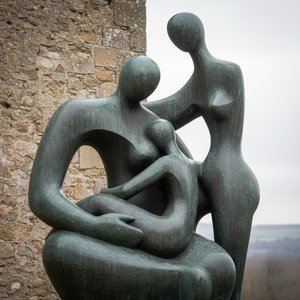 Henry Moore: Sculpting Modernity – Form, Emotion & the Human ConditionExplore the revolutionary sculptures of Henry Moore – abstract forms, reclining figures & powerful expressions of the human condition. Disc…
 Top 10 Cubistische Expressionistische Meesterwerken: Kunst voor uw InterieurOntdek de 10 baanbrekende meesterwerken van het Cubisme & Expressionisme! Leer over Picasso, Braque en Kandinsky. Vind museumkwaliteit kuns…