Schakel over naar print
 Lees meer







































 Voor kunstwerken of reproducties die aan één zijde groter zijn dan 105 cm (ongeveer 41 inch), wordt de lijst als een losse set verzonden. Deze methode garandeert een veilige levering en voorkomt schade tijdens het transport.


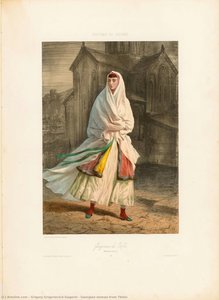
Caucasian Policeman – A Portrait of Courage Amidst Imperial Ambition
Grigory Grigorievich Gagarin’s “Caucasian Policeman,” painted in 1855, transcends mere depiction; it embodies the spirit of a pivotal moment in Russian imperial history and artistic exploration. This striking canvas captures a young Circassian officer standing proudly amidst the arid landscape of Georgia—a testament to Gagarin's fascination with documenting the diverse cultures inhabiting the Caucasus region during his tenure as administrator for Mikhail Vorontsov.
- Subject Matter: The painting portrays a Circassian policeman, symbolizing strength and vigilance against the backdrop of Russian expansion into Georgia. His posture exudes confidence and determination, reflecting the ambition of the era.
- Style & Technique: Gagarin employed a meticulous watercolor technique—characteristic of his time—to achieve remarkable luminosity and detail. The subdued palette emphasizes the harshness of the Caucasus environment while highlighting the officer’s figure with subtle tonal variations.
- Historical Context: Created during Vorontsov's governorship, “Caucasian Policeman” reflects the broader preoccupation with portraying ‘noble savages’ – individuals embodying idealized virtues deemed absent in European society. Gagarin’s work aligns with a trend toward ethnographic realism within Russian art.
The Artist’s Vision & Influences
Born into Saint Petersburg’s aristocratic Gagarin family, Grigory Grigorievich received early artistic instruction from Karl Briullov, cementing his connection to the Romantic tradition. This formative influence is palpable in Gagarin's approach—a dedication to capturing authentic emotion and observation—evident throughout his oeuvre.
- Karl Briullov’s Legacy: Briullov championed a style prioritizing expressive brushwork and tonal harmony, mirroring Gagarin’s commitment to conveying atmosphere and psychological depth.
- Pushkin & Lermontov Connections: Gagarin's friendship with literary giants Alexander Pushkin and Mikhail Lermontov undoubtedly fueled his artistic sensibilities—inspiring him to portray characters with nuance and sensitivity.
Symbolism & Emotional Resonance
"Caucasian Policeman" speaks volumes beyond its visual representation. The officer’s unwavering gaze embodies resilience and honor, qualities valued during a period of intense geopolitical upheaval. Furthermore, the desert landscape symbolizes isolation and challenges—mirroring the heroic spirit depicted in the portrait.
- Color Palette: The muted hues contribute to an overall mood of solemn contemplation, emphasizing the officer’s dignity amidst adversity.
- Composition: Gagarin skillfully utilizes diagonal lines to convey movement and dynamism—underscoring the officer's presence within his environment.
- Emotional Impact: Ultimately, “Caucasian Policeman” evokes admiration for courage, integrity, and a profound connection to one’s heritage – themes resonating powerfully with viewers today.
A Window into Georgian Art History
The painting resides in the Art Palace of Georgia—a repository of exceptional artworks documenting Georgian culture and history. Its inclusion within this museum underscores Gagarin's contribution to preserving cultural memory and celebrating artistic excellence. Consider commissioning a high-quality reproduction to bring this evocative masterpiece into your home or workspace.
Veelgestelde vragen
Hoe wordt het kleurenpalet van "Caucasus Policeman" door Grigori Grigorievich Gagarin beschreven?
De kleuren van "Caucasus Policeman" vormen een Pasteltinten palet. Deze classificatie beschrijft de dominante kleurfamilies.
Wat zijn de vorm en afmetingen van "Caucasus Policeman" door Grigori Grigorievich Gagarin?
"Caucasus Policeman" door Grigori Grigorievich Gagarin heeft de afmetingen van een Staand formaat werk van 59 x 42 cm.
Wanneer en met welke materialen is "Caucasus Policeman" gemaakt?
"Caucasus Policeman" werd gemaakt in 1855, in Acryl op canvas.
 Voorvertoning
 Verstuur
 Delen
Delen
 Details bekijken
 Gids
Gids

 Download
 Vergelijkbare items
 Röntgenonderzoek
 Diavoorstelling
 Vraag & antwoord
 Statistieken