

 Verstuur
 Delen
Delen
 Details bekijken
 Gids voor studentenkunstwerken

 Download
 Vergelijkbare items
 Diavoorstelling
 Statistieken
South pulpit
 Bronze
- Sculpture
- Early Renaissance
 1460
1460- Renaissance
 123.0 x 292.0 cm
 Basilica di San Lorenzo
 Lees meer
Giclée / Kunstafdrukken
Giclée- of canvasafdruk van museumkwaliteit met een snelle productie en flexibele afwerkingsmogelijkheden. ( Koop handgeschilderd kunstwerk Schakel over naar digitale afbeeldingen)




































Kies uit onze vooraf ingestelde maten die overeenkomen met de originele verhoudingen van het kunstwerk.

Voer de breedte en de hoogte in die u nodig heeft, passend bij uw lijst of uw muur. Een afdruk kan alleen worden ingekort, nooit groter worden gemaakt dan het origineel, waardoor een formaat met een andere verhouding een deel van de afbeelding verliest. Wij sturen u een digitaal mockup ter goedkeuring voordat we iets drukken. De afbeelding op deze pagina toont niet de werkelijke uitsnede — dit is alleen te zien op het mockup.
Wereldwijde levering () binnen 2 weken in plaats van de standaard 4/5 weken. (21 oktober)

Gratis wereldwijde expressverzending

Hoogwaardig linnen canvas

Volledige verzendverzekering

Garantie op terugbetaling van invoerrechten

Garantie op exacte kleurweergave

Retourbeleid van 100 dagen (alleen bij defecten)

100% Geld-terug-garantie

Korting bij meerdere afnames
 De optie voor glas is alleen beschikbaar bij een formaat kleiner dan 110 cm.

South pulpit
Giclée / Kunstafdrukken
Formaat reproductie
-


Totaalprijs
€ 71
A Renaissance Vision of Faith: The Soul of Donatello’s South Pulpit
In the heart of Florence, where the echoes of the Renaissance still resonate through the marble corridors of the Basilica di Santa Maria del Fiore, stands a masterpiece that transcends the boundaries of mere sculpture. Donatello’s South pulpit, completed in 1460, is not simply a liturgical structure; it is a visceral, breathing embodiment of human suffering and divine grace. Commissioned by the illustrious Lorenzo Medici, this monumental work serves as a profound meditation on the Passion of Christ, capturing a pivotal moment in art history where the spiritual fervor of the era met the burgeoning humanist ideals of the Florentine Renaissance.
To stand before the pulpit is to witness a masterclass in narrative intensity. The bronze panels do not merely depict scenes; they invite the viewer into the very agony and ecstasy of the Christian narrative. From the brutal reality of the Flagellation to the solemnity of the Crucifixion, Donatello weaves a complex tapestry of movement and emotion. Each figure is imbued with a psychological depth that was revolutionary for its time, moving away from the static, stylized elegance of the Gothic tradition toward a raw, unflinching realism that captures the weight of human existence.
Mastery in Bronze: Technique and Classical Influence
The technical brilliance of the South pulpit lies in Donatello’s ability to manipulate bronze to achieve textures that feel almost organic. Utilizing the intricate lost-wax casting method, the sculptor achieved an exceptional level of precision, allowing for fine details—the tension in a muscle, the drape of a heavy cloth, or the subtle expression of grief—to emerge with startling clarity. The surface of the bronze, polished to a luminous sheen, catches the light in ways that enhance the three-dimensional dynamism of the figures.
Donatello’s stylistic evolution is on full display here, as he masterfully integrates classical principles with deep religious conviction. By employing techniques such as contrapposto—the subtle shift of weight that lends a lifelike quality to the human form—he breathes life into the metal. This engagement with antiquity, a hallmark of the Renaissance, allows the pulpit to serve as a bridge between the heroic ideals of the classical past and the profound spiritual explorations of the fifteenth century. For the discerning collector or designer, this piece represents the pinnacle of sculptural innovation, where material strength meets ethereal beauty.
An Emotional Legacy for the Modern Collector
Beyond its historical significance, the South pulpit possesses an enduring emotional resonance that continues to captivate the modern imagination. It is a work that speaks to the universal human experience: the struggle against injustice, the endurance of pain, and the search for redemption. The dramatic interplay of light and shadow across the sculpted reliefs creates a sense of movement that makes the artwork feel alive, much like a cinematic epic frozen in time.
For those seeking to bring a sense of profound history and intellectual depth into a curated space, a high-quality reproduction of this masterpiece offers more than just decoration. It provides a focal point for contemplation and a conversation piece that honors the legacy of one of history's greatest masters. Whether placed in a grand library, a sophisticated gallery, or a thoughtfully designed interior, the South pulpit serves as a timeless reminder of the power of art to capture the very essence of the human soul.
Vragen & Antwoorden
Hoe is de kleurcompositie van "South pulpit" door Donatello opgebouwd?
De kleurcompositie van "South pulpit" door Donatello combineert een Bold contrast met een Balanced Harmony harmonie.
Is "South pulpit" typerend voor wat Donatello gewoonlijk creëerde?
De terugkerende thema's van Donatello omvatten classical ideals, religious symbolism, humanism, monumental sculpture, renaissance legacy; "South pulpit" richt zich op sculpture, religion, renaissance, michelangelo, donatello, italy, classicalart.
Kan ik "South pulpit" bekijken als een diavoorstelling op volledig scherm?
Er is een diavoorstelling beschikbaar: de Diavoorstelling-pagina van "South pulpit" door Donatello.
Biografie van de kunstenaar
Early Life and Artistic Beginnings
Donatello di Niccolò di Betto Bardi, universally known as Donatello, emerged from the bustling heart of Florence in 1386 – a city that would indelibly shape his artistic vision. His origins were modest; born into a family involved in wool trading, a profession that afforded them a respectable, though not opulent, place within Florentine society. While details about his early childhood remain somewhat elusive, it’s believed he received his initial training as an apprentice stonemason, absorbing the fundamental techniques of carving and shaping stone – skills crucial for any aspiring sculptor. This foundational period likely exposed him to the architectural grandeur of the Duomo (Florence Cathedral), a project that dominated Florentine life and provided countless opportunities for young artisans to hone their craft. Donatello’s early influences were deeply rooted in the prevailing Gothic style, yet he demonstrated an innate ability to transcend its limitations, hinting at the revolutionary approach that would define his mature work.The Influence of Ghiberti and the Dawn of a New Style
Around 1400, Donatello entered the workshop of Lorenzo Ghiberti, a master sculptor renowned for his intricate bronze doors destined for the Baptistery in Florence. This association proved pivotal to Donatello’s development. Ghiberti's style, characterized by its elegant lines and classical allusions, provided a crucial framework for Donatello’s early explorations. However, Donatello quickly distinguished himself through an unprecedented focus on human emotion and realism – a departure from the stylized figures prevalent in contemporary sculpture. He wasn’t merely replicating forms; he was striving to capture the essence of human experience, imbuing his creations with a palpable sense of life. This nascent desire for psychological depth would become a hallmark of his distinctive style. The period spent under Ghiberti also exposed Donatello to the principles of perspective and composition, laying the groundwork for his later innovations in spatial representation.Key Works and Revolutionary Techniques
Donatello’s artistic trajectory truly took flight with several groundbreaking works that cemented his reputation as a visionary artist. Perhaps most famously, his “David” (circa 1404-1407) stands as a watershed moment in sculpture history. Unlike previous depictions of the biblical hero, Donatello's David is not depicted as a triumphant warrior but rather as a youthful, vulnerable figure – a young man contemplating his destiny. This portrayal broke with centuries of tradition and established a new standard for nude male sculpture, demonstrating an unprecedented level of anatomical accuracy and psychological insight. His “Sacrifice of Isaac” (1423-1427), created for the Campanile of Santa Maria del Fiore, further showcased his mastery of relief carving, employing a technique known as *schiacciato* – essentially flattening the sculpted figures onto a shallow panel to create an illusion of depth. This innovative approach allowed him to achieve remarkable realism and dramatic intensity within a limited space. The “St. Louis of Toulouse” (1432-1438), a monumental bronze sculpture commissioned for the Medici family, exemplifies his ability to fuse classical ideals with Christian iconography, creating a figure that is both imposing and profoundly human.A Style Defined by Expressiveness and Classical Echoes
Donatello’s artistic style evolved through distinct phases, each reflecting his growing confidence and experimentation. Initially, his work was heavily influenced by the Gothic tradition, but he quickly moved towards a more expressive and dynamic approach. His figures are characterized by their powerful musculature, dramatic poses, and intense emotionality – qualities that set him apart from his contemporaries. Crucially, Donatello’s art was deeply informed by the rediscovery of classical antiquity. He meticulously studied ancient Roman sculptures, absorbing their principles of proportion, anatomy, and composition. However, he didn't simply imitate these models; instead, he skillfully integrated classical elements into his own unique style, creating a synthesis that is both innovative and profoundly resonant with the spirit of the Renaissance. His work wasn’t immediately embraced by all quarters – some critics found his innovations unsettling, while others questioned his adherence to traditional religious iconography. Yet, Donatello's bold vision ultimately prevailed, establishing him as one of the most influential sculptors in the history of Western art.Legacy and Enduring Influence
Donatello’s legacy extends far beyond his individual masterpieces. He profoundly shaped the course of Renaissance sculpture, inspiring generations of artists with his technical virtuosity, psychological insight, and unwavering commitment to realism. His emphasis on human emotion and anatomical accuracy paved the way for subsequent sculptors, including Michelangelo Buonarroti and Leonardo da Vinci. Donatello’s influence can be seen in countless works of art throughout Europe, from the grand monuments of Rome to the intimate devotional sculptures of Northern Europe. Even today, his sculptures continue to captivate viewers with their power, beauty, and enduring relevance. The Premi David di Donatello, awarded annually to celebrate excellence in Italian cinema, stand as a testament to his lasting impact on culture – a fitting tribute to the artist who dared to redefine the possibilities of sculpture.
Donatello
1386 - 1466 , Italië
Snelle feiten
- Artistic Movement Or Style: Vroege Renaissance
- Artists Or Movements Influenced By This Artist: ['Italiaanse Renaissance']
- Artists Who Influenced This Artist: ['Romeinse beeldhouwers']
- Date Of Birth: c. 1386
- Date Of Death: 1466
- Full Name: Donato di Niccolò
- Nationality: Italiaans
- Notable Artworks:
- David
- St. Louis
- Sacrificie Isaac
- Place Of Birth: Florence, Italië
Gerelateerde artikelen
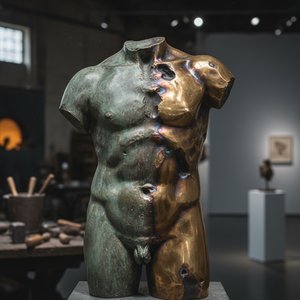
Het Duurzame Erfgoed van Bronzen Beeldhouwkunst: Geschiedenis, Technieken en Hedendaagse Interpretaties
Ontdek de rijke geschiedenis en het duurzame erfgoed van bronzen beeldhouwkunst. Van klassieke technieken tot hedendaagse interpretaties, een gids voor verzamelaars en kunstliefhebbers.

The Enduring Form: Sculpture Across History, Technique & Emotional Resonance
Explore the rich history of sculpture with OriginalUniqueArt. Discover key techniques, influential artists & investment potential for discerning collectors. Expert insights into valuing and collecting timeless masterpieces.

Top 10 Legendarische Bronzen Meesterwerken die de Kunst Veranderden | OriginalUniqueArt
Ontdek de 10 meest legendarische bronzen meesterwerken die de kunstgeschiedenis veranderden! Van Rodin tot Michelangelo, leer over techniek & betekenis. Museumkwaliteit reproducties voor uw interieur op OriginalUniqueArt.com. Exploreer de collectie online!

The Enduring Form: Exploring Themes & Techniques in Sculpture Across Historical Periods
Explore the rich history of sculpture from ancient masterpieces to contemporary innovations. Discover key techniques, influential artists & investment potential for discerning art collectors.

Top 10 Bronzen Beeldhouwwerken die de Kunst Voorgoed Veranderden | OriginalUniqueArt
Ontdek de 10 meest legendarische bronzen beeldhouwwerken die kunstgeschiedenis schreven! Van Rodin tot Michelangelo, leer over hun meesterwerken & technieken. Vind museumkwaliteit reproducties en inspiratie voor uw interieur op OriginalUniqueArt.com.
