

 Bekijk op ware grootte
 Verstuur
 Delen
Delen
 Details bekijken
 Gids voor studentenkunstwerken

 Download
 Vergelijkbare items
 Röntgenonderzoek
 Diavoorstelling
 Statistieken
Model


 Lees meer
De kunstwerken die op deze pagina worden weergegeven, zijn beschermd door de auteursrechtwetgeving, wat betekent dat het ons wettelijk niet is toegestaan om identieke reproducties te maken of te verkopen. Deze bescherming wordt gehandhaafd onder internationale overeenkomsten zoals de Conventie van Bern en door nationale wetgeving, waaronder de bepalingen van de Amerikaanse auteurswet - Titel 17. Alle rechten voorbehouden. Reproduceren of distribueren van afbeeldingen is niet toegestaan zonder uitdrukkelijke schriftelijke toestemming van WahooArt.com en de rechthebbenden.
Deze methode voldoet volledig aan de auteursrechtwetgeving, omdat het niet gaat om het kopiëren of dupliceren van het beschermde kunstwerk. In plaats daarvan is er sprake van een creatieve herinterpretatie — een nieuw schilderij dat door het origineel wordt geïnspireerd, maar er niet identiek aan is.
Giclée / Kunstafdrukken
Giclée- of canvasafdruk van museumkwaliteit met een snelle productie en flexibele afwerkingsmogelijkheden. ( Koop handgeschilderd kunstwerk Schakel over naar digitale afbeeldingen)




P118B €10

P118H €10

P118W €10

P438Z €10

P508JH €12

P508YH €12

P805H €10

P805Z €10

P919BZ €10

P919G €10

P919XJ €10

P959ZH €10

P968JZ €12

W106C €8

W218G €10

W218JH €8

W218Y €10

W307PJ €10

W316G €10

W316PJ €8

W316Y €10

W398PJ €8

W4111J €10

W500HY €15

W500JH €15

W692G €12

W849H €8

W940BG €15

W953PJ €8




Kies uit onze vooraf ingestelde maten die overeenkomen met de originele verhoudingen van het kunstwerk.

Voer de breedte en de hoogte in die u nodig heeft, passend bij uw lijst of uw muur. Een afdruk kan alleen worden ingekort, nooit groter worden gemaakt dan het origineel, waardoor een formaat met een andere verhouding een deel van de afbeelding verliest. Wij sturen u een digitaal mockup ter goedkeuring voordat we iets drukken. De afbeelding op deze pagina toont niet de werkelijke uitsnede — dit is alleen te zien op het mockup.
Wereldwijde levering () binnen 2 weken in plaats van de standaard 4/5 weken. (22 oktober)

Gratis wereldwijde expressverzending

Hoogwaardig linnen canvas

Volledige verzendverzekering

Garantie op terugbetaling van invoerrechten

Garantie op exacte kleurweergave

Retourbeleid van 100 dagen (alleen bij defecten)

100% Geld-terug-garantie

Korting bij meerdere afnames
 De optie voor glas is alleen beschikbaar bij een formaat kleiner dan 110 cm.

Model
Giclée / Kunstafdrukken
Formaat reproductie
-


Totaalprijs
€ 71
The Enigmatic Silhouette: Unpacking Cristóbal Balenciaga’s ‘Model’
Cristóbal Balenciaga’s 1966 photograph, “Model,” isn't merely a portrait; it’s a distilled essence of the designer’s revolutionary approach to fashion. The image captures a woman, her form enveloped in a striking tweed suit – a garment that immediately speaks of geometric precision and timeless elegance. Yet, beneath this surface simplicity lies a profound exploration of structure, proportion, and the very nature of representation. The photograph, often cited as one of Balenciaga’s most iconic works, transcends its status as a simple fashion image, offering a glimpse into the meticulous process and philosophical underpinnings of his design philosophy.
Balenciaga's genius wasn’t simply about creating beautiful clothes; it was about dissecting them, understanding their fundamental components, and rebuilding them with an almost architectural rigor. “Model” exemplifies this perfectly. The tweed itself is a deliberate choice – a robust, slightly stiff material that resists the drape of traditional fabrics, demanding a precise construction. Notice how the seams are barely visible, suggesting a layering technique designed to create volume without adding bulk. This restraint, this careful control over the fabric’s behavior, is characteristic of Balenciaga's work and reflects his deep understanding of materials – he considered himself more a craftsman than a designer in the conventional sense.
A Masterclass in Architectural Form
The suit’s silhouette isn’t simply flattering; it’s deliberately constructed to evoke a sense of solidity and strength. The fitted bodice, the subtly flared skirt – each element contributes to an overall impression of contained power. Balenciaga was deeply influenced by the art movements of his time, particularly Surrealism and Cubism, which encouraged him to deconstruct familiar forms and reassemble them in unexpected ways. This is evident in the suit’s sharp angles and its almost sculptural quality. The photograph itself becomes a study in form – a meditation on how shape can convey meaning and emotion.
The choice of David Bailey as the photographer further enhances the image's impact. Bailey, known for his stark, black-and-white portraits, captures the subject with an unflinching gaze, emphasizing her posture and the suit’s impeccable tailoring. The lighting is carefully controlled, highlighting the textures of the tweed and casting subtle shadows that accentuate the garment’s three-dimensional form. Bailey's skill lies in revealing the underlying structure of the image, mirroring Balenciaga’s own approach to design.
Echoes of a Lost Era: Context and Legacy
“Model” was created during a pivotal moment in fashion history – the mid-1960s. While Yves Saint Laurent was injecting youthful energy into Parisian couture with his Le Smoking tuxedo, Balenciaga remained steadfastly committed to his own vision of timeless elegance. His designs were often perceived as being ahead of their time, challenging conventional notions of beauty and femininity. The photograph serves as a reminder of this period of creative experimentation and the enduring influence of Balenciaga’s work.
The image also speaks to the broader cultural context of the era – a fascination with architecture, technology, and industrial design. Balenciaga's designs were often described as “architectural,” reflecting a growing interest in geometric forms and functional aesthetics. The photograph captures this spirit perfectly, suggesting that fashion could be both beautiful and intellectually stimulating.
A Timeless Icon: Reproduction and Inspiration
Today, “Model” remains one of the most recognizable images in the history of fashion photography. Its enduring appeal lies in its combination of technical skill, artistic vision, and emotional resonance. Reproductions of this photograph are highly sought after by collectors and interior designers alike, who appreciate its timeless elegance and its ability to evoke a sense of sophistication and refinement. When commissioning a hand-painted reproduction, it’s crucial to select an artist who understands Balenciaga's meticulous approach to detail and his commitment to capturing the essence of his designs.
Vragen & Antwoorden
Hoe licht is "Model" in zijn geheel?
Wat betreft de waargenomen helderheid is "Model" door Cristóbal Balenciaga balanced.
Uit welke fase van de ontwikkeling van Cristóbal Balenciaga is "Model"?
"Model" behoort tot de Mid-Career in de carrière van Cristóbal Balenciaga. Deze classificatie plaatst het werk in de context van de ontwikkeling van de kunstenaar.
Welke kleur domineert de compositie van "Model" door Cristóbal Balenciaga?
Phthalo Green (#262424) is de dominante kleur van "Model" door Cristóbal Balenciaga.
Biografie van de kunstenaar
Early Life and Artistic Roots
Cristóbal Balenciaga Eizaguirre, a name synonymous with revolutionary elegance in the world of haute couture, was born in 1895 in Getaria, a picturesque fishing village nestled on the rugged Basque coast of Spain. His early life, steeped in the traditions of his coastal home, provided an unexpected foundation for his future as one of fashion’s most influential designers. His mother, a skilled seamstress, instilled in him from a young age a deep appreciation for textiles and meticulous craftsmanship – a legacy that would profoundly shape his artistic vision. The rugged beauty of the Basque landscape, with its dramatic cliffs and turbulent seas, undoubtedly left an indelible mark on his aesthetic sensibility, informing the powerful silhouettes and sculptural forms that would become hallmarks of his designs. Balenciaga’s childhood was marked by a close connection to the sea; his father, a fisherman, instilled in him a respect for nature's raw power and resilience – qualities he later translated into the strength and structure of his garments.The Foundations of a Master
Balenciaga’s formal training began at the tender age of twelve when he apprenticed with a tailor in San Sebastián, a neighboring city renowned for its vibrant artistic community. This early exposure to the intricacies of tailoring provided him with an invaluable understanding of patternmaking and construction – skills that would later distinguish him from his contemporaries. Crucially, he received patronage from the Marquesa de Casa Torres, a prominent figure in Spanish society who recognized his exceptional talent. Her support enabled him to pursue further studies in Paris, the undisputed center of the fashion world at the time. This period was pivotal; Balenciaga immersed himself in the diverse influences of Parisian couture, absorbing techniques and styles while simultaneously forging his own unique artistic voice. He honed his skills under renowned designers like Jacques Doucet, gaining a deep understanding of the technical demands of haute couture and developing an unparalleled level of precision.A Revolutionary Silhouette
Balenciaga’s arrival in Paris in 1937 marked the beginning of a truly transformative era in fashion. Rejecting the prevailing trends of the time – particularly the overtly feminine silhouettes popularized by Dior – he boldly introduced a new aesthetic characterized by architectural shapes, clean lines, and an almost sculptural quality. He eschewed excessive ornamentation, favoring instead a minimalist approach that highlighted the inherent beauty of the fabric itself. His designs were not merely garments; they were statements—bold declarations of artistic vision. He famously stated, “It’s the fabric that decides,” underscoring his belief in the material as the primary driver of design. This philosophy led him to experiment with a wide range of materials – from stiff silks and heavy wools to delicate lace and shimmering organza – transforming them into garments of extraordinary elegance and sophistication. His iconic “Infanta” gown, inspired by Velázquez’s portraits of Spanish royalty, demonstrated his ability to seamlessly blend historical references with contemporary design.The Influence and Legacy
Balenciaga's influence extended far beyond the fashion world. He was revered by fellow designers – Christian Dior hailed him as "the master of us all," while Coco Chanel described him as “the only couturier in the truest sense of the word.” His innovative designs, including the revolutionary “sack dress” and the dramatic “balloon hem,” fundamentally altered the way women dressed, shaping the fashion landscape for decades to come. Despite facing challenges during World War II and ultimately closing his house in 1968 due to the rise of ready-to-wear, Balenciaga’s legacy endures. His meticulous craftsmanship, sculptural forms, and unwavering commitment to perfection continue to inspire designers today. He remains a towering figure in fashion history—a true visionary who redefined elegance and established a standard of excellence that continues to be emulated.
Cristóbal Balenciaga
1895 - 1972 , Spanje
Snelle feiten
- Artistic Movement Or Style: Avant-garde / Surrealisme
- Artists Or Movements Influenced By This Artist: ['Velázquez']
- Artists Who Influenced This Artist:
- Chanel
- Dior
- Date Of Birth: 21 januari 1895
- Date Of Death: 23 maart 1972
- Full Name: Cristóbal Balenciaga Eizaguirre
- Nationality: Spaans
- Notable Artworks:
- Song van Zingen IV
- Boomwortels
- Akrobat
- Place Of Birth: Getaria, Spanje
Gerelateerde artikelen
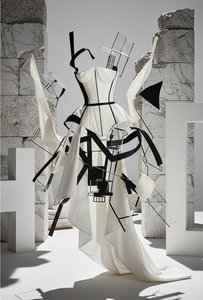
Gianfranco Ferré: Deconstructing Haute Couture – A Legacy of Architectural Form
Explore the revolutionary world of Gianfranco Ferré, 'the architect of fashion.' Discover his architectural approach to haute couture, iconic Dior designs, and lasting influence on luxury style. A deep dive for collectors & enthusiasts.

Cristóbal Balenciaga: Deconstructing Haute Couture's Architectural Legacy
Explore the revolutionary world of Cristóbal Balenciaga, the 'couturier's couturier'. Discover his architectural designs, lasting influence on haute couture, and guide to collecting rare pieces. A connoisseur’s resource.
Draped Narratives: Fashion as Symbol & Subject in Historical Art
Explore the fascinating history of fashion as a symbol of power & status in art! Discover masterpieces from Gainsborough to Tissot and learn how clothing shaped societal narratives. Find museum-quality reproductions at OriginalUniqueArt.
Style Through the Ages: Iconic Artworks That Defined the Evolution of Fashion Design
Explore the breathtaking intersection of fine art and high fashion. Discover how iconic masterpieces from Art Deco to Impressionism have shaped the world of luxury couture and timeless design in this curated visual journey.

The Lens of Luxury: A Visual Journey Through the Evolution and Artistry of Fashion Photography
Embark on a visual journey through the evolution of fashion photography. Discover how masters like Gianfranco Ferré blended geometry, surrealism, and texture to redefine high-fashion art for collectors and connoisseurs of luxury imagery.

