Jan Miel portretas

71 garsiausių Jan Miel paveikių – kiekvienas yra unikalus

Atnaujinta lapkritis 2026 · pagal mūsų populiarumumo koeficientą (paieškos, lankytojai ir užsakymai kiekvienam kūriniui) · 71 Jan Miel darbai mūsų kataloge

Trumpai tariant

Scene from the Life of Tramps (Lazzaroni) (1650) yra viena矚 most žiūrėlių pritraukiančių Jan Miel tapierių; originalas saugomas Ermitažas, Šv. Peterburgas. Po to akmuo patenka į Hunters at Rest (1650) ir Carnival Entertainment (1635). Iš 71 Jan Miel darbų mūsų kataloge šios 71 yra garsiausios – kiekvienas yra unikali originali dai̇lia, pateikta su jos metais, muziejumi ir priežastimi, kodėl ji išlieka per amžius.

1599 – 1663, Beverenas Baroque Daugiausia darbų: Ermitažas

10 geriausių Jan Miel paveikslų: galerijos akimais

1
Scene from the Life of Tramps (Lazzaroni) (1650) aut. Jan Miel

Scene from the Life of Tramps (Lazzaroni)

1650 · Oil On Canvas · Ermitažas, Šv. Peterburgas

A heavy, ochre light settles over the crumbling stone of ancient ruins. Here, the shadows are thick and deep, swallowing the corners of a chaotic street scene. Figures move through the haze of smoke and dust, their bodies caught in a sudden, sharp glare of sun. A man gestures with urgency, his hands carving shapes into the air, while others sit in the dirt, anchored by the weight of their…

2
Hunters at Rest (1650) aut. Jan Miel

Hunters at Rest

1650 · Oil On Canvas · Ermitažas, Šv. Peterburgas

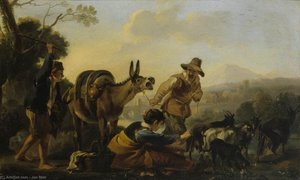
is an oil on canvas painting by the Flemish artist Jan Miel. Created about 1650, the work captures a quiet moment within a pastoral scene. It depicts a hunting party finding respite amidst the landscape. The scene is anchored by the presence of horses and the sturdy silhouette of a fortified tower.

3
Carnival Entertainment (1635) aut. Jan Miel

Carnival Entertainment

1635 · Oil On Canvas · Bavarijos valstybinės paveikslų kolekcijos, Miunchas

In "Carnival Entertainment" by Jan Miel, we find ourselves amidst a dense and dynamic urban scene. The composition is crowded, capturing a street festival where a large group of figures occupies the foreground and middle ground. These individuals—musicians, dancers, and various onlookers—are arranged to create a sense of constant movement. The perspective is a ground-level view, which provides a palpable sense of depth through the careful layering of people and…

4
Sine Cerere et Baccho Friget Venus (1645) aut. Jan Miel

Sine Cerere et Baccho Friget Venus

1645 · Oil

The oil painting titled Sine Cerere et Baccho Friget Venus presents a mythological scene of abundance. Jan Miel rendered this work in 1645. It captures a moment where classical deities gather amidst the symbols of harvest and intoxication. The figures exist within a lush, Baroque-style arrangement of life and plenty.

5
The Veneration of St. Lambert (1648) aut. Jan Miel

The Veneration of St. Lambert

1648 · Oil On Canvas · Fitzwilliam Museum

The air in the grand, classical space feels heavy with the scent of incense and the weight of sudden grief. In the center of this dramatic scene, St. Lambert lies in repose, his body a pale, still anchor amidst a sea of movement. Above him, the celestial realm breaks through the gloom; an angel descends with fluid, sweeping drapery that seems to catch a wind from another world. The light…

6
Soothsayer at an inn (1644) aut. Jan Miel

Soothsayer at an inn

1644 · Oil

The air at the roadside inn feels heavy with the scent of dust and old stone. Under a rugged stone archway, a group of travelers huddles in a moment of quiet tension. A woman in a garment of lapis blue leans toward a man, her presence a cool contrast to the earthy ochre and deep crimson that define the crowd. He is the soothsayer, a figure caught in the flickering…

7
Two hunters resting in a landscape (the standing hunter is a woman in men's clothes) (1639) aut. Jan Miel

Two hunters resting in a landscape (the standing hunter is a woman in men's clothes)

1639 · Oil On Canvas · New York Historical Society, Niujorkas

The scene unfolds within the oil on canvas work titled Two hunters resting in a landscape (the standing hunter is a woman in men's clothes). This composition emerges from the hand of Jan Miel, a painter who brings a sense of immediate life to the quietude of the hunt. The work is dated 1639, capturing a specific moment of stillness amidst the natural world.

8
Three peasants having fun with music and dance (1639) aut. Jan Miel

Three peasants having fun with music and dance

1639 · Oil On Panel · Rafael Valls Limited, City of Westminster

Three peasants having fun with music and dance by Jan Miel presents a lively genre scene centered on three figures engaged in rhythmic activity. The composition is dynamic, utilizing an intimate perspective that places the viewer in close proximity to the subjects. Within this shallow space, the central figure is captured mid-motion, a choice that establishes a sense of rhythmic movement throughout the scene. To the left of the main…

9
The Travelers' Dinner. Peasants Eating Near an Inn or Resting (1650) aut. Jan Miel

The Travelers' Dinner. Peasants Eating Near an Inn or Resting

1650 · Oil On Canvas

The Travelers' Dinner. Peasants Eating Near an Inn or Resting is a genre painting by Jan Miel. This work emerged around 1650, a period when the artist was active within the artistic circles of the seventeenth century. The canvas captures a specific slice of rural life through the eyes of a painter who understood the weight of stone and the texture of coarse cloth.

10
An Italianate Landscape with Peasants Dancing (1650) aut. Jan Miel

An Italianate Landscape with Peasants Dancing

1650 · Oil On Canvas · Nostell Priory, Wakefield

We are looking at An Italianate Landscape with Peasants Dancing, a work by Jan Miel. This piece dates to about 1650, a period when the artist was deeply engaged with the stylistic shifts occurring within the Italian Baroque. It is a significant example of how Miel navigated the transition from the gritty, everyday observations of the Bamboccianti to more expansive, classical compositions.

žinomi Jan Miel paveikslai, nuo 11 iki 71 numerio

11Falcon hunters in front of an inn in a ruin (1650) aut. Jan MielFalcon hunters in front of an inn in a ruin1650 12The beggar (1650) aut. Jan MielThe beggar1650 13Barber and roulette players (1650) aut. Jan MielBarber and roulette players1650 14Military resting with a fortune teller (1650) aut. Jan MielMilitary resting with a fortune teller1650 15Carnival parade in Rome (1660) aut. Jan MielCarnival parade in Rome1660 16Hannibal's dream (1661) aut. Jan MielHannibal's dream1661 17Figures in the vicinity of architectural ruins (1650) aut. Jan MielFigures in the vicinity of architectural ruins1650 18The gathering of the hunters (1660) aut. Jan MielThe gathering of the hunters1660 · Galleria Sabauda 19Boar hunt (1660) aut. Jan MielBoar hunt1660 · Karališkasis Venarijos rūmų kompleksas 20Bear hunt (1659) aut. Jan MielBear hunt1659 · Karališkasis Venarijos rūmų kompleksas 21Diana the Huntress (1658) aut. Jan MielDiana the Huntress1658 · Karališkasis Venarijos rūmų kompleksas 22Adoration of the Shepherds (1650) aut. Jan MielAdoration of the Shepherds1650 · Pushkinio valstybinis dailės muziejus 23Serenade with dancers and musician (1650) aut. Jan MielSerenade with dancers and musician1650 24The Race of the Berber Horses in Rome (1664) aut. Jan MielThe Race of the Berber Horses in Rome1664 25Traveling theatre (1700) aut. Jan MielTraveling theatre1700 26Harbour (1652) aut. Jan MielHarbour1652 · Ermitažas 27La curea - curée - con corte Regale, Carlo Emanuele II e Franesca d (1661) aut. Jan MielLa curea - curée - con corte Regale, Carlo Emanuele II e Franesca d1661 · Karališkasis Venarijos rūmų kompleksas 28Dance in the Trattoria (1647) aut. Jan MielDance in the Trattoria1647 · Vienos dailės akademija 29LE BARBIER NAPOLITAIN aut. Jan MielLE BARBIER NAPOLITAINLiuvro muziejus 30St John the Baptist Preaching in the Desert aut. Jan MielSt John the Baptist Preaching in the DesertNationalmuseum 31The Arch of Constantine in Rome (1648) aut. Jan MielThe Arch of Constantine in Rome1648 · Barber Institute of Fine Arts 32Scene in front of a tavern (1638) aut. Jan MielScene in front of a tavern1638 · Nacionalinis muziejus Varšuvoje 33Figures Feasting at a Fair in Prati, Outside the Walls of Rome, with the Saint Peter's Basilica and Monte Mario Beyond (1650) aut. Jan MielFigures Feasting at a Fair in Prati, Outside the Walls of Rome, with the Saint Peter's Basilica and Monte Mario Beyond1650 34Deer hunt (1661) aut. Jan MielDeer hunt1661 · Karališkasis Venarijos rūmų kompleksas 35The death of the deer (1660) aut. Jan MielThe death of the deer1660 · Karališkasis Venarijos rūmų kompleksas 36The Courtyard of Palazzo Nardini in Rome (1650) aut. Jan MielThe Courtyard of Palazzo Nardini in Rome1650 · Palazzo Barberini 37Hunters at Rest aut. Jan MielHunters at RestMuseo del Prado 38Architectural Landscape (1638) aut. Jan MielArchitectural Landscape1638 · Ermitažas 39Carnival Time in Rome (1653) aut. Jan MielCarnival Time in Rome1653 · Museo del Prado 40The snack aut. Jan MielThe snackMuseo del Prado 41Cottage with inhabitants aut. Jan MielCottage with inhabitantsMuseo del Prado 42The local Barber aut. Jan MielThe local BarberMuseo del Prado 43Popular scene aut. Jan MielPopular sceneMuseo del Prado 44The Flight into Egypt aut. Jan MielThe Flight into EgyptStatens Museum For Kunst 45Soldiers Resting aut. Jan MielSoldiers RestingNationalmuseum 46Peasants Resting aut. Jan MielPeasants RestingNationalmuseum 47Hunters Resting aut. Jan MielHunters RestingNationalmuseum 48Fox hunting aut. Jan MielFox huntingKarališkasis Venarijos rūmų kompleksas 49Jugglers passing – Carnival aut. Jan MielJugglers passing – CarnivalNacionalinis muziejus Varšuvoje 50MARCHAND D'ESCARGOTS aut. Jan MielMARCHAND D'ESCARGOTS 51Road in the Roman Campagna aut. Jan MielRoad in the Roman CampagnaErmitažas 52PAYSAGE AVEC FIGURES aut. Jan MielPAYSAGE AVEC FIGURES 53Maraudeurs italiens Une halte (autre titre) aut. Jan MielMaraudeurs italiens Une halte (autre titre) 54Pastorale avec bergère endormie aut. Jan MielPastorale avec bergère endormie 55The fugitive Erminia asks a fellow countryman for admission aut. Jan MielThe fugitive Erminia asks a fellow countryman for admission 56The Assembly (1660) aut. Jan MielThe Assembly1660 · Château de Versailles 57The vihuela player aut. Jan MielThe vihuela playerMuseo del Prado 58LA DINEE DES VOYAGEURS aut. Jan MielLA DINEE DES VOYAGEURSLiuvro muziejus 59Genre Scene (1650) aut. Jan MielGenre Scene1650 · Ermitažas 60Landscape with herders aut. Jan MielLandscape with herdersMuseo del Prado 61LA HALTE MILITAIRE aut. Jan MielLA HALTE MILITAIRELiuvro muziejus 62Landscape with a Battle between Two Rams (1640) aut. Jan MielLandscape with a Battle between Two Rams1640 · Metropolitano meno muziejus 63Hunters at Rest aut. Jan MielHunters at RestErmitažas 64Shepherds and herd in a mountainous landscape aut. Jan MielShepherds and herd in a mountainous landscapeMusée Calvet 65Carnival in the Piazza Colonna, Rome aut. Jan MielCarnival in the Piazza Colonna, RomeWadsworth Atheneum 66Roman Lime Kiln with Peasants Gambling aut. Jan MielRoman Lime Kiln with Peasants Gambling 67Italian Peasants outside a Tavern aut. Jan MielItalian Peasants outside a TavernRoyal Collection 68Un savetier aut. Jan MielUn savetier 69The bowls players aut. Jan MielThe bowls players 70LE MENDIANT aut. Jan MielLE MENDIANTLiuvro muziejus 71Charlatan aut. Jan MielCharlatanErmitažas

žymios Jan Miel tapiojamos, pagal laikotarpį

Temos, kurios domino Jan Miel

Ketverios temos, dažniausiai pasikrausto originaluose, kiekvienos su savo puikiausiu pavyzdžiu.

Muziejai, kuriuose saugomi Jan Miel originalūs darbai

8 muziejai, kuriuose saugoma daugiausia šioje pusėje esamų paveikslų.

Muzejaus Miestas Jan Miel darbai Šiojo sąrašo paveikslai
Ermitažas, Šv. PeterburgasErmitažas Šv. Peterburgas 8 Scene from the Life of Tramps (Lazzaroni), Hunters at Rest, Harbour
Museo del Prado, MadridasMuseo del Prado Madridas 8 Hunters at Rest, Carnival Time in Rome, The snack
Karališkasis Venarijos rūmų kompleksas, Venaria RealeKarališkasis Venarijos rūmų kompleksas Venaria Reale 7 Boar hunt, Bear hunt, Diana the Huntress
Liuvro muziejus, ParyžiusLiuvro muziejus Paryžius 4 LE BARBIER NAPOLITAIN, LA DINEE DES VOYAGEURS, LA HALTE MILITAIRE
Nationalmuseum, StokholmasNationalmuseum Stokholmas 4 St John the Baptist Preaching in the Desert, Soldiers Resting, Peasants Resting
Nacionalinis muziejus Varšuvoje, VaršuvaNacionalinis muziejus Varšuvoje Varšuva 2 Scene in front of a tavern, Jugglers passing – Carnival
Bavarijos valstybinės paveikslų kolekcijos, MiunchasBavarijos valstybinės paveikslų kolekcijos Miunchas 1 Carnival Entertainment
Fitzwilliam MuseumFitzwilliam Museum 1 The Veneration of St. Lambert

Jan Miel per dešimtmečius: vieniškas originalas kiekvienam

Darbai pagal dešimtmečius

Pasirinkite dešimtmetį, kad pamatytėte jį apibrėžusį originalą.

Jan Miel tapų klausimai galerijai

Koks yra garsiausias Jan Miel kūrinys?Atsakymas

Scene from the Life of Tramps (Lazzaroni) (1650), Ermitažas, Šv. Peterburgas. Toliau seka Hunters at Rest (1650) ir Carnival Entertainment (1635).

Kuriuo amžiaus atσταση Jan Miel sukūrė Scene from the Life of Tramps (Lazzaroni)?Atsakymas

51 metų amžiaus: Scene from the Life of Tramps (Lazzaroni) sukurta 1650 m. Nr. Jan Miel gimė 1599.

Kurios Jan Miel dešimt paveikslų yra garsiausi?Atsakymas

Scene from the Life of Tramps (Lazzaroni), Hunters at Rest, Carnival Entertainment, Sine Cerere et Baccho Friget Venus, The Veneration of St. Lambert, Soothsayer at an inn, Two hunters resting in a landscape (the standing hunter is a woman in men's clothes), Three peasants having fun with music and dance, The Travelers' Dinner. Peasants Eating Near an Inn or Resting ir An Italianate Landscape with Peasants Dancing. Viršuje esančioje reitingo sąraše nurodyta kiekvieno kūrinio metis ir muziejus.

Kiek žinoma Jan Miel darbų?Atsakymas

Mūsų kataloge yra 71 Jan Miel darbų, skirtų laikotarpiui nuo 1635 iki 1661.

Kur galima pamatyti garsiausių Jan Miel originalų?Atsakymas

Daugiausia – Ermitažas (Šv. Peterburgas), Museo del Prado (Madridas) ir Karališkasis Venarijos rūmų kompleksas (Venaria Reale). Viršuje esančiame muziejų sąraše yra visi jie.

Kuriuo laikotarpiu Jan Miel sukūrė savo žymiausias paveikslus?Atsakymas

1650s laikotarpiu: 18 iš 71 šioje pusėje esančių darbų buvo sukurtos tada, iš jų Scene from the Life of Tramps (Lazzaroni).

Kuris iš garsių Jan Miel paveikslų yra pirmasis, o kuris – paskutinis?Atsakymas

Šioje pusėje seniausias darbas yra Carnival Entertainment (1635), o naujausias – Hannibal's dream (1661).

Kokia temos Jan Miel mėgavosi?Atsakymas

People (21), Landscape (15) ir Architecture (14) iš 71 šioje pusėje esamų darbų.

Kuriomis medžiagomis Jan Miel tapė dažniausiai?Atsakymas

Oil On Canvas, iš 71 šios puslapio darbų – 34.

Kelią meno kryžkelę priklauso Jan Miel kūryba?Atsakymas

Baroque, vadovaujantis šios puslapio originalais kūriniais.

Kurius Jan Miel originalius galėčiau pamatyti Ermitažas?Atsakymas

Scene from the Life of Tramps (Lazzaroni), Hunters at Rest ir Harbour: Ermitažas, Šv. Peterburgas kolekcijoje yra 8 šioje pusėje esančių darbų.

Jan Miel: meno kūrinys – autoportretas

Jan Miel: Tiltas tarp olandriško realizmo ir baroko prachtės

Jan Mielis (1599–1663) yra viena esminių siedemnintmečio meno figūrų, įkūnijanti įtraukiantį flamvių tradicijos ir Italijos inovacijų susiliejimą. Gimęs Belgijoje, Beverene – nors dėl jo gimimo vietos kandidatai išlieka Antverpijus ir ’s-Hertogenbosch – Mielio ankstyvoji gyvenimo istorija išlieka vage, todėl biografiniai duomenys yra skrepli. Tačiau mokslinių tyrimų rezultatai atskleidžia nuostabų meninę kelionę, pasižyminčią stilistine evoliucija ir bendradarbiavimu, kuris užtvirtino jo vietą gyvybingoje Romas ir Turino kultūrinėje aplinkoje.

Savo kūrybinį meistriškumą jis tobulino pirmiausia Antverpijoje, kur pasisavino žymių flamvių meistrų, tokių kaip Anthony van Dyck, įtarmį. Nors tiksli jo mokymosi apimtis išlieka neaiški, ši patirtis neabejotinai įsidiegė jame kruopštumą bei tobulą techniką – savybes, kurios tapo būdingomis daugeliui jo vėlesnių kūrinių. Šis klasikinio piešimo ir portretavimo pagrindas suteikė jam būtinus įrankius karjerai, kuri vėliau persiplėtė per regionines sienas.

Romos transformacija ir „Bamboccianti“ dvasia

Mielio atvykimas Romai apie 1636 metus pažymėjo transformacinį momentą jo meninėje trajektorijoje. Jis greitai prisijungė prie Bentvueghels – įtakingos olandų ir flamvių menininkų bendruovės, gyvenančios Amžinojoje mieste. Šioje brolystėje jis priėmė įsimintiną pravardą „bieco“, kuri atspindėjo jo išskirtinį šilkanį žvilgsnį – bruzdą, tapusį sinonimu jo meninei asmenybei. Šis ryšys suteikė jam gilias konexijas platesnei meninei bendruomenei, tuo metu stipriai paveiktai Pieterio van Laerio Bamboccianti stiliaus.

Ši judėjimo kryptis buvo skirta romiečių ir jų aplinkos žemiųjų klasių kasdienio gyvenimo scenų vaizduoti, vengiant idealizuotos Aukštojo Renesanso meno prachtės dėl kažko daug žadusio ir tiesioginio. Mielis visplati šią tendenciją, sukurdamas užburiančius žanrinio meno paveikslus, kurie su neįtikėtinu realizmu ir jautrumu įamžino miesto egzistencijos dvasią. Jo darbuose dažnai atskyrendavo:

  • Gyvus gatvės peizažus, kupinus keliaujančiųjų, prekybininkų ir dirbančiųjų.
  • Meistrišką šviesos naudojimą, atgaivinantį dulkingą, saulės prisigriebtą romiečių siaurų gatvelių atmosferą.
  • Subtilią žmogaus emocijų sąveiką triuškinamose, chaotiškose aplinkose.
  • Kruopštų dėmesį audinio, akmens ir žemės tekstūroms.

Evoliucija link klasicizmo ir dvaro prachtės

Plėgiodamas savo karjerą, Mielio meninė vizija patyrė reikšmingą metamorfozę. Nors jis išliko žanrinio meno meistru, jis pradėjo atsisuktėti nuo „Bamboccianti“ grubaus realizmo link labiau klasicizuojančių istorinių paveikslų. Šis posūkis atspindėjo platesnę Europos meno tendenciją, kur grynoji baroko energija vis dažniau buvo švelninama siekiu į ambiciją, kilnumą ir klasikinę alegoriją.

Ši evoliucija galiausiai nukreipė jį į prestižinius paskyrius, ypač svarbu – tarnauti kaip dvaro menininkui Savojos kunigaikščio Karoliui Emanuelui II. Turinio dvaro tarnyboje Mielio kūryba įgavo oficialesnį ir grandioziškesnį charakterį. Ankstyvųjų romiečių scenų intymumas ustūmėjo didesnio masto ir sudėtingumo kompozicijoms, kurios buvo sukurtos atspindėti karališko globėjo galią ir prestižą. Šis laikotarpis yra jo profesionalinės pasiekimo viršūnė, kurioje jo flamviškas detalumas susitiko su didingomis naratyvomis, reikalingomis Europos aristokratijai.

Istorinė Jan Mielio reikšmė slypi jo gebėjime naviguoti tarp šių skirtingų pasaulių. Jis buvo menininkas, galintis rasti grožį skurdžių romiečių gatvės vaikai kovose ir orumą epinėse senovės pasakose. Užpildęs atotrūkį tarp kruopštaus Šiaurės realizmo ir dramatiško Pietų klasicizmo, Mielis paliko neištrinčiam pėdsaką siedemnintmečio kanonui, užtikrindamas savo palikimą kaip tikro baroko eros kosmopolito.