Ecsalių versija
 Viskas apie Sculptural Objects (Cramer 47)







































 Dėl meno kūrinių ar reprodukcijų, kurių bet kuri pusė yra didesnė nei 105 cm (apie 41 inch), rėmas bus siunčiamas kaip išskaidytas surinkimo rinkinys. Šis metodas užtikrina saugų pristatymą ir apsaugo nuo transportavimo metu galimos žalos.


A Symphony of Form: The Modernist Vision of Henry Moore
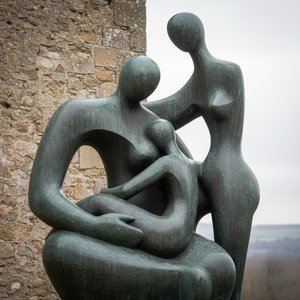
In the vast landscape of twentieth-century modernism, few names resonate with as much tactile power and organic grace as Henry Moore. While the world often recognizes him through his monumental bronze figures that command public squares across the globe, his foray into the two-dimensional realm offers a uniquely intimate window into his creative psyche. Sculptural Objects (Cramer 47) stands as a breathtaking testament to this versatility, a painting that does not merely depict shapes but breathes life into them. In this work, Moore transcends the boundaries of his usual medium, using the canvas to explore the very essence of volume, weight, and spatial relationship that defined his sculptural career.
The composition is a masterful dance of geometry and humanity. At first glance, the viewer is greeted by an array of striking shapes—a large, commanding blue sphere, a vibrant red shoe, and smaller crimson accents that punctuate the scene like rhythmic beats in a visual melody. Yet, these are not isolated relics; they exist within a living ecosystem. Moore populates this abstract landscape with figures who interact with these objects, creating a profound dialogue between the inanimate and the animate. This interplay suggests that art is not a distant, untouchable entity, but something woven into the fabric of human experience, inviting us to touch, move, and inhabit the space alongside the subjects.
Technique, Perspective, and the Modernist Spirit
What makes Sculptural Objects (Cramer 47) so captivating for the discerning collector or interior designer is its sophisticated use of perspective and depth. Moore employs a technique that allows for multiple viewpoints to coexist within a single frame, a hallmark of modernist innovation. This creates a sense of kinetic energy, as if the painting is shifting beneath our gaze. The way light and shadow play across the blue ball and the red forms gives them a palpable three-dimensionality, tricking the eye into perceiving weight where there is only pigment. It is this illusion of mass that makes the piece feel remarkably "sculptural" despite being a flat surface.
The emotional impact of the work lies in its balance of abstraction and familiarity. While the shapes are undeniably modern and abstract, the presence of the human figures anchors the piece in a recognizable reality. There is a sense of wonderment, a childlike curiosity as the people navigate this world of colorful totems. For those looking to adorn a sophisticated interior, this painting offers more than just decoration; it provides a focal point of intellectual depth and aesthetic joy. It brings with it the legacy of the English master—a legacy of finding the eternal in the organic and the monumental in the small.
Owning a high-quality reproduction of such a masterpiece allows one to bring the revolutionary spirit of Moore into the home. Whether placed in a minimalist contemporary gallery or a richly textured traditional study, Sculptural Objects (Cramer 47) serves as a conversation starter, an invitation to contemplate the beautiful tension between the shapes we create and the lives we lead.
Klausimai ir atsakymai
Ar šis kūrinys Sculptural Objects (Cramer 47) yra sukeitintas rankiniu būdu ar atspausdintas?
Ranko darbas: profesionalus pavežėjas rankiniu būdu nukopijuoja Sculptural Objects (Cramer 47) aliejuje ant lino drobės.
Kokią dydį turėčiau pasirinkti darbui Sculptural Objects (Cramer 47)?
Dydviai svyra nuo 25.4 x 39.3 cm (€178) iki 155.4 x 240.1 cm (€1255); šioje pusėje pateiktoje lentelėje nurodyti pagrindiniai etapai ir jų kainos.
Kiek trunka pristatymas?
Pristatymas užtruks nuo 4 iki 5 savaičių, naudojant nemokamą ekspresinį siuntimą visame pasaulyje; šioje pusėje taip pat galite rinktis skubios gamybos variantą. Jūs galite grąžinti prekę per 100 dienų ir gauti visą sumokėtą sumą atgal, nepriklausomai nuo bet kokių sąlygų.
Kokia technika buvo naudojama kūriniui Sculptural Objects (Cramer 47) autoriu Henry Moore?
Painting
 Peržiūrėti realaus dydžio版

 Pasidalinti
 Dalintis
 Išsamiau
 Informacinė l lapelė


 Atsisiųsti
 Panašūs eksponatai
 Rentgeno spindulių nuotrauka
 Automatinė diorama
 问答

 Statistika