Peržiūrėti realaus dydžio版
 Siųsti
 Dalintis
 Išsamiau
 Vadovas

 Atsisiųsti
 Panašūs eksponatai
 Rentgeno spindulių nuotrauka
 Diaporama
 Statistika
Seated Woman, Back View

 Rodyti daugiau
Rankų darbo aliejinės reprodukcijos
Rankiniu būdu tapytas aliejus ant droblio jūsų pageidaujamame dydį ir rėmuose – mūsų menininkų darbas pagal užsakymą. ( Perjungti į spausdinimą Perejti prie skaitmeninių vaizdų)




P118B €10

P118H €10

P118W €10

P438Z €10

P508JH €12

P508YH €12

P805H €10

P805Z €10

P919BZ €10

P919G €10

P919XJ €10

P959ZH €10

P968JZ €12

W106C €8

W218G €10

W218JH €8

W218Y €10

W307PJ €10

W316G €10

W316PJ €8

W316Y €10

W398PJ €8

W4111J €10

W500HY €15

W500JH €15

W692G €12

W849H €8

W940BG €15

W953PJ €8




Pasirinkite iš mūsų nustatytų dydžių, atitinkančių originalaus meno kūrinio proporcijas.

Įveskite jums reikiamą plotį ir aukštį, kad paveikslas atitiktų jūsų rėmą ar sieną. Kadangi šis darbas yra rankinio darbo, siekiant išgauti kitokio formos dydį, paveikslas gali būti šiek tiek didesnis (nuo kraštų bus palikta daugiau erdvės) arba mažesnis – pasirinkite jums patogiausią variantą. Prieš pradedant tapyti, atsiųsime jums skaitmeninį maketą patvirtinimui. Šioje puslapio nuotraukoje matomas vaizdas nėra galutinis rezultatas – jį parodys tik sukurtas maketas.
Gavus užsakymą, OriginalUniqueArt.com komanda susisieks su klientu el. paštu dėl instrukcijų ir pateiks maketo pavyzdį
Pristatymas visame pasaulyje () per 3–4 savaites, o ne įprastai – per 5 savaites. (26 spalis). Kokybė lieka nepakeičiama.

Nemokamas greitasis pristatymas visame pasaulyje

Aukštos kokybės lininis drobė

Pilnas siuntimo draudimas

Muitinės mokesčių grąžinimo garantija

Tikro spalvų atitikimo garantija

100 dienų grąžinimo politika (tik esant įtaigoms)

100% pinigų grąžinimo garantija

Nuolaida dideliems užsakymams
 Stiklo variantas prieinamas tik pasirinkus dydį iki 110 cm

Seated Woman, Back View
Reprodukcijos technika
Reprodukcijos dydis
-


Visų pasirinktų variantų kaina
€ 263
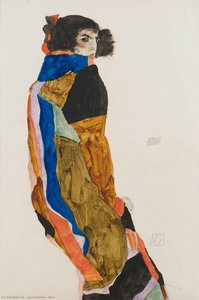
Egon Schiele’s ‘Seated Woman, Back View’: A Study in Fragility and Intensity
Egon Schiele's “Seated Woman, Back View,” painted in 1917, is not merely a portrait; it’s a distilled essence of anxiety, vulnerability, and the unsettling beauty found within human form. Created during a turbulent period in Schiele’s life – a time marked by illness, loss, and an increasingly fraught relationship with his wife, Edith Harms – this watercolor on paper offers a poignant glimpse into the artist's intensely personal world. The work immediately arrests the eye with its muted palette of blues and yellows, colors that simultaneously evoke both melancholy and a subtle, almost feverish energy. Schiele’s signature, delicately placed in the lower right corner, serves as a quiet marker of ownership over this deeply felt image, a testament to his singular vision.
The Composition: A Study in Restrained Movement
What immediately draws attention is the woman's posture – seated, yet profoundly withdrawn. Her back is turned to the viewer, creating an immediate sense of intimacy and exclusion. This deliberate choice forces us to confront her presence not through direct gaze but through suggestion, a technique Schiele frequently employed to amplify emotional impact. The figure’s limbs are drawn upwards, almost as if seeking support or attempting to shield herself from something unseen. The striped shirt and dress, rendered in a restrained palette of blues and yellows, hint at a conventional appearance – a respectable lady – yet the positioning of her lower body, clad in a stark white lace slip and dark stockings, introduces an element of unsettling contrast. This juxtaposition speaks volumes about Schiele’s complex and often contradictory perceptions of femininity, hinting at both admiration and a certain degree of unease.
Expressionism and the Artist's Inner Landscape
Schiele was a pivotal figure in the development of Expressionism, an artistic movement characterized by its subjective emotional expression rather than objective representation. In “Seated Woman, Back View,” this is powerfully evident. The loose brushstrokes, the distorted proportions, and the intense color choices all contribute to a sense of psychological turmoil. The painting isn’t concerned with capturing a realistic likeness; instead, it aims to convey an internal state – a feeling of isolation, perhaps even despair. Schiele's use of watercolor lends itself particularly well to this expressive intent, allowing for delicate gradations of tone and the creation of atmospheric effects that heighten the sense of mood.
Symbolism and the Shadow of Loss
Considering Schiele’s personal life at the time of painting – his father's death from syphilis, the loss of his sister Elvira, and the growing strain within his marriage – it’s not surprising that “Seated Woman, Back View” is imbued with a sense of profound sadness. The woman’s averted gaze can be interpreted as a shield against an unbearable reality. The contrast between her upper body, suggesting respectability, and her lower body, hinting at vulnerability and perhaps even shame, mirrors the complexities of Schiele's own emotional landscape. Some art historians have suggested that the figure represents Edith Harms, reflecting Schiele’s ambivalent feelings towards his wife – a woman he both loved deeply and struggled to fully understand. The painting becomes a visual embodiment of this internal conflict, a poignant meditation on love, loss, and the fragility of human existence.
OriginalUniqueArt offers meticulously crafted hand-painted reproductions of Egon Schiele’s “Seated Woman, Back View,” allowing you to bring this powerfully evocative artwork into your home or office. Each reproduction is created by skilled artists using traditional techniques, ensuring a faithful and stunning representation of Schiele's original vision. Explore our collection today and experience the raw emotion and enduring beauty of this masterpiece.
问答 (or more naturally for a website heading): Klausimai ir atsakymai
Kokio ryškumo spalvos turi „Seated Woman, Back View“, autorius – Egon Šylė?
„Seated Woman, Back View“, autorius – Egon Šylė pasižymi Vivid spalvų intensyvumu.
Atsižvelgiant į spalvas, oje rekomenduojamas „Seated Woman, Back View“, autorius – Egon Šylė?
„Seated Woman, Back View“, autorius – Egon Šylė Pastels spalvos dera su rekomenduojama erdvė: tai Living Room.
Kokio dydžio „Seated Woman, Back View“, autorius – Egon Šylė spausdinimas tinka rekomenduojamai patalpai?
Rekomenduojamas derinimas kūriniui „Seated Woman, Back View“, autorius – Egon Šylė: Medium dydžio spausdinimas, skirtas Living Room.
Autoriaus biografija
Egon Schiele
Austrijos pozicija dviejų pasaulinio karo horizonte buvo labai abejojanti: vienu metu ji buvo šiek tiek iš Šiaurės į rytus, lengvai įsitikinusi veiksmų vyrai. Mažėjęs šalis po 1918 m., beveik visiškai neišplitusi tarptautiniu pasauliu buvo lengvai įvykdinta Hitlerio Reichui 1938 m.; meno srityje tai reiškė kad modernizmo istorija buvo išvykstanti nuo Šiaurės iki pietų, su pagrindiniu dėmesiu į formą. Vokelių šiek tiek pripažino ekspresionizmą kaip svarbų meno srovę; jis buvo vienas iš žymiausius austrių artistas XX amžiaus pradžioje – kartu su Gustavu Klimtu ir Oskar Kokoschka išvykę į Vieną buvo laikomas vienu iš Žyduvo šimtmečio svarbiausių vizualinių menininkų.
Gyvenimas
Egonas Šylė gimė 1890 m. vasario 3 d. Tulne, Austrijoje. Jo tėvas Adolfas Šylė buvo Tulno geležinkelio stoties direktorius ir gimė 1851 m. Vienoje Adolfo Šyly tevai turėjo tris jaunesnes seseris: Elvirą, Melaniją ir Gertrūdą. Elvira mirė vaikyste dėl gimtinių sifiliso. Jo tėvas buvo užsikrėtęs sifiliu įsimėlynėje savo jaunystės metais po vienos jo naujosios žmonos išėjimo iš kambario.
Meno vystymasis
Šylė mokytojo Christian Griepenkerl įtaką išgyveno Vienoje 1907 m. ir G. Klimtas tapo jo svarbiu rėmėju. Šylė paliko akademiją 1906 m., nes jos mokymo metodai buvo labai konservatyvus, ir įkūrė Naują austrių dailės grupę 1909 m. Grupėje vyravo ekspresionistinė estetika, kuri iššūkiant šiuolaikinėms kultūros normas.
Žymūs kūriniai
Šylė buvo vienas iš žymiausius austrių artistas XX amžiaus pradžioje – kartu su Gustavu Klimtu ir Oskar Kokoschka išvykę į Vieną buvo laikomas vienu iš Žyduvo šimtmečio svarbiausių vizualinių menininkų. Šylė buvo ekspresionizmo meno srovės atstovas.
Žymūs veiksniai
Šylė buvo žinomas dėl savo iššūkiantį įžiūrą į pasaulio problemas ir šiuolaikinę estetika, kuri iššūkiant šiuolaikinėms kultūros normas. Šylė buvo ekspresionizmo meno srovės atstovas.

Egon Šylė
1890 - 1918 , Austrija
Trumpa informacija apie kūrėją
- Artistic Movement Or Style: Ekspresionizmas
- Artists Who Influenced This Artist: ['Gustavas Klimtas']
- Date Of Birth: 1890 m.
- Date Of Death: 1918 m.
- Full Name: Egon Schiele
- Nationality: Austras
- Notable Artworks:
- Savęs portretas su fizižalis
- Porą įemčianti
- Žemės apėjimų kraštovaizdis
- Place Of Birth: Tulnas, Austrija
Susiję straipsniai

Watercolor Wonders: 10 Masterpieces That Redefined Art History | OriginalUniqueArt
Journey through 10 legendary watercolor masterpieces by Sargent, Turner & Homer! Explore iconic landscapes, portraits & floral art that redefined history. Find museum-quality reproductions and curated decor ideas at OriginalUniqueArt.com.
Egon Schiele: 25 Šedevrai, Atspindintys Menininko Sielą | OriginalUniqueArt.lt
Atraskite 25 įspūdingiausius Egon Schiele šedevrus! Gilinkitės į ekspresionizmo pasaulį, portretų istorijas ir unikalią menininko spalvų paletę. Aukštos kokybės reprodukcijos interjerui – OriginalUniqueArt.lt

Ephemeral Visions: Exploring the History & Emotional Resonance of Watercolor Painting
Explore the captivating history of watercolor painting, from ancient techniques to modern masters like Kandinsky & Blake. Discover essential artists, collecting tips & the emotional power of this luminous medium. Expert insights for art enthusiasts.

Ephemeral Visions: Exploring the Artistic Legacy & Nuances of Watercolor Painting
Explore the captivating world of watercolor painting! Discover its rich history, essential techniques, influential artists & collecting tips from art experts. A comprehensive guide for enthusiasts.

Ephemeral Visions: Exploring the Artistic Legacy & Contemporary Practice of Watercolor Painting
Explore the captivating world of watercolor painting! Discover its rich history, essential techniques, influential artists & collecting tips. A comprehensive guide for art enthusiasts from OriginalUniqueArt.