Peržiūrėti realaus dydžio版
 Pasidalinti
 Dalintis
 Išsamiau
 Vadovas

 Atsisiųsti
 Panašūs eksponatai
 Rentgeno spindulių nuotrauka
 Automatinė diorama
 问答
问答 Statistika
Nude with Blue Stockings, Bending Forward

- 289.0 x 375.0 cm


 Skaityti daugiau
Giclée / Meno spausdinimas
Muziejų lygio „giclée“ arba drobos spausdinimas: greita gamyba ir lankstios apdailos parinktys. ( Pirkti rankų darbo tapybą Perejti prie skaitmeninių vaizdų)




P118B €10

P118H €10

P118W €10

P438Z €10

P508JH €12

P508YH €12

P805H €10

P805Z €10

P919BZ €10

P919G €10

P919XJ €10

P959ZH €10

P968JZ €12

W106C €8

W218G €10

W218JH €8

W218Y €10

W307PJ €10

W316G €10

W316PJ €8

W316Y €10

W398PJ €8

W4111J €10

W500HY €15

W500JH €15

W692G €12

W849H €8

W940BG €15

W953PJ €8




Pasirinkite iš mūsų nustatytų dydžių, atitinkančių originalaus meno kūrinio proporcijas.

Įveskite jums reikiamą plotį ir aukštį, kad atvaizdas derėtų prie jūsų rėmo ar sienos. Spausdiną galima tik sumažinti, bet nepadidinti virš originalaus paveikslėlio dydžio, todėl keičiant proporcijas, dalis vaizdo prarandama. Prieš spausdinimą atsiųsime jums skaitmeninį maketą patvirtinimui. Šioje puslapio nuotraukoje matomas pjūvis nėra tikslus – jį rodo tik maketas.
Pristatymas visame pasaulyje () per 2 weeks, o ne įprastas 4/5 savaičių laikotarpis. (7 lapkritis)

Nemokamas greitasis pristatymas visame pasaulyje

Aukštos kokybės lininis drobė

Pilnas siuntimo draudimas

Muitinės mokesčių grąžinimo garantija

Tikro spalvų atitikimo garantija

100 dienų grąžinimo politika (tik esant įtaigoms)

100% pinigų grąžinimo garantija

Nuolaida dideliems užsakymams
 Stiklo variantas prieinamas tik pasirinkus dydį iki 110 cm

Nude with Blue Stockings, Bending Forward
Giclée / Meno spausdinimas
Reprodukcijos matmenys
-


Bendroji kaina
€ 72
A Study in Vulnerability: Egon Schiele’s “Nude with Blue Stockings, Bending Forward”
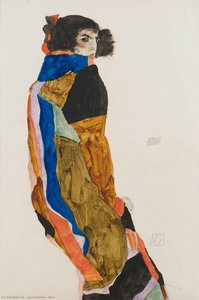
Egon Schiele's "Nude with Blue Stockings, Bending Forward," painted in 1912, is not merely a depiction of the female form; it’s a raw and intensely personal exploration of mortality, fragility, and the unsettling beauty of human vulnerability. This arresting image, now rendered in a substantial 289 x 375 cm hand-painted reproduction, captures a moment suspended between defiance and surrender – a young woman poised on the precipice of something unknown, her posture both yielding and powerfully assertive.
The photograph itself, bearing subtle signs of age—creases that whisper of its history—adds to the work’s poignant character. These imperfections aren't flaws; they are evidence of time, mirroring the themes of decay and remembrance so central to Schiele’s oeuvre. The inclusion of two indistinct figures in the background hints at a private world, perhaps suggesting the woman’s isolation or the presence of observers judging her exposed state. This deliberate ambiguity invites viewers to project their own interpretations onto the scene, deepening its emotional resonance.
The Expressionist Palette and Anatomical Precision
Schiele was a pivotal figure in the Vienna Secession movement, a group that rejected academic art traditions in favor of subjective expression and bold experimentation. “Nude with Blue Stockings” exemplifies this approach through its use of color – a deliberately muted palette dominated by cool blues and browns, punctuated by the striking vibrancy of the blue stockings themselves. These stockings aren’t simply decorative; they are a deliberate focal point, drawing attention to the curves and contours of her body while simultaneously hinting at a vulnerability—a fleeting moment of pleasure or exposure.
Technically, Schiele employed a rapid, almost frantic brushstroke – a hallmark of his style. Lines are broken and fragmented, creating a sense of movement and instability within the figure. He meticulously studied human anatomy, evident in the precise rendering of muscles and bones beneath the skin, yet he never shied away from distorting or exaggerating forms to convey emotional intensity. This masterful blend of anatomical accuracy and expressive distortion is what gives Schiele’s work its unique power.
A Reflection of Personal Trauma
To understand “Nude with Blue Stockings,” it's crucial to consider the context of Schiele’s life. Born in 1890, he endured a childhood marked by illness and loss – his father succumbed to syphilis when he was just fourteen, followed later by the death of his sister Elvira. These experiences profoundly shaped his artistic vision, fueling an obsession with themes of mortality, disease, and the ephemeral nature of beauty. The woman in this painting embodies a certain fragility, a sense of being caught between life and death – a direct reflection of Schiele’s own anxieties.
The pose itself—bending forward, almost collapsing inward—suggests a profound emotional state. It's not a sensual pose; rather, it conveys a feeling of introspection, perhaps even despair. The blue stockings, often associated with both allure and vulnerability, further amplify this sense of unease. They are a visual shorthand for the precariousness of female identity in a society that frequently objectified women’s bodies.
Symbolism and Emotional Impact
Beyond its immediate visual impact, “Nude with Blue Stockings” is rich in symbolism. The bending posture can be interpreted as a gesture of surrender to fate or an acknowledgment of one's own mortality. The stark black and white photograph (and by extension, the hand-painted reproduction) emphasizes the subject’s vulnerability against a potentially indifferent world. The painting doesn’t offer easy answers; instead, it compels viewers to confront uncomfortable truths about human existence.
A hand-painted reproduction of this powerful work offers an unparalleled opportunity to experience Schiele's vision in exquisite detail. The nuanced brushwork, the subtle shifts in tone, and the raw emotional intensity are all faithfully captured, transforming this haunting image into a captivating centerpiece for any discerning collection or interior space. It’s more than just a painting; it’s a window into the soul of a tormented genius.
Klausimai ir atsakymai
Kodėl „Nude with Blue Stockings, Bending Forward“ autoriškos teisės statusas yra toks, koks yra?
Autorinės teisės statusas kūriniui „Nude with Blue Stockings, Bending Forward“ – yra viešosios erdvės dalis – jo autorinė teisė pasibaigusi – nustatomas remiantis to, kad menininkas mirė 1918 m.
Kokią nuotaiką į erdvę atneštų „Nude with Blue Stockings, Bending Forward“?
Dramatic atmosfera kūrybinėje veikale „Nude with Blue Stockings, Bending Forward“ – Egon Šylė dera su rekomenduojama erdvė: tai Living Room.
Kada ir kokiais medžiagomis buvo sukurta „Nude with Blue Stockings, Bending Forward“?
„Nude with Blue Stockings, Bending Forward“ sukurtas 1912 m., naudojant Acrylic On Canvas.
Autoriaus biografija
Egon Schiele
Austrijos pozicija dviejų pasaulinio karo horizonte buvo labai abejojanti: vienu metu ji buvo šiek tiek iš Šiaurės į rytus, lengvai įsitikinusi veiksmų vyrai. Mažėjęs šalis po 1918 m., beveik visiškai neišplitusi tarptautiniu pasauliu buvo lengvai įvykdinta Hitlerio Reichui 1938 m.; meno srityje tai reiškė kad modernizmo istorija buvo išvykstanti nuo Šiaurės iki pietų, su pagrindiniu dėmesiu į formą. Vokelių šiek tiek pripažino ekspresionizmą kaip svarbų meno srovę; jis buvo vienas iš žymiausius austrių artistas XX amžiaus pradžioje – kartu su Gustavu Klimtu ir Oskar Kokoschka išvykę į Vieną buvo laikomas vienu iš Žyduvo šimtmečio svarbiausių vizualinių menininkų.
Gyvenimas
Egonas Šylė gimė 1890 m. vasario 3 d. Tulne, Austrijoje. Jo tėvas Adolfas Šylė buvo Tulno geležinkelio stoties direktorius ir gimė 1851 m. Vienoje Adolfo Šyly tevai turėjo tris jaunesnes seseris: Elvirą, Melaniją ir Gertrūdą. Elvira mirė vaikyste dėl gimtinių sifiliso. Jo tėvas buvo užsikrėtęs sifiliu įsimėlynėje savo jaunystės metais po vienos jo naujosios žmonos išėjimo iš kambario.
Meno vystymasis
Šylė mokytojo Christian Griepenkerl įtaką išgyveno Vienoje 1907 m. ir G. Klimtas tapo jo svarbiu rėmėju. Šylė paliko akademiją 1906 m., nes jos mokymo metodai buvo labai konservatyvus, ir įkūrė Naują austrių dailės grupę 1909 m. Grupėje vyravo ekspresionistinė estetika, kuri iššūkiant šiuolaikinėms kultūros normas.
Žymūs kūriniai
Šylė buvo vienas iš žymiausius austrių artistas XX amžiaus pradžioje – kartu su Gustavu Klimtu ir Oskar Kokoschka išvykę į Vieną buvo laikomas vienu iš Žyduvo šimtmečio svarbiausių vizualinių menininkų. Šylė buvo ekspresionizmo meno srovės atstovas.
Žymūs veiksniai
Šylė buvo žinomas dėl savo iššūkiantį įžiūrą į pasaulio problemas ir šiuolaikinę estetika, kuri iššūkiant šiuolaikinėms kultūros normas. Šylė buvo ekspresionizmo meno srovės atstovas.

Egon Šylė
1890 - 1918 , Austrija
Trumpa informacija
- Artistic Movement Or Style: Ekspresionizmas
- Artists Who Influenced This Artist: ['Gustavas Klimtas']
- Date Of Birth: 1890 m.
- Date Of Death: 1918 m.
- Full Name: Egon Schiele
- Nationality: Austras
- Notable Artworks:
- Savęs portretas su fizižalis
- Porą įemčianti
- Žemės apėjimų kraštovaizdis
- Place Of Birth: Tulnas, Austrija
Susiję straipsniai
Egon Schiele: 25 Šedevrai, Atspindintys Menininko Sielą | OriginalUniqueArt.lt
Atraskite 25 įspūdingiausius Egon Schiele šedevrus! Gilinkitės į ekspresionizmo pasaulį, portretų istorijas ir unikalią menininko spalvų paletę. Aukštos kokybės reprodukcijos interjerui – OriginalUniqueArt.lt
Egon Schiele: Expressionism, Anxiety & the Modern Condition – A Comprehensive Exploration
Explore the emotionally charged world of Egon Schiele (1890-1918). Discover his Expressionist masterpieces, psychological themes, and lasting impact on modern art. A comprehensive guide for collectors & enthusiasts.

Slate Blue Masterpieces: 10 Iconic Paintings & Timeless Home Decor Ideas
Immerse yourself in the captivating world of slate blue! Explore 10 iconic paintings by Monet, Van Gogh & Renoir. Discover their stories, techniques & find museum-quality art reproductions for your home at .
The Allure of Azure: Exploring the Symbolic & Aesthetic Depths of Blue in Art History
Explore the rich history of blue in art! Discover its symbolism, from ancient pigments to modern masterpieces by Kandinsky & Seurat. Uncover the psychological impact and cultural meanings behind this captivating hue.
Expressionist Painting: 10 Masterpieces That Defined a Movement | OriginalUniqueArt
Explore 10 Expressionist paintings that revolutionized art! Discover Munch, Kirchner & Kandinsky's iconic works. Find museum-quality reproductions and vibrant canvas prints to elevate your home decor on OriginalUniqueArt.com.