Peržiūrėti realybėje
 Pasidalinti
 Dalintis
 Išsamiau

 Atsisiųsti
 Panašūs eksponatai
 Rentgeno nuotrauka
 Automatinė diorama
 Statistika
Girl in a Blue Apron


 Skaityti daugiau
Rankų darbo aliejinės reprodukcijos
Rankiniu būdu tapytas aliejus ant droblio jūsų pageidaujamame dydį ir rėmuose – mūsų menininkų darbas pagal užsakymą. ( Perejti prie spausdinimo Perejti prie skaitmeninio vaizdo)




P118B $10

P118H $10

P118W $10

P438Z $10

P508JH $12

P508YH $12

P805H $10

P805Z $10

P919BZ $10

P919G $10

P919XJ $10

P959ZH $10

P968JZ $12

W106C $8

W218G $10

W218JH $8

W218Y $10

W307PJ $10

W316G $10

W316PJ $8

W316Y $10

W398PJ $8

W4111J $10

W500HY $15

W500JH $15

W692G $12

W849H $8

W940BG $15

W953PJ $8




Pasirinkite iš mūsų nustatytų dydžių, atitinkančių originalaus meno kūrinio proporcijas.

Galite įvesti savo matmenis, kad jie atitiktų konkretų rėmą ar erdvę. Jei pasirinktas dydis neatitinka originalaus paveikslėlio proporcijų, mes arba apkropsime meno kūrinį, arba papildysime tapybą rankomis dažytい elementais. Prieš pradėdami gamybą, jūsų patvirtinimui atsiųsime skaitmeninį maketą.
Atkreipkite dėmesį, kad ekrane rodomas vaizdas neatspindi tikrojo apkarpymo ar papildymo. Tik maketas tiksliai parodys galutinę kompoziciją.
Nors galima rinktis ir individualius dydžius, rekomenduojame pasirinkti matmenis iš nustatytos sąrašo, kad būtų išlaikytos originalios proporcijos.
Gavus užsakymą, OriginalUniqueArt.com komanda susisieks su klientu el. paštu dėl instrukcijų ir pateiks maketo pavyzdį.
Pristatymas visame pasaulyje () per 3–4 savaites, o ne įprastai – per 5 savaites. (13 rugsėjis). Kokybė lieka nepakeičiama.

Nemokamas greitasis pristatymas visame pasaulyje

Aukštos kokybės lininis drobė

Pilnas siuntimo draudimas

Muitinės mokesčių grąžinimo garantija

Tikro spalvų atitikimo garantija

100 dienų grąžinimo politika (tik esant įtaigoms)

100% pinigų grąžinimo garantija

Nuolaida už kelias reprodukcijas
 Stiklo variantas prieinamas tik pasirinkus dydį iki 110 cm

Girl in a Blue Apron
Reprodukcijos technika
Reprodukcijos matmenys
-


Galutinė kaina
$ 300
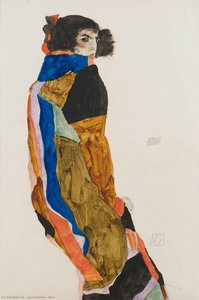
Egon Schiele’s ‘Girl in a Blue Apron’: A Study in Fragility and Intensity
Egon Schiele's “Girl in a Blue Apron,” painted in 1912, is not merely a portrait; it’s a distilled essence of anxiety, vulnerability, and the unsettling beauty inherent in human existence. Created during a period of intense personal turmoil for the artist – marked by illness, loss, and the burgeoning horrors of World War I – this watercolor offers a poignant glimpse into Schiele's uniquely expressive vision. The work immediately draws the eye with its muted palette dominated by blues and browns, colors often associated with melancholy and introspection. Yet, within this somber foundation lies an undeniable vibrancy, particularly in the girl’s gaze—a direct, almost challenging stare that pierces through the painting’s quietude.
Schiele's signature style is powerfully evident here. His elongated figures, rendered with rapid, gestural brushstrokes, convey a sense of restless energy and emotional instability. The figure isn’t idealized; she possesses a raw, unvarnished quality that reflects the artist’s own preoccupation with mortality and the imperfections of the human form. Notice how he utilizes broken lines and fragmented planes to create an atmosphere of unease—a feeling that something is about to break or shift. This technique, characteristic of Expressionism, prioritizes emotional impact over realistic representation.
The Symbolism of Blue and Apron
The choice of blue as the dominant color is particularly significant. In Schiele’s oeuvre, blue frequently represents sadness, introspection, and a sense of impending doom. It's not a cheerful or comforting hue; rather, it underscores the girl’s vulnerability and perhaps even her awareness of her own fragility. The apron itself—a simple garment traditionally associated with domesticity and service—takes on a new layer of meaning within this context. It suggests a confinement, a restriction upon her freedom, yet simultaneously offers a degree of protection, mirroring the complex interplay of safety and exposure that defines the painting’s emotional core.
The object she holds in her hand is deliberately obscured, adding to the sense of mystery and inviting speculation. It could be anything—a flower, a piece of fruit, or simply an empty gesture—but its ambiguity serves as a focal point for the viewer's attention, forcing us to confront the girl’s unspoken thoughts and feelings. The positioning of her hand, slightly outstretched, suggests a yearning, a reaching out towards something just beyond her grasp.
A Window into Schiele’s World
Painted in 1912, “Girl in a Blue Apron” reflects the turbulent atmosphere of Vienna at the turn of the century. The city was grappling with social and political upheaval, and artists like Schiele were pushing against established conventions, exploring themes of sexuality, death, and psychological distress. His work is deeply rooted in his personal experiences—the early deaths of his sister and father, his own struggles with illness—and these traumas are powerfully channeled through his art.
Considering Schiele’s biography, the painting can be interpreted as a meditation on loss and the precariousness of life. The girl's intense gaze seems to hold both sorrow and defiance, suggesting a resilience born from confronting difficult realities. It is a testament to Schiele’s ability to capture not just outward appearances but also the profound emotional landscape beneath.
Reproductions & Artistic Decoration
OriginalUniqueArt offers meticulously crafted hand-painted reproductions of “Girl in a Blue Apron,” allowing you to bring this emotionally resonant artwork into your home or office. Our artists replicate Schiele’s distinctive style and technique with exceptional fidelity, capturing the painting's subtle nuances and atmospheric depth. These reproductions are not merely copies; they are artistic interpretations that honor the original while offering a unique and captivating addition to any collection. Consider framing this piece within a minimalist setting to allow its emotional intensity to truly shine, or incorporating elements of blue and brown into your interior design scheme to evoke Schiele’s evocative world.
Autoriaus biografija
Egon Schiele
Austrijos pozicija dviejų pasaulinio karo horizonte buvo labai abejojanti: vienu metu ji buvo šiek tiek iš Šiaurės į rytus, lengvai įsitikinusi veiksmų vyrai. Mažėjęs šalis po 1918 m., beveik visiškai neišplitusi tarptautiniu pasauliu buvo lengvai įvykdinta Hitlerio Reichui 1938 m.; meno srityje tai reiškė kad modernizmo istorija buvo išvykstanti nuo Šiaurės iki pietų, su pagrindiniu dėmesiu į formą. Vokelių šiek tiek pripažino ekspresionizmą kaip svarbų meno srovę; jis buvo vienas iš žymiausius austrių artistas XX amžiaus pradžioje – kartu su Gustavu Klimtu ir Oskar Kokoschka išvykę į Vieną buvo laikomas vienu iš Žyduvo šimtmečio svarbiausių vizualinių menininkų.
Gyvenimas
Egonas Šylė gimė 1890 m. vasario 3 d. Tulne, Austrijoje. Jo tėvas Adolfas Šylė buvo Tulno geležinkelio stoties direktorius ir gimė 1851 m. Vienoje Adolfo Šyly tevai turėjo tris jaunesnes seseris: Elvirą, Melaniją ir Gertrūdą. Elvira mirė vaikyste dėl gimtinių sifiliso. Jo tėvas buvo užsikrėtęs sifiliu įsimėlynėje savo jaunystės metais po vienos jo naujosios žmonos išėjimo iš kambario.
Meno vystymasis
Šylė mokytojo Christian Griepenkerl įtaką išgyveno Vienoje 1907 m. ir G. Klimtas tapo jo svarbiu rėmėju. Šylė paliko akademiją 1906 m., nes jos mokymo metodai buvo labai konservatyvus, ir įkūrė Naują austrių dailės grupę 1909 m. Grupėje vyravo ekspresionistinė estetika, kuri iššūkiant šiuolaikinėms kultūros normas.
Žymūs kūriniai
Šylė buvo vienas iš žymiausius austrių artistas XX amžiaus pradžioje – kartu su Gustavu Klimtu ir Oskar Kokoschka išvykę į Vieną buvo laikomas vienu iš Žyduvo šimtmečio svarbiausių vizualinių menininkų. Šylė buvo ekspresionizmo meno srovės atstovas.
Žymūs veiksniai
Šylė buvo žinomas dėl savo iššūkiantį įžiūrą į pasaulio problemas ir šiuolaikinę estetika, kuri iššūkiant šiuolaikinėms kultūros normas. Šylė buvo ekspresionizmo meno srovės atstovas.

Egon Šylė
1890 - 1918 , Austrija
Trumpa informacija
- Artistic Movement Or Style: Ekspresionizmas
- Artists Who Influenced This Artist: ['Gustavas Klimtas']
- Date Of Birth: 1890 m.
- Date Of Death: 1918 m.
- Full Name: Egon Schiele
- Nationality: Austras
- Notable Artworks:
- Savęs portretas su fizižalis
- Porą įemčianti
- Žemės apėjimų kraštovaizdis
- Place Of Birth: Tulnas, Austrija
Susiję straipsniai

Ephemeral Visions: Exploring the Artistic Legacy & Contemporary Practice of Watercolor Painting
Explore the captivating world of watercolor painting! Discover its rich history, essential techniques, influential artists & collecting tips. A comprehensive guide for art enthusiasts from OriginalUniqueArt.

Ephemeral Visions: Exploring the History & Emotional Resonance of Watercolor Painting
Explore the captivating history of watercolor painting, from ancient techniques to modern masters like Kandinsky & Blake. Discover essential artists, collecting tips & the emotional power of this luminous medium. Expert insights for art enthusiasts.

Watercolor Wonders: 10 Masterpieces That Redefined Art History | OriginalUniqueArt
Journey through 10 legendary watercolor masterpieces by Sargent, Turner & Homer! Explore iconic landscapes, portraits & floral art that redefined history. Find museum-quality reproductions and curated decor ideas at OriginalUniqueArt.com.
Egon Schiele: 25 Šedevrai, Atspindintys Menininko Sielą | OriginalUniqueArt.lt
Atraskite 25 įspūdingiausius Egon Schiele šedevrus! Gilinkitės į ekspresionizmo pasaulį, portretų istorijas ir unikalią menininko spalvų paletę. Aukštos kokybės reprodukcijos interjerui – OriginalUniqueArt.lt

Slate Blue Masterpieces: 10 Iconic Paintings & Timeless Home Decor Ideas
Immerse yourself in the captivating world of slate blue! Explore 10 iconic paintings by Monet, Van Gogh & Renoir. Discover their stories, techniques & find museum-quality art reproductions for your home at .