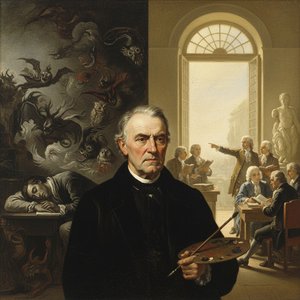
The Visionary of the Working Class
Born in the mid-19th century, likely amidst the vibrant streets of Madrid or the quiet landscapes of Cella, Vicente Cutanda y Toraya emerged as a profound voice in Spanish art. His early life was marked by a delicate struggle; a nervous disorder during his childhood threatened his very ability to perceive the world through sight. Yet, this fragility did not stifle his creative spirit. Though he initially pursued the structured discipline of architecture, the call of the canvas proved irresistible. He abandoned the drafting table for the studios of the Real Academia de Bellas Artes de San Fernando, where the shadows and light of masters like Eduardo Rosales began to shape his burgeoning aesthetic.
Cutanda’s journey was one of constant evolution, moving from the rigid traditions of academic painting toward a deeply empathetic form of social realism. While his early commissions in Toledo focused on the sacred and the divine through religious subjects, a transformative shift occurred as he encountered the raw, unvarnished realities of human existence. Influenced by his travels to Italy and the profound social shifts occurring in Europe, he began to turn his gaze away from the heavens and toward the earth, finding his true muse in the grit and dignity of the common laborer.
A Canvas of Social Truth
The heart of Cutanda’s oeuvre lies in its ability to elevate the mundane to the monumental. He possessed a unique talent for capturing the rhythmic toil of the working classes, particularly drawing inspiration from the rugged landscapes and resilient people of the Basque country, specifically Biscay. His brushwork did not merely depict scenes; it breathed life into the struggle of the proletariat. This transition was solidified by his friendship with Ricardo Arredondo Calmache, which steered him away from historical romanticism and toward a more grounded, sociological approach to art.
His mastery was recognized on the grandest stages of his time. The accolades he received served as milestones in his career:
- The National Exhibition of Fine Arts (1887): Where his poignant work, "At the Feet of the Savior," earned him a Third Class prize, showcasing his early command of religious sentiment.
- The Triumph of Realism (1892): A pivotal moment when he was awarded a First Class prize for "A Workers' Strike in Vizcaya," a masterpiece that signaled his arrival as a premier chronicler of social upheaval and labor movements.
Legacy of the Empathetic Eye
Beyond the gallery walls, Cutanda was a dedicated educator, sharing his profound understanding of form and composition with future generations. His roles as a Professor of Drawing in Toledo, Segovia, and Logroño allowed him to instill a sense of technical rigor paired with social consciousness in his students. He lived through an era of immense transition, and his art remains a vital historical document of the late 19th and early 20th centuries—a period where the industrial revolution and new social philosophies, such as those found in the Papal encyclical Rerum novarum, were reshaping the very fabric of society.
When he passed away in Toledo in 1925, he left behind a legacy that transcends mere technique. Through his watercolors and oils, Vicente Cutanda y Toraya ensured that the faces of the forgotten—the strikers, the farmers, and the craftsmen—would remain etched in the annals of art history. His work stands as a testament to the power of the artist to act as both a witness and a defender of human dignity.
Q&A
Vicente Cutanda Toraya의 모든 작품을 어디에서 볼 수 있나요?
이 사이트에 등록된 Vicente Cutanda Toraya의 모든 작품은 작가의 전체 작품 보기 페이지에서 만나보실 수 있습니다.
Vicente Cutanda Toraya의 출생지와 출생 연도는 어떻게 되나요?
Vicente Cutanda Toraya은(는) 1850년 Madrid에서 태어났습니다.
Vicente Cutanda Toraya의 다른 이름이나 별칭에는 무엇이 있나요?
Vicente Cutanda Toraya은(는) Vicente Cutanda, Vicente Cutanda y Toraya, ビセンテ・クタンダ, Висенте Кутанда(으)로도 알려져 있습니다.
Vicente Cutanda Toraya의 작품을 매체별로 찾아볼 수 있나요?
Vicente Cutanda Toraya의 작품은 작가 페이지인 모든 매체별에서 매체별로 둘러보실 수 있습니다.