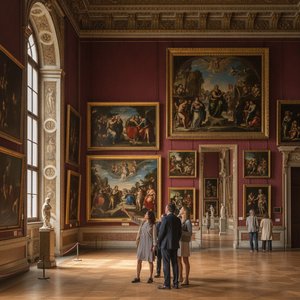
The Soul of Venice: The Life and Legacy of Girolamo Forabosco
In the heart of the seventeenth century, as the golden light of the Venetian lagoon cast long, dramatic shadows across the marble palaces of Italy, Girolamo Forabosco emerged as a master of the human spirit. Born in Venice around 1605, Forabosco was a child of the Baroque era, a period defined by movement, tension, and an unyielding pursuit of emotional truth. His life was deeply intertwined with the prestigious Fraglia dei Pittori, the venerable Venetian guild of artists, where his presence was officially recorded between 1634 and 1639. This formal affiliation was more than a mere professional milestone; it was his immersion into a lineage of greatness, placing him at the epicenter of one of Europe’s most vibrant artistic movements.
The development of Forabosco’s hand was shaped by the heavyweights of his age. As a pupil of Alessandro Varotari, known as il Padovanino, he learned to navigate the complexities of form and grace. However, it was the atmospheric influence of artists like Bernardo Strozzi that truly breathed life into his canvases. From these masters, Forab려는bosco inherited a fascination with the interplay of light and shadow—the chiaroscuro technique that would become his signature. His work does not merely depict faces; it captures the very breath of his subjects, utilizing a dramatic lighting style reminiscent of Caravaggio to pull the viewer into a private, psychological moment.
A Mastery of Realism and Emotion
To gaze upon a Forabosco portrait is to encounter a profound sense of presence. While many of his contemporaries sought to idealize their subjects, elevating them to a state of untouchable perfection, Forabosco found beauty in the authentic. He embraced the nuances of human anatomy—the subtle furrow of a brow, the weary tilt of a head, or the soft curve of a lip—to convey a deep-seated psychological realism. His canvases are not static images but living narratives, where every gesture serves to reveal the inner character of the Venetian nobility and commoners alike.
His technical prowess is perhaps most evident in his ability to manipulate texture and light to create depth. In works such as David with the Head of Goliath, one can feel the visceral intensity of the scene, where the stark contrast between darkness and illumination heightens the drama of the biblical triumph. Similarly, his portraits of women, such as the Portrait of a Courtesan or the Portrait of Maria Farnese, showcase an exquisite attention to detail, from the heavy sheen of silk to the delicate translucency of skin. Through these meticulous renderings, he achieved a sense of tactile reality that made his subjects feel palpably alive.
Historical Significance and Artistic Lineage
The influence of Girolamo Forabosco extended far beyond his own lifetime, as he played a vital role in nurturing the next generation of Venetian talent. His studio became a crucible for emerging artists, including Gregorio Lazzarini and Pietro Bellotto, ensuring that his commitment to emotive realism would persist through the decades. Though his later years saw him active in Padua, where he eventually passed away in 1679, his artistic identity remained forever anchored in the Venetian tradition of elegance and drama.
Today, Forabosco is remembered not just as a painter of faces, but as a chronicler of an era. His work serves as a window into the social fabric of Baroque Venice, capturing the dignity, the sorrow, and the opulence of a civilization at its zenith. His legacy resides in the way he bridged the gap between the physical world and the emotional landscape, leaving behind a body of work that continues to resonate with anyone moved by the profound beauty of the human condition.
Q&A
Gerolamo Forabosco의 출생지와 출생 연도는 어떻게 되나요?
Gerolamo Forabosco은(는) 1605년 Venice에서 태어났습니다.
Gerolamo Forabosco 작가의 작품에서 가장 자주 나타나는 색상은 무엇인가요?
이 사이트에 등록된 작품 전반에 나타나는 Gerolamo Forabosco의 색채 활용은 작가의 팔레트 지놈 페이지에서 자세히 살펴보실 수 있습니다.
Gerolamo Forabosco의 작품을 분위기별로 찾아볼 수 있나요?
Gerolamo Forabosco의 무드 룸에서는 작가의 작품들을 분위기별로 만나보실 수 있습니다.