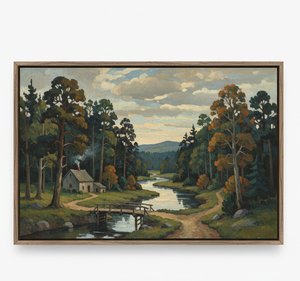
The Quiet Observer of the Dutch Landscape
George Andries Roth lived a life tied closely to the soil and the shifting light of the Netherlands. Born in Amsterdam, his eyes were trained early on the textures of the natural world. He studied under George Pieter Westenberg, learning to translate the physical presence of the earth onto canvas. His hands were those of a painter and a printmaker, working through the decades as he moved between the streets of Amsterdam and the quieter reaches of Opheusden, Tiel, and beyond. He was a man of the academy, a member of the Koninklijke Akademie van Beeldende Kunsten, yet his work often felt more grounded in the immediate, tangible reality of the woods and the riverbanks.
His brushwork followed the rhythms of the seasons and the specific geometry of the terrain. He did not seek to distort the world but to record it with a clear, steady hand. In his landscapes, one finds a meticulous attention to how light settles upon a surface, whether it is the bark of an old tree or the movement of a forest floor. He spent time traveling through Germany in the mid-1830s, a period that likely deepened his understanding of how different light and topography might be captured through paint.
The Structure of Nature
The works left behind by Roth reveal a specific way of seeing. He looked at the forest not as a chaotic mass, but as a series of organized, distinct elements. His compositions often relied on a careful balance between the massive and the minute. In his later years, his paintings achieved a clarity that allowed the viewer to trace the path of the light as it moved through the trees.
Several details define his approach to the canvas:
- A focus on wooded landscapes, cityscapes, and river views.
- The use of light to highlight specific focal points, such as a single tree or a group of workers.
- A sense of scale that places human activity within a much larger, more enduring natural setting.
- A detailed rendering of the ground, the sky, and the foliage.
A Legacy in Detail
By the time of his death in Amsterdam, Roth had established a body of work that captured the quiet dignity of the Dutch landscape. His paintings, such as those found in the Rijksmuseum, show a man who understood the weight of a tree and the smallness of a person working within its shadow. He taught others, including Elias Pieter van Bommel and Cornelis Petrus van ’t Hoen, passing on his method of observation. His paintings remain as records of a specific time and place, held in collections from Amsterdam to Cleveland, preserved for their clarity and their steady, unhurried gaze.
Q&A
키워드로 George Andries Roth의 작품을 찾아볼 수 있나요?
특정 주제의 George Andries Roth 작품을 찾으려면 키워드별로 작품이 분류된 작가의 키워드별 탐색 페이지를 이용해 보세요.
George Andries Roth의 작품을 색상별로 찾아볼 수 있나요?
George Andries Roth의 컬러 인덱스에서는 작가의 작품들을 색상별로 모아 보실 수 있습니다.
George Andries Roth의 작품을 팔레트별로 모아둔 곳은 어디인가요?
특정 색상 팔레트의 George Andries Roth 작품을 찾으시려면, 작가의 컬러 팔레트별로 보기 페이지를 이용해 보세요.
George Andries Roth 작가의 작품을 감상할 수 있는 3D 가상 투어가 있나요?
George Andries Roth의 작품은 작가의 3D 갤러리 페이지 내 3D 갤러리에서 감상하실 수 있습니다.