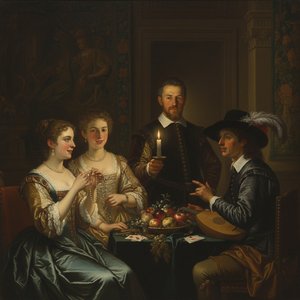
The Romantic Vision of Elias Pieter van Bommel
Born in the vibrant heart of Amsterdam in 1819, Elias Pieter van Bommel emerged as a significant voice within the Dutch Romantic movement. His artistic journey began under the prestigious tutelage of the Rijksacademie Amsterdam, where he refined his technical prowess under the watchful eye of the landscape painter Andries Roth. In these formative years, Van Bommel’s brush was primarily guided by the serene and sweeping vistas of nature. Influenced heavily by Roth, his early repertoire focused on the quiet majesty of landscapes, capturing the tranquil essence of riverbanks and the rhythmic ebb and flow of coastal scenes at places like Scheveningen and Vlissingen.
As his career matured, a profound stylistic evolution took hold, transforming him from a painter of solitary nature into a master of the bustling urban stage. By the 1850s, Van Bommel had pivoted toward finely elaborated cityscapes that breathed with an unprecedented sense of vitality and monumentality. He possessed a rare ability to capture the very soul of a city, populating his canvases with a palpable sense of movement and life. These works were not merely architectural records but lived-in chronicles of 19th-century society, where the grandeur of historic buildings met the energetic pulse of everyday commerce and human interaction.
A Journey Through Europe's Grandeur
Van Bommel’s artistic perspective was deeply enriched by his extensive travels, which allowed him to weave a tapestry of European culture into his work. He did not merely observe from afar; he immersed himself in the light and atmosphere of diverse landscapes. His excursions took him through the historic corridors of Belgium, Germany, France, Hungary, and Italy, each region leaving an indelible mark on his palette and composition. This nomadic spirit allowed him to bring a cosmopolitan breadth to his Dutch roots, blending the meticulous detail characteristic of his training with the romantic splendor found in the great art capitals of Europe.
His exhibition history reflects a steady presence within the prestigious art circles of the Netherlands. Between 1833 and 1859, his works graced the galleries of Amsterdam, The Hague, Groningen, and Leeuwerden, establishing him as a respected figure in the Dutch art scene. His ability to document both the historical weight of architecture and the fleeting moments of street life provided a dual value to his work—serving as both aesthetic triumphs and vital historical documents of a changing era.
Legacy and Historical Significance
The later years of Van Bommel’s life saw him settling in Vienna, Austria, where he remained until his passing in 1890. Though his physical presence moved toward the heart of the Austro-Hungarian Empire, his artistic legacy remained firmly rooted in the Dutch tradition of precision and atmospheric storytelling. His contribution to art extends beyond his own canvases; he also served as a mentor, notably teaching the artist Jan David Geerling Grootveld, thereby ensuring that his technical discipline would influence subsequent generations.
Today, the significance of Elias Pieter van Bommel is preserved through both his celebrated paintings and the historical insights they provide. His works serve as windows into a bygone era, capturing the transition from the quietude of Romantic landscapes to the industrious energy of the modernizing city. Collectors and historians alike continue to find value in his ability to render monumental architecture with such exquisite detail that the bustling merchants and travelers of the 19th century seem almost capable of stepping off the canvas into the present day.
Q&A
Elias van Bommel의 활동 시기는 어떻게 구분되어 있나요?
Elias van Bommel의 예술적 여정은 연대기 페이지에서 시기별로 펼쳐집니다. 이곳에서는 작가의 활동 시기를 장(chapter)으로 나누어 작품들을 연대순 타임라인 형태로 한눈에 확인할 수 있습니다.
Elias van Bommel가 그린 모든 주제를 한눈에 볼 수 있는 개요가 있나요?
Elias van Bommel의 작품은 작가의 주제별 작품 모음 페이지에서 주제별로 찾아보실 수 있습니다.
Elias van Bommel의 작품을 색상별로 모아둔 곳은 어디인가요?
컬러 인덱스 페이지에서는 Elias van Bommel의 작품들을 색상별로 모아 보실 수 있습니다.
Elias van Bommel의 전 작품에 걸친 색채 활용을 살펴볼 수 있을까요?
Elias van Bommel 작가 작품의 컬러 프로필은 작가의 팔레트 지놈 페이지에서 확인하실 수 있습니다.