Pop Art
Visa (스튜어트 데이비스)
스튜어트 데이비스 (1892–1964) 작가의 Visa Pop Art 운동에 속합니다.

 미리보기

 수작업 유화 작품
 공유하기
 공유하기
 학습용 요약본


 다운로드
 유사 작품 더 보기
 X-레이
 슬라이드 쇼 보기
 질의응답

 통계 정보
Visa 요약
Visa은(는) 무엇을 묘사하고 있나요?
A Dynamic Synthesis: Exploring Stuart Davis’ “Visa”
Stuart Davis's "Visa" is a captivating example of American Modernism at its most vibrant and energetic. This collage-style painting isn’t merely an aesthetic statement; it’s a visual articulation of the dynamism of early 20th-century America, infused with the rhythms of jazz and the burgeoning spirit of Pop Art decades before its formal emergence. The artwork immediately commands attention through its bold typography – the phrase “CHAMPION ELSE” emblazoned across a complex field of geometric abstraction. This isn’t a tranquil scene; it's a burst of controlled chaos, reflecting the accelerating pace and multifaceted nature of modern life.Style & Technique: Cubism Meets Jazz Age Energy
Davis masterfully blends influences in “Visa.” While the fragmented forms and overlapping planes clearly nod to Cubism, particularly the Synthetic Cubist approach, the work transcends simple imitation. The bright, contrasting colors and graphic treatment anticipate the boldness of Pop Art, demonstrating Davis’s forward-thinking vision. His technique appears to be a sophisticated combination of hand-painted elements layered with potentially printed components – creating texture and depth. This mixed-media approach allows for a unique visual density and a slightly rough surface quality that adds to its tactile appeal. The flattened perspective further emphasizes the artwork's graphic nature, prioritizing impact over illusionistic space. It’s a testament to Davis’s skill in translating musicality—specifically, the improvisational spirit of jazz—into visual form.Historical Context & Symbolic Resonance
Created during a period of significant artistic upheaval and experimentation, “Visa” reflects Davis's early engagement with avant-garde movements. His inclusion in the groundbreaking Armory Show of 1913, alongside European Modernists, was pivotal in shaping his artistic trajectory. The title itself, while seemingly simple, hints at a deeper meaning. "Visa" can be interpreted as a metaphorical stamp of approval – a validation of striving and competition, aligning with the phrase “CHAMPION ELSE.” The repeated ‘C’ shapes within the composition could symbolize cycles, continuous effort, or even musical chords, reinforcing the jazz-inspired undercurrents. Davis wasn't simply depicting objects; he was exploring concepts—the energy of urban life, the pursuit of success, and the very essence of American identity in a rapidly changing world.Emotional Impact & Interior Design Considerations
“Visa” evokes a sense of exhilaration and restless energy. It’s a piece that demands attention and sparks conversation. Its bold color palette and dynamic composition make it a striking focal point for any space. In an interior design context, “Visa” would be particularly effective in modern or contemporary settings, adding a vibrant accent to minimalist décor. The artwork's graphic quality also lends itself well to larger spaces where its impact won’t be diminished. A high-quality reproduction of "Visa" offers an opportunity to bring a piece of American Modernist history into your home or office, injecting it with the spirit of innovation and artistic freedom that defines Stuart Davis’s legacy.Visa의 고해상도 이미지
스튜어트 데이비스, Visa.
스튜어트 데이비스 (1892–1964), Visa. 이미지: OriginalUniqueArt.com
Visa에 관한 질문과 답변
스튜어트 데이비스의 "Visa"에는 어떤 소재가 등장하나요?
"Visa"에 담긴 소재는 bold typography, geometric shapes, dynamic composition, color collage, modernist design, abstract expression, jazz influence입니다.
스튜어트 데이비스의 "Visa"의 이미지를 자유롭게 복제할 수 있나요?
"Visa"은(는) 어떤 화풍에 속하나요?
스튜어트 데이비스의 "Visa"의 저작권 상태는 어떻게 되나요?
"Visa"의 저작권 상태(저작권 보호 대상입니다)는 작가의 1964년 사망 시점을 기준으로 결정됩니다.
"Visa"은(는) 스튜어트 데이비스의 작품 세계와 화풍을 어떻게 반영하고 있나요?
"Visa"은(는) 스튜어트 데이비스의 평소 작업 세계를 잘 보여주는 작품인가요?
스튜어트 데이비스의 작품 세계를 관통하는 주요 주제에는 early pop experiments, bold color exploration, proto-pop imagery, pop art & cubism, jazz aesthetics, geometric abstraction, competition & victory, american modernity가 포함되어 있으며, "Visa"은 특히 bold typography, geometric shapes, dynamic composition, color collage, modernist design, abstract expression, jazz influence에 초점을 맞추고 있습니다.
아티스트 스튜어트 데이비스 소개
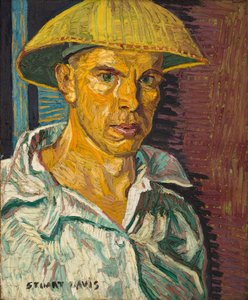
1892–1964, 미국
스튜어트 데이비스
스튜어트 데이비스: 아메리카 모더니즘의 선구자 1892년 12월 7일 필라델피아에서 태어난 스튜어트 데이비스는 어린 시절부터 예술적인 환경 속에서 성장했습니다. 그의 아버지 에드워드 와이어트 데이비스는 필라델피아 프레스의 미술 편집자였고, 어머니 헬렌 스튜어트 데이비스는 조각가였습니다. 이러한 가정환경은 의심할 여지 없이 그의 초기 예술적 관심을 키웠습니다. 데이비스는 1909년부터 1912년까지 뉴욕시의 로버트 헨리 미술학교에서 로버트 헨리의 지도를 받으며 정식 교육을 받았습니다.
스튜어트 데이비스의 다른 작품들
 오돌
 Lucky Strike1924
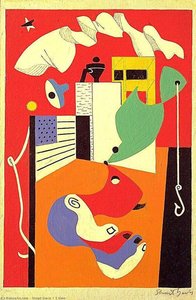 T View1951
 Sixth Avenue El1931
Visa 관련 에세이
 American artworks of the 1950s1951's Saying Grace by Norman Rockwell and Jackson Pollock's 1949 Number 1 show the shift from Paris to New York through 10 key works.
 Geometry with Purpose: Distinguishing Suprematism from ConstructivismKazimir Malevich hung his Black Square in the corner of a room in Petrograd in 1915. Why did this single gesture change the purpose of art?
 Dreams on Canvas: Understanding Automatist and Veristic SurrealismIn 1924, André Breton launched a movement in Paris to liberate the mind. One path used spontaneous gestures, while the other used photograp…