프린트 판매로 전환
 더 보기
더 보기







































 가로 또는 세로 중 어느 한 면이라도 105cm(약 41인치)를 초과하는 작품이나 복제화의 경우, 프레임은 분해된 키트 형태로 배송됩니다. 이는 안전한 배송을 보장하고 운송 중 발생할 수 있는 손상을 방지하기 위함입니다.


A Melancholic Journey Through the Surreal
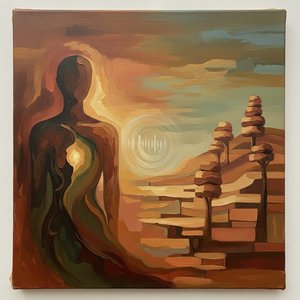
In the evocative landscape of Michael Sowa’s "Moving House," viewers are transported into a realm where the boundaries between reality and dream dissolve into a poignant, somber stillness. The artwork presents a scene that feels deeply rooted in the quietude of rural America, yet it is infused with a surrealist tension that defies simple interpretation. At first glance, the composition captures a desolate stretch of countryside, dominated by three imposing structures arranged along a winding dirt road that disappears into an uncertain distance. The atmosphere is heavy, draped in an overcast sky where dark, brooding clouds cast a diffused light over the earth, stripping the landscape of harsh shadows and replacing them with a soft, pervasive gloom. This muted palette—a careful orchestration of earthy browns, slate grancys, deep blues, and mossy greens—creates a sense of profound age and quiet contemplation, inviting the observer to linger in its melancholic embrace.
The technique employed by Sowa breathes life into this stillness through a rich, layered application of oil paint. Each brushstroke feels intentional, contributing to a texture that is both rough and tactile, suggesting the weathered surfaces of the buildings and the ruggedness of the path itself. While the shapes are fundamentally geometric—rectangular silhouettes and simple, curving lines—the edges are softened, lending the piece a slightly blurred, dreamlike quality reminiscent of early 20th-century realism or even the emotional weight of German Expressionism. This lack of sharp definition allows the viewer's imagination to fill the voids, turning a literal depiction of buildings into a psychological landscape where the physical world feels as fluid as a memory.
Symbolism and the Weight of Change
Beyond its visual beauty, "Moving House" serves as a profound meditation on the themes of displacement, transition, and the passage of time. The very title suggests a state of flux, yet the scene itself is frozen in a moment of heavy, static isolation. The lone figure positioned in the foreground acts as a vital emotional anchor, providing a human element to an otherwise inanimate and vast landscape. This presence heightens the sense of loneliness, transforming the act of "moving" from a mere physical relocation into a symbolic journey of loss or profound personal change. One might see in these migrating structures a reflection of the transient nature of life itself—the way we carry our histories and our homes with us through shifting terrains.
For the discerning collector or interior designer, this piece offers more than just a striking visual; it offers an emotional atmosphere. The artwork possesses a unique ability to anchor a room, providing a focal point that encourages introspection and quietude. Whether placed in a contemporary gallery setting or a more traditional study, the painting’s muted tones and complex textures harmonize with sophisticated decor, adding a layer of intellectual depth and narrative intrigue. It is a work that does not merely decorate a wall but tells a story, making it an exquisite choice for those who seek art that resonates with the complexities of the human experience.
질의응답
마이클 소와의 "moving house"의 방문객 분포는 어떻게 되나요?
"moving house"에 대한 방문 통계 페이지가 있습니다. 이 페이지에서는 해당 작품과 작가의 다른 작품들에 대한 월별 방문자 수를 국가 및 언어별로 상세히 확인할 수 있습니다.
"moving house"에는 어떤 색상들이 사용되었나요?
"moving house"의 색상은 Neutrals 팔레트를 이룹니다. 이 분류는 작품을 지배하는 주요 색상군을 나타냅니다.
"moving house"의 형태는 어떻게 되나요?
마이클 소와의 "moving house"은(는) Landscape 구도로 이루어져 있습니다. 프린트 크기를 결정하시기 전에 비율을 확인해 보시는 것이 좋습니다.
이 작품에 대해 더 알아보기
 미리보기
미리보기
 공유하기
공유하기 공유하기
공유하기
 상세 정보
상세 정보 가이드 보기

 다운로드
다운로드
 유사 작품 더 보기
 X-레이
X-레이 슬라이드 쇼 보기
 질의응답
질의응답 통계 정보
통계 정보