유화 원작 구매
 Stalingrad에 관한 모든 것







































 가로 또는 세로 중 어느 한 면이라도 105cm(약 41인치)를 초과하는 작품이나 복제화의 경우, 프레임은 분해된 키트 형태로 배송됩니다. 이는 안전한 배송을 보장하고 운송 중 발생할 수 있는 손상을 방지하기 위함입니다.


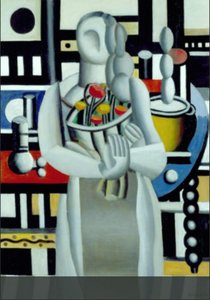
The Creation of Stalingrad by Fernand Léger
In 1924, Fernand Léger turned his gaze toward the heavy, rhythmic pulse of industrial labor. His painting, Stalingrad, emerged from this fascination with the intersection of man and machine. The canvas captures a moment of intense industrial collaboration, where the human form and the mechanical tool become inseparable. It is a scene of construction and movement, a study of how steel and muscle work in tandem to reshape a landscape.
The work is rooted in the language of Cubism, utilizing fragmented planes to organize the chaos of the machine age. At the same time, it carries the simplified, direct clarity often associated with Naïve Art. This duality allows the subject matter to remain grounded. The heavy machinery and the workers are not mere decorations; they are the structural bones of the composition. Fernand Léger sought to translate the energy of the modern era into a visual reality of intersecting lines and solid forms.
Steel pistons and heavy cranes define the space. The work exists in the tension between the organic and the manufactured. It is a quiet record of strength.
Artistic Movements and Stylistic Influences
The canvas is anchored in the fractured logic of Cubism. It follows the path cleared by the pioneers of the movement, breaking the world into a sequence of overlapping planes and geometric shards. This is not a soft dissolution of form, but a structural dismantling. The artist’s own hand developed a specific variation of this language, often called Tubism, which emphasizes cylindrical, tubular shapes. These rounded, mechanical volumes replace the organic curves of the natural world with the hard, rhythmic precision of the machine age.
There is a heavy, industrial pulse within these shapes. The work looks toward the future, acting as a forerunner to the Pop Art movement that would emerge decades later. By treating modern, mechanical subjects with such directness, the artist bridges the gap between fine art and the objects of a consumer society. The painting captures a moment where the human figure and the machine become inseparable parts of a single, moving mechanism. Steel and shadow define the new reality.
질의응답
Stalingrad은(는) 수작업으로 그린 작품인가요, 아니면 프린트된 작품인가요?
수작업 제작: 숙련된 화가가 Stalingrad을(를) 리넨 캔버스 위에 유화로 재현합니다.
Stalingrad의 사이즈는 어떤 것을 선택해야 하나요?
원작의 크기는 32 x 50 cm입니다. 사이즈는 29.9 x 33.4 cm (₩338846)부터 217.2 x 242.6 cm (₩2663326)까지 있으며, 이 페이지의 표에 주요 단계별 가격이 안내되어 있습니다.
배송은 얼마나 걸리나요?
배송은 전 세계 무료 특송으로 4~5주가 소요되며, 본 페이지에서 긴급 제작 옵션을 선택하실 수 있습니다. 제품은 조건 없이 100일 이내에 반품하여 전액 환불받으실 수 있습니다.
페르낭 레제 작가는 Stalingrad 작품에 어떤 재료를 사용했나요?
Oil On Canvas
 미리보기

 공유하기
 공유하기
 상세 정보
 학습용 요약본


 다운로드
 유사 작품 더 보기
 X-레이
 슬라이드 쇼 보기
 질의응답

 통계 정보