수작업 채색 복제본 주문하기
 더 보기







































 가로 또는 세로 중 어느 한 면이라도 105cm(약 41인치)를 초과하는 작품이나 복제화의 경우, 프레임은 분해된 키트 형태로 배송됩니다. 이는 안전한 배송을 보장하고 운송 중 발생할 수 있는 손상을 방지하기 위함입니다.


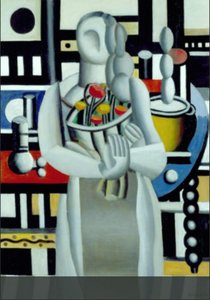
A Mechanical Vision: Decoding Fernand Léger’s ‘Composition’
Created in 1924, this striking work by French artist Fernand Léger is a powerful example of his distinctive “Tubism” – a unique offshoot of Cubism. The artwork presents a tightly cropped and detailed depiction of complex machinery, rendered with meticulous precision in sepia tones. It’s an image that immediately draws the eye, inviting contemplation on themes of industry, modernity, and the beauty found within mechanical structures.Style & Technique: The Essence of Tubism
Léger's style is instantly recognizable for its emphasis on cylindrical forms and geometric shapes – hence the term “Tubism.” ‘Composition’ exemplifies this approach perfectly. Notice how circles, rectangles, and angled planes interlock to create a sense of depth and complexity. The artist masterfully employs hatching and cross-hatching techniques to build form and texture, giving the impression of solidity and weight despite the two-dimensional surface. This isn't simply a drawing; it’s an exploration of volume and space achieved through line work alone. The monochromatic palette further emphasizes the focus on structure and form, reminiscent of technical illustrations or blueprints.Historical Context: Post-War Modernity
Fernand Léger’s artistic development was profoundly impacted by his experiences during World War I. Witnessing the power and precision of machinery in wartime led him to embrace industrial motifs as subjects for his art. ‘Composition’ reflects this shift, moving away from traditional representational painting towards a celebration of the modern, machine age. The 1920s were a period of rapid technological advancement and social change, and Léger's work captures the spirit of optimism and dynamism that characterized this era. He was part of the Puteaux Group (Section d’Or), exploring new ways to represent reality in a post-Cubist world.Symbolism & Interpretation: Beyond the Gears
While seemingly abstract, ‘Composition’ is rich with symbolic potential. The intricate machinery can be interpreted as representing the interconnectedness of modern life, the power of industry, or even the human body itself – reduced to its essential mechanical components. The absence of any human figures encourages viewers to focus on the machine as an entity in its own right. It prompts questions about humanity’s relationship with technology and the impact of industrialization on society.Emotional Impact & Aesthetic Appeal
Despite its subject matter, ‘Composition’ isn't cold or sterile. The meticulous detail and dynamic arrangement of forms create a visually engaging experience. The artwork evokes a sense of awe at human ingenuity and the elegance of engineering. Its neutral color palette makes it incredibly versatile for interior design – complementing both modern and traditional spaces. A reproduction of this piece would serve as a striking focal point in a study, living room, or office, sparking conversation and inspiring contemplation.Key Features
- Artist: Fernand Léger
- Date: 1924
- Medium: Graphite or Charcoal on Paper
- Dimensions: 25 x 23 cm
- Style: Tubism, Cubism, Technical Illustration
질의응답
Composition은(는) 수작업으로 그린 작품인가요, 아니면 프린트된 작품인가요?
수작업 제작: 숙련된 화가가 Composition을(를) 리넨 캔버스 위에 유화로 재현합니다.
Composition의 사이즈는 어떤 것을 선택해야 하나요?
원작의 크기는 25 x 23 cm입니다. 사이즈는 30.3 x 33.0 cm (₩266762)부터 229.8 x 249.9 cm (₩2762325)까지 있으며, 이 페이지의 표에 주요 단계별 가격이 안내되어 있습니다.
배송은 얼마나 걸리나요?
배송은 전 세계 무료 특송으로 4~5주가 소요되며, 본 페이지에서 긴급 제작 옵션을 선택하실 수 있습니다. 제품은 조건 없이 100일 이내에 반품하여 전액 환불받으실 수 있습니다.
페르낭 레제 작가는 Composition 작품에 어떤 재료를 사용했나요?
Acrylic On Canvas
이 작품에 대해 더 알아보기
 미리보기

 공유하기
 공유하기
 상세 정보
 가이드 보기


 다운로드
 유사 작품 더 보기
 X-레이
 슬라이드 쇼 보기
 질의응답

 통계 정보