유화 원작 구매
 Evening에 관한 모든 것







































 가로 또는 세로 중 어느 한 면이라도 105cm(약 41인치)를 초과하는 작품이나 복제화의 경우, 프레임은 분해된 키트 형태로 배송됩니다. 이는 안전한 배송을 보장하고 운송 중 발생할 수 있는 손상을 방지하기 위함입니다.


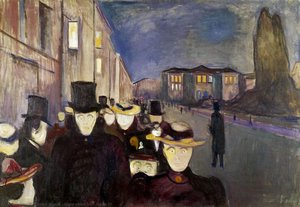
Edvard Munch's "Evening": A Study in Melancholy and Solitude
Edvard Munch’s “Evening,” painted in 1888, is an early work that foreshadows the artist’s later explorations of psychological depth and emotional intensity. This piece, housed within the Museo Nacional Thyssen-Bornemisza, offers a poignant glimpse into Munch's developing style as he transitioned from Impressionism towards Expressionism. The painting depicts a solitary figure, believed to be his sister Laura, seated in profile against a backdrop of a Norwegian fjord at dusk.
Style and Technique
“Evening” showcases a blend of Impressionistic techniques with emerging Symbolist tendencies. While the brushstrokes are looser than those found in purely academic works, they still retain a degree of naturalism in depicting the landscape. However, Munch’s use of color is far from objective; he employs dark, muted tones—primarily blues, greens, and browns—to evoke a sense of melancholy and introspection. The composition itself contributes to this mood: Laura's placement on the left side of the canvas, partially obscured and truncated, emphasizes her isolation. The original painting included two additional figures which Munch later removed, further amplifying the feeling of solitude.
Historical Context and Influences
Created during a period of significant artistic change in the late 19th century, “Evening” reflects a broader shift away from traditional representational art. Artists were increasingly interested in exploring subjective experiences and expressing inner emotions rather than simply depicting external reality. Munch was influenced by Symbolism and early Expressionist ideas, which sought to convey psychological states through symbolic imagery and distorted forms. The painting’s somber atmosphere aligns with the growing sense of alienation and anxiety that characterized modern life during this era.
Symbolism and Emotional Impact
The symbolism within “Evening” is subtle yet powerful. Laura's gaze directed towards the distant fjord suggests a longing or contemplation, while her detached posture conveys a profound sense of solitude. The darkening sky and tranquil waters contribute to an overall atmosphere of quiet melancholy. Munch’s choice to eliminate other figures from the scene underscores this feeling of isolation, drawing the viewer’s attention solely to Laura's introspective state. The painting resonates with viewers because it taps into universal human experiences of loneliness, reflection, and the passage of time.
A Precursor to Munch's Masterpieces
“Evening” serves as a crucial stepping stone in Munch’s artistic development, foreshadowing many of the themes and stylistic elements that would define his later masterpieces, including “The Scream.” It demonstrates his early mastery of conveying complex emotions through color, composition, and subtle symbolism. Owning a reproduction of this work allows one to appreciate not only its inherent beauty but also its significance within the broader context of modern art history.
질의응답
Evening은(는) 수작업으로 그린 작품인가요, 아니면 프린트된 작품인가요?
수작업 제작: 숙련된 화가가 Evening을(를) 리넨 캔버스 위에 유화로 재현합니다.
Evening의 사이즈는 어떤 것을 선택해야 하나요?
사이즈는 27.2 x 36.7 cm (₩269539)부터 181.4 x 244.4 cm (₩2210220)까지 있으며, 이 페이지의 표에 주요 단계별 가격이 안내되어 있습니다.
배송은 얼마나 걸리나요?
배송은 전 세계 무료 특송으로 4~5주가 소요되며, 본 페이지에서 긴급 제작 옵션을 선택하실 수 있습니다. 제품은 조건 없이 100일 이내에 반품하여 전액 환불받으실 수 있습니다.
Evening 원본은 어디에 있나요?
원본은 마드리드에 위치한 테시엔-본헤르메스 미술관 소장품입니다.
에드바르 뭉크 작가는 Evening 작품에 어떤 재료를 사용했나요?
Oil On Canvas
 미리보기

 공유하기
 공유하기
 상세 정보
 학습용 요약본


 다운로드
 유사 작품 더 보기
 X-레이
 슬라이드 쇼 보기
 질의응답

 통계 정보