プリント版に切り替え
 詳細を表示
詳細を表示







































 いずれかの辺が105 cm(約41インチ)を超えるアートワークまたは複製画の場合、フレームは分解されたキットの状態でお届けいたします。この方法は、輸送中の破損を防ぎ、安全に配送するために採用しております。


A Fragmented Vision: Unpacking the Enigmatic World of ‘Women’
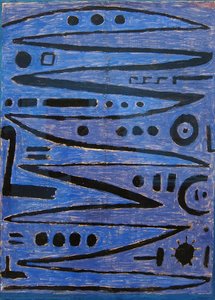
Paul Klee's “Women,” painted in 1921, isn’t a straightforward depiction; it’s an invitation into a deeply personal and profoundly evocative dreamscape. This work, rendered primarily in shades of charcoal, gray, and deep green punctuated by flashes of red and yellow, immediately arrests the viewer with its fragmented composition and ambiguous subject matter. It's a piece that resists easy interpretation, prompting contemplation rather than offering immediate answers – a hallmark of Klee’s artistic philosophy and his engagement with Expressionism and Primitivism. The painting feels less like a representation of reality and more like a distillation of emotion, memory, and perhaps even the subconscious.
The composition itself is deliberately unsettling. Two central groupings of figures, resembling women holding parasols or branches, are positioned slightly off-center, creating a sense of imbalance and drawing the eye through a complex network of overlapping shapes. These aren’t portraits in the traditional sense; Klee has stripped them down to their essential forms – simplified silhouettes that hint at humanity without revealing individual identity. Horizontal lines establish a grounding depth, while vertical elements define the figures, contributing to a layered effect reminiscent of architectural plans or even musical scores. This deliberate flattening of perspective, characteristic of Klee’s style, further enhances the painting's dreamlike quality.
Color and Line: A Symphony of Contrasts
Klee masterfully employs both sharp and soft lines to achieve a remarkable textural complexity. Geometric shapes – circles, triangles, and squares – are juxtaposed with organic forms, creating a dynamic tension that mirrors the painting’s emotional core. The color palette is deliberately restrained, dominated by dark tones that evoke feelings of melancholy and mystery. However, strategic accents of vibrant red, yellow, and muted green inject moments of visual interest and subtly shift the mood. These colors aren't used realistically; instead, they serve to amplify the painting’s atmosphere and underscore its symbolic weight. The watercolor and ink techniques Klee utilized allowed for subtle gradations in color and texture, lending a remarkable sense of depth and movement to the surface.
Symbolism and Emotional Resonance
“Women” is rich with potential symbolism, though Klee himself often resisted definitive interpretations. The figures holding parasols or branches could represent protection, guidance, or perhaps even the burdens of societal expectations. The overall setting – a fragmented cityscape – suggests alienation and isolation, reflecting themes prevalent in Klee’s work during this period. The painting evokes feelings of melancholy, mystery, and a sense of timelessness. It's not simply about women; it’s about the human condition itself—the complexities of relationships, the search for meaning, and the inherent ambiguity of life. The lack of distinct features on the figures contributes to their universality, suggesting that they represent all women rather than any specific individual.
A Legacy of Playful Abstraction
Paul Klee’s “Women” stands as a testament to his unique artistic vision – a synthesis of Expressionism, Cubism, and Surrealism. The painting's creation in 1921 coincided with a period of intense experimentation for the artist, reflecting his ongoing exploration of color theory, musicality, and the relationship between art and emotion. The work’s influence can be seen in subsequent generations of artists who embraced abstraction and sought to express subjective experience through visual form. Today, reproductions of “Women” continue to captivate viewers with their haunting beauty and enduring mystery. It remains a powerful example of Klee's ability to transform simple forms into profound expressions of the human spirit.
Q&A
「Women」は、拡張現実(AR)でのプレビューに対応していますか?
「Women」は、拡張現実(AR)でのプレビューが可能です。対応デバイスで作品のARで見るページを表示すると、ご自身の空間に作品を配置してご確認いただけます。
パウル・クレー作「Women」の向き(横長・縦長)はどちらですか?
「Women」の形式はLandscapeです。複製画を飾る場所を検討する際にお役立てください。
「Women」は、パウル・クレーのこれまでの作風を象徴するものと言えるでしょうか?
「Women」はabstraction, women, parasols, geometry, shadows, ambiguity, surrealism, colorを描いていますが、パウル・クレーのこれまでの主要なテーマはexpressionism, cubism, surrealism, modernity, uncertainty, dreams, symbolic, psychological themesです。この二つを比較することで、本作が作家の恒常的な主題とどのように結びついているかが浮き彫りになります。
この絵画の詳細を見る
 設置イメージを表示
 シェアする
シェアする シェアする
シェアする
 詳細を見る
詳細を見る ガイドを表示

 ダウンロード
 似ている作品
 X線調査
X線調査 スライドショーを表示
 Q&A
Q&A 統計情報
統計情報