Passa alle stampe
 Espandi i dettagli







































 Per opere d'arte o riproduzioni con un lato superiore a 105 cm (circa 41 pollici), la cornice verrà spedita in forma di kit smontato. Questo metodo garantisce una consegna sicura e previene danni durante il trasporto.


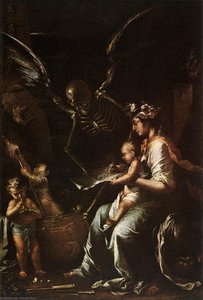
Salvator Rosa’s Self-Portrait: A Window into Baroque Thought
Salvator Rosa’s “Self-Portrait,” painted circa 1645, stands as a testament to the burgeoning spirit of philosophical inquiry within the Baroque period. More than just a likeness of the artist himself—Francesco Maria Rosa—the painting delves into themes of contemplation and intellectual pursuit, reflecting Rosa's profound engagement with humanist ideals prevalent during his time.
- Subject Matter: The central figure is depicted in a studio setting, meticulously engaged in sketching or writing on a spherical object – likely a globe. This deliberate choice isn’t merely decorative; it symbolizes Rosa’s ambition to map out the universe of knowledge and understanding, mirroring the broader intellectual currents of the era.
- Style & Technique: Executed in oil paint on canvas, Rosa employs a masterful blend of chiaroscuro—the dramatic interplay of light and shadow—characteristic of Baroque art. This technique amplifies the emotional impact of the portrait, highlighting Rosa’s face and hand as points of focus against a dark, indistinct background.
- Historical Context: Painted during Rosa’s formative years, “Self-Portrait” aligns with the philosophical debates surrounding Pythagoras—the Greek mathematician and philosopher who championed harmony and proportion. Rosa's inclusion of this figure underscores his fascination with rational thought and its role in shaping human experience – a core concern for artists and intellectuals alike.
A Study in Baroque Composition & Texture
Rosa’s brushwork is visible throughout the portrait, particularly in the depiction of Rosa's hair and clothing. This meticulous attention to detail lends texture and realism to the image, conveying a sense of immediacy and capturing the physicality of the artist. The composition itself directs the viewer’s gaze downwards towards Rosa’s work, emphasizing his concentration and embodying the humanist ideal of active engagement with intellectual pursuits.
- Color Palette: Primarily muted earth tones—browns, ochres, and grays—create a subdued yet dignified atmosphere. These colors contribute to the overall mood of introspection and seriousness, aligning perfectly with Rosa’s philosophical interests.
- Lighting & Shadow: The dramatic lighting emphasizes Rosa's face and hand, casting deep shadows that heighten the sense of depth and drama – a hallmark of Baroque painting techniques designed to evoke emotion and convey spiritual significance.
Symbolism Beyond Appearance
"Self-Portrait" transcends mere visual representation; it speaks to the artist’s inner life and intellectual convictions. The globe serves as a powerful symbol of Rosa's desire to comprehend the cosmos—both literally and metaphorically—reflecting the humanist preoccupation with understanding humanity’s place in the universe. Furthermore, Rosa’s posture conveys a quiet dignity and unwavering commitment to his craft, embodying the Renaissance artist’s belief in the transformative power of art.
- Emotional Impact: The portrait invites contemplation and encourages viewers to consider the role of reason and observation in shaping human understanding. It captures not only Rosa's physical likeness but also hints at his personality and profession through the act of creation he undertakes – a gesture that resonates with the humanist spirit of the Baroque era.
A reproduction of Salvator Rosa’s “Self-Portrait” offers an exceptional opportunity to bring this seminal artwork into your home or studio. Its masterful technique, evocative symbolism, and profound philosophical undercurrents continue to inspire admiration and provide insight into the intellectual landscape of seventeenth-century Italy.
Domande e risposte
Qual è la tonalità dominante di "Self-Portrait" di Salvatore Rosa?
La tonalità dominante di "Self-Portrait" di Salvatore Rosa è Golden Yellow Range, un colore che costituisce il tono di fondo dell'intera tavolozza.
È possibile visualizzare un'anteprima di "Self-Portrait" di Salvatore Rosa prima dell'ordine?
La pagina di Anteprima in ambiente di "Self-Portrait" ti permette di visualizzare un'anteprima dell'opera prima dell'ordine.
Dove posso acquistare una stampa di "Self-Portrait" di Salvatore Rosa?
"Self-Portrait" è disponibile come una stampa fine art su tela di cotone o carta canvas d'archivio. È possibile effettuare l'ordine nella pagina Stampa Fine Art, scegliendo la dimensione che preferisci.
 Anteprima in scala reale
 Invia
Invia Condividi
 Dettagli opera
 Guida
Guida

 Scarica
 Simili
 Radiografia
 Slideshow
 Q&A
Q&A Statistiche