Anteprima in scala reale
 Condividi
 Condividi
 Dettagli
 Guida stampabile

 Scarica
 Articoli simili
 Radiografia
 Slideshow
 Statistiche
Mirror -4


 Leggi tutto
L'opera d'arte visualizzata in questa pagina è protetta dalle leggi sul diritto d'autore, il che significa che non possiamo legalmente creare o vendere una riproduzione identica. Tale protezione è garantita da accordi internazionali quali la Convenzione di Berna e dalle leggi nazionali, incluse quelle stabilite da Legge sul copyright degli Stati Uniti - Titolo 17. Tutti i diritti riservati. Le immagini presenti su questo sito sono protette da copyright e non possono essere riprodotte o utilizzate senza l'autorizzazione scritta di WahooArt.com o dei rispettivi proprietari del copyright.
Come alternativa rispettosa e legale, offriamo opere d'arte personalizzate e dipinte a mano, ispirate all'originale. I nostri artisti esperti e professionisti studiano con cura lo stile, l'atmosfera e l'essenza artistica dell'opera originale per creare un pezzo nuovo e unico che evochi la stessa emozione, pur rimanendo una creazione originale a pieno titolo.
Questo metodo è pienamente conforme alle normative sul diritto d'autore poiché non prevede la copia o la duplicazione dell'opera protetta. Si tratta invece di una rielaborazione creativa: un nuovo dipinto che trae ispirazione dall'originale, senza tuttavia esserne identico.
Riproduzione a olio fatta a mano
Olio su tela dipinto a mano nelle tue dimensioni e con la tua cornice, realizzato su ordinazione dai nostri artisti. ( Passa alle stampe Passa all'immagine digitale)




P118B €10

P118H €10

P118W €10

P438Z €10

P508JH €12

P508YH €12

P805H €10

P805Z €10

P919BZ €10

P919G €10

P919XJ €10

P959ZH €10

P968JZ €12

W106C €8

W218G €10

W218JH €8

W218Y €10

W307PJ €10

W316G €10

W316PJ €8

W316Y €10

W398PJ €8

W4111J €10

W500HY €15

W500JH €15

W692G €12

W849H €8

W940BG €15

W953PJ €8




Scegli tra le nostre dimensioni predefinite, che rispettano le proporzioni originali dell'opera d'arte.

Inserisci la larghezza e l'altezza di cui hai bisogno, per adattarle alla tua cornice o alla tua parete. Trattandosi di un'opera dipinta a mano, in caso di dimensioni con una forma differente, l'artista può dipingere un po' più oltre i bordi dell'immagine o ritagliare leggermente — la scelta spetta a te. Ti invieremo un mockup digitale da approvare prima che la pittura abbia inizio. L'immagine mostrata in questa pagina non rappresenta il risultato reale — solo il mockup lo fa.
Dopo l'ordine, il team di OriginalUniqueArt.com contatterà il cliente via e-mail per ricevere le istruzioni e fornirà un'anteprima del mockup
Consegna in tutto il mondo () in 3/4 settimane anziché nelle normali 5 settimane. (21 Ottobre). Nessun compromesso sulla qualità.

Spedizione espressa gratuita in tutto il mondo

Tela in lino di alta qualità

Assicurazione completa sulla spedizione

Garanzia di rimborso dei dazi doganali

Garanzia di perfetta fedeltà cromatica

Politica di reso entro 100 giorni (solo per difetti di fabbricazione)

Garanzia di rimborso al 100%

Sconto per acquisti multipli
 L'opzione vetro è disponibile solo per dimensioni inferiori a 110 cm

Mirror -4
Tecnica di riproduzione
Dimensioni della riproduzione
-


Prezzo totale
€ 262
A Reflection on Modernity: Roy Lichtenstein’s “Mirror -4”
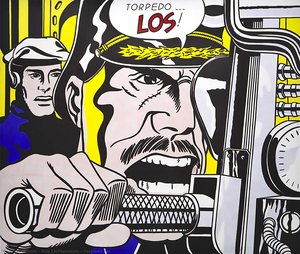
Roy Lichtenstein's "Mirror -4," created in 1970, is not a depiction of literal reflection but rather an exploration of perception itself—a visual puzzle rendered with the artist’s signature Pop Art vocabulary. This work, part of a larger series, moves beyond Lichtenstein’s earlier appropriations of comic book imagery to delve into the very mechanisms by which we see and interpret the world around us. The composition centers on a bold yellow and black circle, stark against a white background, immediately drawing the eye inward. Within this graphic frame resides a stylized tennis racket, not as an object in space but as a flattened, almost symbolic element. This isn’t about a game of tennis; it’s about the representation *of* a tennis racket, its essence distilled into lines and color. The surface is intentionally textured with small dots – a hallmark of Lichtenstein’s technique mimicking the Ben-Day dot printing process used in mass-produced comics—creating a visual vibration that adds depth and complexity to what might otherwise be a simple geometric form.- Technique: Lichtenstein employed the Ben-Day dot printing process, meticulously applying dots of color onto canvas to simulate the halftone shading found in comic books. This technique contributes significantly to the artwork’s textural quality and visual vibrancy.
- Color Palette: The dominant colors—yellow and black—create a striking contrast that emphasizes the geometric simplicity of the composition. Lichtenstein skillfully utilizes these hues to convey emotion and dynamism.
- Composition: The circular frame serves as an anchor for the tennis racket, guiding the viewer’s gaze and reinforcing the artwork's conceptual exploration of perception.
Deconstructing Representation
The “Mirror” series, as a whole, represents a fascinating turning point in Lichtenstein's artistic journey. Having achieved fame for his large-scale paintings of comic book panels, he began to investigate the ways images are constructed and how they interact with our understanding of reality. The mirrors themselves aren’t reflecting recognizable scenes; instead, they present fragmented compositions—abstracted shapes, bold colors, and graphic elements—that force us to question what we’re actually seeing. Is it a reflection? An illusion? Or simply a carefully orchestrated arrangement of forms? This ambiguity is central to the work’s power. Lichtenstein wasn’t interested in replicating reality; he was interested in dissecting it, revealing the underlying structures and conventions that shape our visual experience. The tennis racket within “Mirror -4” acts as a focal point, a recognizable object placed within this constructed space, further emphasizing the tension between representation and reality. Historical Context: This series emerged during the height of Pop Art’s influence, challenging traditional artistic conventions and engaging with themes of consumer culture and mass media. Lichtenstein's work reflects a broader intellectual debate about how images communicate meaning and shape our perceptions.Pop Art & Beyond: A Historical Context
To understand "Mirror -4," it’s crucial to situate it within the broader context of Pop Art and the cultural landscape of the late 1960s and early 1970s. Emerging in the mid-20th century, Pop Art challenged traditional notions of fine art by embracing imagery from popular culture—advertising, comic books, everyday objects. Lichtenstein was a leading figure in this movement, alongside artists like Andy Warhol and Claes Oldenburg. However, while Warhol often focused on celebrity and consumerism, Lichtenstein’s work frequently engaged with questions of perception, representation, and the nature of art itself. “Mirror -4” builds upon this foundation, moving beyond simple appropriation to a more conceptual exploration of visual language. The piece reflects a growing self-awareness within Pop Art—a questioning of its own methods and assumptions. It's a moment where the movement begins to look inward, examining not just *what* is being represented but *how*. Emotional Resonance: Despite its cool, graphic aesthetic, “Mirror -4” evokes a surprisingly emotional response. The stark contrast between the yellow and black, the precise lines, and the deliberate texture create a sense of visual energy that is both stimulating and unsettling. There’s a feeling of detachment, as if we are observing something from a distance—a reflection in a mirror, perhaps. This distance invites contemplation, prompting us to consider our own role in the act of seeing. The work isn’t about providing answers; it’s about raising questions. It challenges us to look beyond the surface and to question the assumptions that shape our perception of reality.- Symbolism: The tennis racket represents a deliberate simplification of recognizable form, symbolizing not just sport but also the process of artistic representation itself.
- Ambiguity: Lichtenstein’s refusal to depict realistic scenes encourages viewers to engage in active interpretation and consider multiple perspectives.
An Emotional Resonance
Interior Design Considerations: A reproduction of “Mirror -4” can serve as a striking focal point within an interior space, injecting vibrancy and intellectual stimulation into the design aesthetic. Its geometric precision and bold color palette complement modern interiors beautifully. Consider framing it in a minimalist frame to maximize its visual impact.Domande e risposte
È disponibile un download per "Mirror -4"?
Puoi scaricare "Mirror -4" di Roy Lichtenstein dalla pagina Scarica dell'opera, come download di un'immagine digitale ad alta risoluzione.
Chi è l'autore e in che anno è stata realizzata "Mirror -4"?
"Mirror -4" è stata creata da Roy Lichtenstein nel 1970."
Quanti anni aveva Roy Lichtenstein quando ha creato "Mirror -4" nel 1970?
Roy Lichtenstein aveva 47 anni quando ha creato "Mirror -4" nel 1970. L'età è calcolata sulla base dell'anno di nascita dell'artista, 1923.
Biografia dell'artista
vitae e istruzione
Roy Fox Lichtenstein, un illustre artista pop americano, è nato il 27 ottobre 1923 a New York City. È cresciuto in una famiglia ebraica della classe media alta, con suo padre agente immobiliare e sua madre casalinga. L'interesse di Lichtenstein per l'arte e il design è iniziato come hobby durante i suoi anni scolastici.Carriera artistica
Dopo aver completato la sua istruzione superiore alla Dwight School nel 1940, Lichtenstein ha frequentato l'Art Students League of New York sotto la guida di Reginald Marsh. Ha poi conseguito una laurea in belle arti presso l'Ohio State University, che è stata interrotta da un periodo di tre anni nell'esercito durante la Seconda Guerra Mondiale.- Look Mickey (1961, National Gallery of Art, Washington, D.C.), una delle prime opere pop art di Lichtenstein, ha segnato l'inizio della sua influente carriera.
- Il suo lavoro è stato fortemente influenzato dagli stili pubblicitari e dei fumetti popolari, con opere notevoli tra cui Wham!, Drowning Girl e Oh, Jeff...I Love You Too...But...
- Il pezzo più costoso di Lichtenstein, Masterpiece, è stato venduto per 165 milioni di dollari nel gennaio 2017.
Insegnamento e influenze
Lichtenstein ha insegnato presso varie istituzioni, tra cui l'Università dello Stato di New York a Oswego e l'Università Rutgers. Il suo lavoro è stato influenzato da Allan Kaprow, un collega docente all'Università Rutgers, che ha riacceso il suo interesse per le immagini proto-pop. Mostre degne di nota:- The Museum Chambre de Commerce (Tolosa, Francia), che presenta varie opere d'arte, tra cui quelle del movimento pop art.
- Il lavoro di Lichtenstein è stato esposto alla Leo Castelli Gallery a New York City, con il suo primo singolo in 1962 acquistato interamente da collezionisti influenti prima dell'apertura.
Eredità e impatto
Roy Lichtenstein è morto il 29 settembre 1997, lasciando dietro di sé un'eredità come figura di spicco nel movimento pop art. Il suo lavoro continua ad essere celebrato per la sua innovativa fusione tra arte alta e bassa, rendendola accessibile a un pubblico più ampio.- Esplora altri lavori di Lichtenstein su OriginalUniqueArt.com
- Scopri il mondo dell'arte pop e dei suoi influenti artisti su Arte Pop e oltre: navigare tra gli stili contemporanei con OriginalUniqueArt.com
- Wikipedia: Roy Lichtenstein
- The Museum Chambre de Commerce (Tolosa, Francia) su OriginalUniqueArt.com

Roy Lichtenstein
1923 - 1997 , Stati Uniti d'America
Informazioni rapide
- Artisti Che Hanno Influenzato Questo Artista:
- Reginald Marsh
- Allan Kaprow
- Data Di Morte: 29 settembre 1997
- Data Di Nascita: 27 ottobre 1923
- Luogo Di Nascita: Manhattan, Stati Uniti
- Movimento Artistico: Pop Art
- Nazionalità: Americano
- Nome Completo: Roy Lichtenstein
- Opere Notevoli:
- Look Mickey
- Whaam!
- Drowning Girl
- Masterpiece
Articoli correlati

Astrazione Geometrica: 10 Capolavori che Hanno Definito un Movimento Artistico
Esplora i 10 capolavori dell'Astrazione Geometrica: Mondrian, Malevich e Kandinsky rivoluzionano l'arte moderna. Scopri la storia, i colori e le tecniche di questi movimenti iconici. Stampe d'arte di alta qualità su OriginalUniqueArt.com!
Roy Lichtenstein: Le 25 Opere Iconiche che Hanno Rivoluzionato l'Arte Pop | OriginalUniqueArt
Esplora le 25 opere iconiche di Roy Lichtenstein, il maestro della Pop Art! Scopri la storia, i colori e lo stile unico dei suoi dipinti più famosi. Trova riproduzioni d'arte di alta qualità per arredare casa con OriginalUniqueArt.com.

Neo-Abstract Art: The High-Impact Evolution of Modern Visual Energy and Geometric Sophistication
Discover the power of Neo-Abstract art. Explore how bold geometric forms and high-impact visual energy are redefining modern design. Learn to curate sophisticated, high-energy spaces with the latest trends in contemporary abstraction and structural color.

Kandinsky: I 25 Capolavori che Hanno Rivoluzionato l'Arte Moderna | OriginalUniqueArt
Esplora i 25 capolavori di Wassily Kandinsky, pioniere dell'arte astratta. Scopri la storia, il significato e le tecniche dietro ogni dipinto iconico. Trova riproduzioni d'arte di alta qualità per decorare la tua casa su OriginalUniqueArt.com.

Beyond Form & Color: Geometric Abstraction's Evolution in 20th/21st Century Art
Explore the evolution of geometric abstraction from Cubism to contemporary art. Discover key artists like Malevich & Mondrian, investment insights, and expert collecting advice at OriginalUniqueArt.