Pop Art · 1970
Mirror -4 (Roy Lichtenstein, 1970)
Roy Lichtenstein (1923–1997) ha realizzato Mirror -4. Risale al 1970. Fa parte del movimento Pop Art. È realizzato in Acrilico su tela.
- 1970
- Acrilico su tela

 Anteprima in scala reale

 Dipinto a olio fatto a mano
 Invia
 Condividi
 Scheda didattica


 Scarica
 Simili
 Radiografia
 Slideshow
 Domande e risposte

 Statistiche
Mirror -4, in breve
- Titolo
- Mirror -4
- Artista
- Roy Lichtenstein (1923–1997)
- Artista nato a
- Manhattan, Stati Uniti d'America
- Date
- 1970
- Tecnica
- Acrilico su tela
- Movimento
- Pop Art
- Epoca
- Età Moderna
- Soggetto
- geometric abstraction, tennis racket, ben-day dots, reflection, conceptual art, visual perception
Cosa raffigura Mirror -4?
A Reflection on Modernity: Roy Lichtenstein’s “Mirror -4”
Roy Lichtenstein's "Mirror -4," created in 1970, is not a depiction of literal reflection but rather an exploration of perception itself—a visual puzzle rendered with the artist’s signature Pop Art vocabulary. This work, part of a larger series, moves beyond Lichtenstein’s earlier appropriations of comic book imagery to delve into the very mechanisms by which we see and interpret the world around us. The composition centers on a bold yellow and black circle, stark against a white background, immediately drawing the eye inward. Within this graphic frame resides a stylized tennis racket, not as an object in space but as a flattened, almost symbolic element. This isn’t about a game of tennis; it’s about the representation *of* a tennis racket, its essence distilled into lines and color. The surface is intentionally textured with small dots – a hallmark of Lichtenstein’s technique mimicking the Ben-Day dot printing process used in mass-produced comics—creating a visual vibration that adds depth and complexity to what might otherwise be a simple geometric form.- Technique: Lichtenstein employed the Ben-Day dot printing process, meticulously applying dots of color onto canvas to simulate the halftone shading found in comic books. This technique contributes significantly to the artwork’s textural quality and visual vibrancy.
- Color Palette: The dominant colors—yellow and black—create a striking contrast that emphasizes the geometric simplicity of the composition. Lichtenstein skillfully utilizes these hues to convey emotion and dynamism.
- Composition: The circular frame serves as an anchor for the tennis racket, guiding the viewer’s gaze and reinforcing the artwork's conceptual exploration of perception.
Deconstructing Representation
The “Mirror” series, as a whole, represents a fascinating turning point in Lichtenstein's artistic journey. Having achieved fame for his large-scale paintings of comic book panels, he began to investigate the ways images are constructed and how they interact with our understanding of reality. The mirrors themselves aren’t reflecting recognizable scenes; instead, they present fragmented compositions—abstracted shapes, bold colors, and graphic elements—that force us to question what we’re actually seeing. Is it a reflection? An illusion? Or simply a carefully orchestrated arrangement of forms? This ambiguity is central to the work’s power. Lichtenstein wasn’t interested in replicating reality; he was interested in dissecting it, revealing the underlying structures and conventions that shape our visual experience. The tennis racket within “Mirror -4” acts as a focal point, a recognizable object placed within this constructed space, further emphasizing the tension between representation and reality. Historical Context: This series emerged during the height of Pop Art’s influence, challenging traditional artistic conventions and engaging with themes of consumer culture and mass media. Lichtenstein's work reflects a broader intellectual debate about how images communicate meaning and shape our perceptions.Pop Art & Beyond: A Historical Context
To understand "Mirror -4," it’s crucial to situate it within the broader context of Pop Art and the cultural landscape of the late 1960s and early 1970s. Emerging in the mid-20th century, Pop Art challenged traditional notions of fine art by embracing imagery from popular culture—advertising, comic books, everyday objects. Lichtenstein was a leading figure in this movement, alongside artists like Andy Warhol and Claes Oldenburg. However, while Warhol often focused on celebrity and consumerism, Lichtenstein’s work frequently engaged with questions of perception, representation, and the nature of art itself. “Mirror -4” builds upon this foundation, moving beyond simple appropriation to a more conceptual exploration of visual language. The piece reflects a growing self-awareness within Pop Art—a questioning of its own methods and assumptions. It's a moment where the movement begins to look inward, examining not just *what* is being represented but *how*. Emotional Resonance: Despite its cool, graphic aesthetic, “Mirror -4” evokes a surprisingly emotional response. The stark contrast between the yellow and black, the precise lines, and the deliberate texture create a sense of visual energy that is both stimulating and unsettling. There’s a feeling of detachment, as if we are observing something from a distance—a reflection in a mirror, perhaps. This distance invites contemplation, prompting us to consider our own role in the act of seeing. The work isn’t about providing answers; it’s about raising questions. It challenges us to look beyond the surface and to question the assumptions that shape our perception of reality.- Symbolism: The tennis racket represents a deliberate simplification of recognizable form, symbolizing not just sport but also the process of artistic representation itself.
- Ambiguity: Lichtenstein’s refusal to depict realistic scenes encourages viewers to engage in active interpretation and consider multiple perspectives.
An Emotional Resonance
Interior Design Considerations: A reproduction of “Mirror -4” can serve as a striking focal point within an interior space, injecting vibrancy and intellectual stimulation into the design aesthetic. Its geometric precision and bold color palette complement modern interiors beautifully. Consider framing it in a minimalist frame to maximize its visual impact.Immagini ad alta risoluzione di Mirror -4

Protetti da copyright: questi file sono per uso personale e non costituiscono una licenza per la ripubblicazione.
Roy Lichtenstein, Mirror -4 (1970).
Domande su Mirror -4, risposte
In che anno è stata creata "Mirror -4" di Roy Lichtenstein?
"Mirror -4" di Roy Lichtenstein è stata creata nel 1970.
Con quale tecnica è realizzata "Mirror -4" di Roy Lichtenstein?
"Mirror -4" è realizzata con Acrilico su tela.
Qual è il soggetto di "Mirror -4"?
I temi presenti in "Mirror -4" di Roy Lichtenstein includono geometric abstraction, tennis racket, ben-day dots, reflection, conceptual art, visual perception, comic book influence, elementi che insieme sintetizzano il soggetto dell'opera.
"Mirror -4" è di pubblico dominio?
Per quanto riguarda il copyright, "Mirror -4" è ancora protetta dal diritto d'autore.
Chi ha creato "Mirror -4"?
"Mirror -4" è stata creata da Roy Lichtenstein. Le informazioni contenute in questa pagina descrivono l'opera originale di Roy Lichtenstein.
A quale movimento artistico appartiene "Mirror -4" di Roy Lichtenstein?
Il movimento associato a "Mirror -4" di Roy Lichtenstein è Pop Art. Questa classificazione colloca l'opera tra artisti e opere d'arte correlati.
A quale fase della carriera di Roy Lichtenstein appartiene "Mirror -4"?
"Mirror -4" appartiene al Mature Period della carriera di Roy Lichtenstein. Questa classificazione riconduce l'opera all'evoluzione dell'artista.
Quanti anni aveva Roy Lichtenstein quando è stata creata "Mirror -4"?
Quando "Mirror -4" fu creata nel 1970, Roy Lichtenstein - nato nel 1923 - aveva 47 anni.
Qual è la spiegazione relativa allo stato del copyright di "Mirror -4" di Roy Lichtenstein?
"Mirror -4" di Roy Lichtenstein è di ancora protetta dal diritto d'autore. I termini del copyright si calcolano a partire dalla morte dell'artista, e Roy Lichtenstein è deceduto nel 1997.
Informazioni sull'artista, Roy Lichtenstein

1923–1997, Stati Uniti d'America
Roy Lichtenstein
La Vita di Roy Lichtenstein Manhattan, New York City, 27 ottobre 1923. Roy Lichtenstein entra nel mondo come figlio di Milton e Beatrice. L'energia urbana della metropoli fa da sfondo a una vita che, col tempo, sfiderà i confini stessi della fine art. Cresce in una famiglia ebraica dell'alta borghesia, assorbendo i ritmi culturali della città attraverso i musei e la musica jazz.
Altre opere di Roy Lichtenstein
 Whaam!1963
 Guarda Mickey1961
 Ragazza Affogata1963
 Ragazza con la palla1961
Saggi su Mirror -4
 Astrazione Geometrica: 10 Capolavori che Hanno Definito un Movimento ArtisticoEsplora i 10 capolavori dell'Astrazione Geometrica: Mondrian, Malevich e Kandinsky rivoluzionano l'arte moderna. Scopri la storia, i colori…
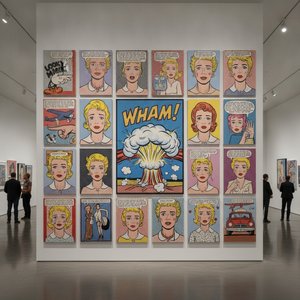 I 25 capolavori di Roy Lichtenstein: l'icona della Pop ArtScopri i 25 capolavori di Roy Lichtenstein e l'essenza della Pop Art. Esplora la collezione su OriginalUniqueArt.com.
 L'Alchimia Cromatica di Roy Lichtenstein: Psicologia e Teoria del Colore nella Pop ArtScopri la psicologia del colore e la tecnica Ben-Day di Roy Lichtenstein. Approfondisci l'iconica estetica della Pop Art ora.