Passa alle stampe
 Espandi i dettagli







































 Per opere d'arte o riproduzioni con un lato superiore a 105 cm (circa 41 pollici), la cornice verrà spedita in forma di kit smontato. Questo metodo garantisce una consegna sicura e previene danni durante il trasporto.


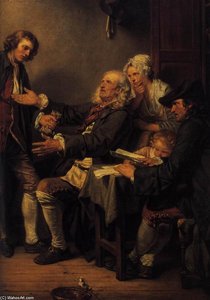
A Glimpse into Sentimental Life: Analyzing Greuze's Self-Portrait
To stand before this depiction of a man with distinguished white hair, pipe held thoughtfully in his mouth, is to step directly into the emotional landscape of late eighteenth-century France. Jean-Baptiste Greuze, master chronicler of human feeling, has captured not merely a likeness, but a moment imbued with quiet contemplation. The subject gazes out, seemingly connecting with the viewer across the span of two centuries. His attire, suggesting an earlier epoch, anchors him in a time when sentimentality was becoming the dominant current in art. Yet, it is the subtle presence of the two other figures—one flanking the left, another on the right—that enriches the narrative, transforming what might be a simple portrait into a complex tableau of social interaction.
The Artistry of Sentiment and Genre
Greuze’s genius lay in his ability to elevate everyday life—the genre scene—to the level of high art. While academic painters often gravitated toward grand historical epics or mythological grandeur, Greuze found his profound resonance in the intimate dramas of ordinary people. This Self-Portrait, dated around 1780, exemplifies this focus. The technique employed speaks to a mastery of tonal subtlety; observe how the light catches the texture of the brown coat and the wisps of white hair. It is a painting that rewards close inspection, allowing the eye to wander from the direct gaze of the central figure to the muted activities unfolding around him. This careful balance between individual focus and surrounding narrative depth is characteristic of his most compelling works.
Historical Echoes: Life in the Late Enlightenment
The period surrounding 1780 was a time of profound intellectual ferment, one where emotion began to challenge rigid classical structures. Greuze’s work resonated deeply with the burgeoning sentimental taste—a cultural shift that valued empathy, domestic virtue, and relatable human struggle over sheer grandeur. The inclusion of multiple figures suggests a community moment, perhaps a gathering or an informal portrait session. These secondary characters are not mere props; they participate in the atmosphere, grounding the central figure's introspection within a tangible social reality. Owning a reproduction of this piece allows one to bring that historical resonance—that feeling of intimate, observed life—into a modern setting.
Symbolism and Emotional Resonance for the Collector
The pipe itself functions as more than just an accessory; it is a classic symbol of contemplation, reflection, and perhaps even melancholy wisdom. The man seems caught between the outward performance of his composure and the deep thoughts suggested by his posture. For the collector or designer, this painting offers immediate emotional depth. It speaks to the quiet dignity found in aging, in companionship, and in the act of simply observing life unfold. Whether placed above a mantelpiece or within a gallery setting, this artwork does not shout for attention; rather, it invites the viewer into a hushed, thoughtful conversation, making it an exquisite piece for those who appreciate art with a soulful whisper.
Domande e risposte
Quali sono la tecnica e le dimensioni dell'originale "Self-Portrait" di Jean-Baptiste Greuze?
L'originale "Self-Portrait" di Jean-Baptiste Greuze è un'opera in Oil On Canvas di dimensioni 56 x 46 cm. La tecnica e le dimensioni si riferiscono all'opera originale.
Quale tavolozza di colori utilizza "Self-Portrait"?
I colori di "Self-Portrait" compongono una tavolozza Earthy. Questa classificazione descrive le famiglie di colori dominanti.
È possibile ordinare una riproduzione a olio di "Self-Portrait"?
Puoi ordinare una riproduzione dipinta a mano di "Self-Portrait" di Jean-Baptiste Greuze direttamente nella sua pagina Riproduzione dipinta a mano: una riproduzione a olio dipinta a mano su tela di lino, realizzata su ordinazione.
 Anteprima in scala reale
 Invia
Invia Condividi
 Dettagli opera
 Guida
Guida

 Scarica
 Simili
 Radiografia
 Slideshow
 Q&A
Q&A Statistiche