

 Előnézet
 Megosztás
 Megosztás
 Részletek
 Útmutató

 Letöltés
 Hasonló darabok
 X-ray felvétel
 Diavetítés
 Statisztika
Multiplex D
 Acrylic On Canvas
- WallArt
- Geometric Abstraction
 1948
1948 22.0 x 30.0 cm
 De Young Múzeum
 Tovább olvasom
Az ezen az oldalon megjelenített műalkotások szerzői jogi védelem alatt állnak, ami azt jelenti, hogy törvényileg nem készíthetünk és nem adhatunk el belőlük pontos másolatokat. Ez a védelem olyan nemzetközi megállapodások alapján érvényesül, mint például a Berni Egyezmény és a nemzeti törvények által, beleértve azokat is, amelyeket meghatározott Az USA szerzői jogi törvénye – 17. cím.
Mint tiszteletes és törvényes alternatívát, olyan egyedi, kézzel festett alkotásokat kínálunk, amelyek az eredetiből merítnek inspirációt. Tapasztalt és professzionális művészeink alaposan tanulmányozzák az eredeti stílusát, hangulatát és művészeti esszenciáját, hogy egy olyan új, egyedi alkotást hozzunk létre, amely ugyanazt az érzést kelti – miközben önálló, eredeti alkotásként létezik.
Ez a módszer teljes mértékben megfelel a szerzői jogi szabályozásnak, mivel nem tartalmazza a védett műalkotás másolását vagy duplikálását. Ehelyett ez egy kreatív újinterpretáció – egy új festmény, amely az eredetivel való összefüggései miatt hatással van rá, de nem az az.
Kézzel készített olajfestmény reprodukció
Kézzel festett olajvastú vászon, az Ön által választott méretben és keretben, művészeink készítik meglévőre. ( Váltás nyomtatványra Áttérés digitális képre)




P118B Ft10

P118H Ft10

P118W Ft10

P438Z Ft10

P508JH Ft12

P508YH Ft12

P805H Ft10

P805Z Ft10

P919BZ Ft10

P919G Ft10

P919XJ Ft10

P959ZH Ft10

P968JZ Ft12

W106C Ft8

W218G Ft10

W218JH Ft8

W218Y Ft10

W307PJ Ft10

W316G Ft10

W316PJ Ft8

W316Y Ft10

W398PJ Ft8

W4111J Ft10

W500HY Ft15

W500JH Ft15

W692G Ft12

W849H Ft8

W940BG Ft15

W953PJ Ft8




Válasszon előre meghatározott méreteink közül, amelyek megfelelnek a műalkotás eredeti arányainak.

Írja be a kívánt szélességet és magasságot, hogy illeszkedjen a keretéhez vagy a falához. Mivel ez kézzel festett alkotás, egy eltérő formájú méret esetén a művész akár festhet is valamivel többet a kép körül, vagy korolathat is belőle — az Ön döntésének megfelelően. A festés megkezdése előtt küldünk egy digitális tervezetet jóváhagyásra. Az oldalon látható kép nem tartalmazza a végeredményt — csak a tervezet mutatja meg a valódi eredményt.
A rendelést követően a OriginalUniqueArt.com csapata e-mailt küld az ügyfélnek az instrukciókért, és biztosít egy előnézeti képet (mockup).
Világszerte elérhető szállítás () 3-4 hét alatt a szokásos 5 hét helyett. (22 október). A minőség nem kérdőjelezhető.

Ingyenes globális expressz szállítás

Prémium minőségű len vászon

Teljes körű szállítási biztosítás

Vámvisszatérítési Garancia

Tökéletes színarányosság garancia

100 napos visszaküldési garancia (csak gyártási hibás termékek esetén)

100% pénzvisszatérítési garancia

Több darab vásárlásakor kedvezmény
 Az üvegkeretes opció csak 110 cm alatti méretben érhető el

Multiplex D
Reprodukciós technika
Reprodukció méretei
-


Összesített ár
Ft 95869
Josef Albers’s Geometric Exploration of Color and Perception
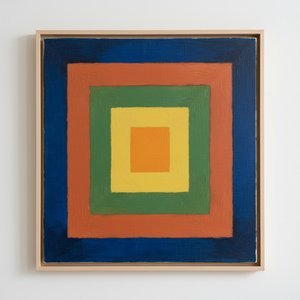
Josef Albers's "Multiplex D," created in 1948, stands as a cornerstone of American Abstract Expressionism while simultaneously embodying the principles of Bauhaus design—a testament to his multifaceted artistic vision. This deceptively simple woodcut print showcases nine squares meticulously arranged on a rectangular canvas, each square subtly offset from its neighbors, creating an illusion of depth and movement that transcends mere visual representation. Albers’s masterful manipulation of tonal variations within the squares contributes significantly to this perceptual experience, prompting viewers to contemplate how color interacts with form and how individual perception shapes our understanding of reality.- Artist: Josef Albers (American (born Germany), Bottrop 1888–1976 New Haven, Connecticut)
- Medium: Woodcut on Paper
- Dimensions: Sheet: 9 × 12 1/16 in
- Date: 1948
The Bauhaus Influence and Geometric Precision
Albers’s formative years were deeply rooted in the Bauhaus school of art and design, where he absorbed the revolutionary ideas championed by Walter Gropius regarding functionalism and the unification of art and craft. This influence is palpable in “Multiplex D,” which rejects representational imagery in favor of geometric abstraction—a deliberate choice to prioritize form over content and to explore the fundamental properties of visual perception. The repetition of squares, a motif prevalent throughout Bauhaus aesthetics, underscores the school’s belief that simplified shapes could convey complex ideas effectively.Color Theory and Illusionistic Depth
“Multiplex D” exemplifies Albers's pioneering contributions to color theory—specifically his concept of simultaneous contrast. He understood that adjacent squares emit hues that appear differently depending on the surrounding colors, generating a dynamic interplay between perception and reality. This technique isn’t merely decorative; it serves as a conduit for investigating how our eyes perceive color and how these perceptions are influenced by context. The subtle gradations of tone within each square amplify this illusionistic depth, inviting contemplation about the nature of visual experience.Symbolism Beyond Surface Appearance
While seemingly devoid of narrative content, “Multiplex D” possesses a profound symbolic resonance. The squares themselves can be interpreted as representing stability and order—characteristics aligned with Bauhaus ideals—yet their overlapping positions suggest interconnectedness and the complexities inherent in human experience. Albers’s deliberate use of monochrome reinforces this notion, stripping away extraneous details to focus on the essential relationship between color and form. It encourages viewers to consider how visual elements communicate ideas beyond literal depiction.A Legacy of Influence
“Multiplex D” solidified Josef Albers's reputation as a visionary artist who reshaped the landscape of modern art. His meticulous attention to detail, coupled with his groundbreaking exploration of color perception, continues to inspire artists and designers globally. The print’s enduring appeal lies in its ability to provoke intellectual curiosity while simultaneously conveying an understated elegance—a reflection of Albers's unwavering commitment to artistic integrity and his profound understanding of the transformative power of visual art. Its inclusion in museums like The Metropolitan Museum of Art demonstrates its significance as a pivotal piece within American art history.Gyakran Ismételt Kérdések
A "Multiplex D" jellemző arra, amit Albers József általában alkotott?
Albers József ismétlődő témái közé tartozik a color exploration, geometric abstraction, bauhaus legacy, minimalist aesthetic, formal experimentation; a „Multiplex D” fókuszál a squares, color theory, geometric forms, composition, minimalism, printmaking, bauhaus témakörre.
Mely művészeti irányba tartozik a „Multiplex D”, Albers József alkotása?
A "Multiplex D" a Geometric Abstraction egyik alkotása. A művészeti irány jelzi azt a művészeti hagyományt, amelybe a mű tartozik.
Vannak a „Multiplex D” alkotáshoz hasonló művek?
A „Multiplex D”, Albers József alkotása alkotással hasonló műwerkepek a műalkotás Hasonló műalkotások oldalán gyűjthetők össze.
A művész életrajza
A Life Forged in Material: The Early Years and Bauhaus Formation
Josef Albers’s artistic journey began not amidst the rarefied air of established academies, but within the pragmatic world of his father’s contracting business in Bottrop, Germany. Born in 1888, young Josef absorbed a deep respect for materials – carpentry, plumbing, house-painting – skills that would fundamentally shape his aesthetic sensibility. This wasn’t merely vocational training; it was an immersion into the very essence of making, understanding how forms materialized and the inherent qualities within each medium. He learned to appreciate the subtle nuances of wood grain, the precise balance of a plumb bob, the transformative power of color applied to walls – experiences that would later inform his abstract explorations. Before dedicating himself fully to art, Albers spent five years as a schoolteacher, honing patience and pedagogical skill—attributes that would later define his influential teaching career. Formal artistic training commenced at the Königliche Kunstschule in Berlin between 1913 and 1915, where he explored printmaking, painting, and, crucially, stained glass. His early commission, “Rosa Mystica Ora Pro Nobis” (1918), a stunning stained-glass window for a church in Germany, foreshadowed his lifelong fascination with the interplay of light and color, hinting at the abstract explorations to come. This initial work wasn’t simply decorative; it was an investigation into how light *transformed* material, a theme that would resonate throughout his career – a fundamental shift from representation to perception.The Bauhaus Crucible: Color as Subject
A pivotal moment arrived in 1922 when Albers joined the faculty of the Bauhaus, a revolutionary school seeking to unify all artistic disciplines under Walter Gropius’s visionary leadership. Initially tasked with teaching the preliminary course – *Werklehre* (workshop practice) – he immersed himself in its core principles: functionalism, geometric abstraction, and material exploration. This period proved transformative. Albers began a systematic investigation into color perception, moving away from representational art towards an increasingly abstract vocabulary. He wasn’t interested merely in *what* colors were, but *how* they interacted, how they influenced each other, and how our eyes perceived them. The influence of fellow Bauhaus masters like Paul Klee and Wassily Kandinsky is discernible in his early work, yet Albers charted a unique course, prioritizing empirical observation over metaphysical interpretation. He wasn’t seeking spiritual truths through color; he was meticulously documenting its physical effects – a scientific rigor that became the hallmark of his artistic method. This focus on perception, on how we *see*, rather than what is *seen*, set him apart and laid the groundwork for his future explorations. The Bauhaus environment fostered experimentation with unconventional materials—wire netting, matchboxes, glass shards—pushing Albers to consider the inherent properties of each substance and their impact on visual experience.Homage to the Square: A Laboratory of Perception
Following a period teaching at Black Mountain College – where he fostered a generation of American artists including Robert Rauschenberg and Cy Twombly – Albers embarked on what would become his most iconic series in 1949: “Homage to the Square.” This ongoing project consisted of paintings featuring nested squares within squares, each iteration exploring subtle variations in color relationships. It’s a deceptively simple premise, but one that belies an incredibly complex and rigorous investigation. Albers meticulously documented his experiments, revealing how colors aren't static entities but dynamic forces governing each other through internal logic – often misleading to the eye. A seemingly brighter square might appear to recede while a darker one advances, defying intuitive understanding. The series wasn’t intended as a celebration of geometry; rather, it was a laboratory for studying color perception. Albers’s goal was not to create beautiful pictures but to reveal the underlying mechanisms of visual experience. This research culminated in his seminal book, “Interaction of Color” (1963), a foundational text still studied by artists and designers today – a distillation of years of painstaking observation and analysis. The book isn't a treatise on color theory; it’s a series of exercises designed to demonstrate how our perception of color is relative and contextual – a testament to Albers’ belief that seeing is not passive, but an active process of interpretation.Chromatic Interactions and Legacy
Albers’s work extended beyond the “Homage to the Square” series, encompassing murals for buildings like the Corning Glass Building and the Time & Life Building in New York City, as well as explorations in glass and design. Throughout his career, he consistently sought to bridge the gap between art and craft, emphasizing the importance of material knowledge and direct experience. His teaching at Yale University from 1950 until his retirement in 1958 profoundly shaped the course of modern art education. He instilled a rigorous approach to observation, encouraging students to question assumptions and develop their own unique artistic voices. Josef Albers died on March 25, 1976, in New Haven, Connecticut, leaving behind a legacy that continues to inspire artists, designers, and educators alike – a testament to the power of observation, experimentation, and the enduring mystery of color. His influence can be seen not only in his own groundbreaking work but also in the countless artists who have been shaped by his teachings and his profound understanding of visual perception.Notable Works
- Gray Instrumentation I Prospectus (1975): A minimalist monochrome painting exemplifying geometric balance and subtle tonal variations.
- Study for Homage to the Square – Beaming (Date Unknown): A classic example of Albers’s exploration of color interaction within nested squares, evoking a sense of calm and spatial depth.
- Rosa Mystica Ora Pro Nobis (1918): His early stained-glass commission, foreshadowing his lifelong fascination with light and color.

Albers József
1888 - 1976 , Németország
Gyors információk
- Artistic Movement Or Style: Geometriai absztrakt
- Artists Or Movements Influenced By This Artist:
- Minimalizmus
- Színterületek
- Artists Who Influenced This Artist:
- Paul Klee
- Wassily Kandinsky
- Date Of Birth: 1888. március 19.
- Date Of Death: 1976. március 25.
- Full Name: Josef Albers
- Nationality: Német-amerikai
- Notable Artworks:
- Homage a Szögzet
- Szürke Műszerek I.
- Rosa Mystica
- Place Of Birth: Bottrop, Németország
Kapcsolódó cikkek
Josef Albers: A Homage to Color Interaction & the Foundations of Visual Perception
Explore Josef Albers's groundbreaking color theory & the 'Homage to the Square' series. Discover how his work revolutionized visual perception and influenced modern art movements like Minimalism & Op Art. Learn about his Bauhaus roots & lasting legacy.

Beyond Form & Color: Geometric Abstraction's Enduring Legacy in Art History
Explore the captivating world of geometric abstraction! Discover its origins, key artists like Malevich & Mondrian, and why this movement remains highly valued by art collectors today. Expert insights at OriginalUniqueArt.

Beyond Form & Color: Geometric Abstraction's Evolution in 20th/21st Century Art
Explore the evolution of geometric abstraction from Cubism to contemporary art. Discover key artists like Malevich & Mondrian, investment insights, and expert collecting advice at OriginalUniqueArt.

The Enduring Appeal of Geometric Patterns in Art: A Historical & Contemporary Exploration
Explore the captivating history of geometric abstraction in art, from ancient roots to contemporary masters. Expert insights for collectors & enthusiasts. Discover key artists, movements & investment potential.

Geometrikus Absztrakció Mesterei: 10 Alapvető Műalkotás a Lakberendezéshez
Fedezze fel a geometrikus absztrakció 10 legikonikusabb műalkotását! Kandinsky, Mondrian és más mesterek festményeinek története inspirálja otthona dekorációját. Múzeumi minőségű reprodukciók a OriginalUniqueArt.com-on – fedezze fel online!