
 Megtekintés
 Küldés
 Megosztás
 Részletek
 Útmutató

 Letöltés
 Hasonló darabok
 X-ray felvétel
 Diavetítés
 Q&A
Q&A Statisztika
The Angels' Kitchen

- 59.0 x 47.0 cm


 Összes részlet megjelenítése
Szerezzen be nyomtatásra kész fájlt, amely messze túlmutat a webes előnézeten. Minden általunk értékesített digitális kép az adatbázisunkban található nagy felbontású mesterfájlból származik – általában 5 000 és 15 000 pixel szélességű –, így magabiztosan nyomtathat nagy méretben, sokat vághat a képen, vagy reprodukálhatja a legfinomabb részleteket is.
Stúdiómból egyetlen fájl sem távozik feltartózkodás nélkül. Egy digitális szakértő az eredeti festménnyel összehasonlítja a színeket, és szükség esetén korrigálja azokat, majd professzionális retusználó eszközökkel javítja a tisztaságot és a részletgazdagságot — miközben mindig hű marad a művész vonalvezetéséhez és stílusához. Az eredmény egy olyan kép, amely úgy néz ki, mint egy festmény, és nem úgy, mint egy szűrőzött szkenn.
A végső munka befejezése előtt jóvá kell hagynia a képet: szakértőnk 72 órán belül elküldi azt e-mailben ellenőrzésre. Nem tetszett? Kérhet javításokat vagy korrekciókat, illetve visszatérítést kérhet, amennyiben a minőség nem felel meg az elvárásoknak.
Ez az a minőség, amelyre a kiadók, a design stúdiók, a galériák és a nyomdaték megbízhatnak.
Digitális kép
Töltsön le nagy felbontású fájlt személyes kiállításokhoz, nyomtatáshoz és kreatív projektekhez. ( Váltás nyomtatványra Kézzel festett másolat rendelése)
Minden digitális kép rendeléséhez tartozó extrák
Szakértői digitális kézbesítés, garantáltan
Amikor a OriginalUniqueArt.com szolgáltatást választja, nem csupán egy képet kap – professzionálisan felmagasított digitális műalkotást kap, amely precizitással készült, és amelyet megelégsedési gwarancia tesz biztoslássá. Az alábbiakban automatikusan minden benne 】

Gyors e-mail teslimítés
A nagy felbontású digitális képmásolatát a megrendelést követő 72 órán belül e-mailben elküldjük Önnek – azonnal használható formátumban.

MI-alapú digitális fájljavítás
Műve professzionális módon kerül optimalizálásra fejlett mesterséges intelligencia eszközök és manuális szerkesztés segítségével, biztosítva a maximális részletességet, tisztaságot és színpontosságot.

Örök életű ingyenes újradelivery
Véletlenül törölted vagy elvesztetted a fájlodat? Ne aggódj – bármikor ingyen újra megküldjük neked.

Nincs importköltség – soha
Élvezze műalkotásait azonnal, vám, illeték vagy szállítási költség nélkül – a digitális letöltések mindig adamentesek.

Színpontosság garantálása
Professzionális eszközök és színkezelés segítségével garantáljuk, hogy digitális képe a lehető legpontosabban tükrözze az eredeti színeket.

100 napos elégedettségi garancia
Ha nemມີ elégedett a digitális képével, 100 napon belül felülvizsgáljuk vagy 100% visszatérítjük az amountot – kérdés बिना.

100% Pénzvisszatérítési garancia
Nem tetszett a vásárlás? 100 napon belül teljes visszatérítést garantálunk a digitális fájl megvételétől számítva – kérdés nélkül.

Tömegrendelési kedvezmények
Vásároljon 3 képet, spóroljon 10%-et - Vásároljon 5-öt, spóroljon 15%-et - Vásároljon 10+ képet, spóroljon 20%-at. Kiváló kreatív projektekhez, galériákhoz és ügynökségekhez.
The Angels' Kitchen: A Surrealist Reverie by Jacek Yerka
Jacek Yerka’s “The Angels’ Kitchen,” painted in 2005, is more than just a depiction of a domestic scene; it’s an immersive journey into a meticulously crafted surrealist dream. Measuring 59 x 47 cm, this artwork immediately captivates with its juxtaposition of the familiar – a kitchen brimming with everyday objects – and the extraordinary – a fully-fledged angel engaged in culinary activities amidst an orchard bursting with life.
- A Flemish Masterpiece: Yerka’s dedication to the classic Flemish technique, honed through years of study and unwavering commitment, is strikingly evident. The painting's rich detail, meticulous rendering of textures, and masterful use of light evoke the spirit of masters like Jan van Eyck and Pieter Bruegel, while simultaneously forging a distinctly modern vision.
- A Dreamscape in Detail: The composition itself is layered with symbolic richness. A cat calmly observes from the sink, an apple tree dominates the center – laden with fruit – and bottles are scattered across surfaces, adding to the whimsical atmosphere. This isn’t simply a kitchen; it's a carefully constructed world where the mundane and the divine intertwine.
Yerka’s artistic lineage is profoundly influential, drawing inspiration from figures like Hieronymus Bosch and Hugo van der Goes. This influence manifests in the painting’s slightly unsettling yet undeniably beautiful depiction of fantastical elements – a blend of recognizable objects and imaginative additions that invites contemplation on themes of creation, nourishment, and perhaps even spiritual grace.
Decoding the Symbolism
“The Angels’ Kitchen” is replete with symbolic meaning. The angel itself represents purity and divine intervention, yet it's presented in an utterly ordinary setting – preparing food. This deliberate contrast elevates the painting beyond a simple still life; it prompts us to consider the intersection of the sacred and the secular. The kitchen, traditionally associated with nourishment and earthly pursuits, becomes imbued with spiritual significance within Yerka’s vision.
- The Apple Tree: Symbolizing abundance, fertility, and knowledge – a recurring motif in Western art – the apple tree is central to the painting's narrative.
- The Cat: Often associated with mystery and intuition, the cat’s presence adds an element of quiet observation and perhaps even guardianship.
The overall effect is one of serene contemplation, inviting viewers to lose themselves in Yerka’s meticulously rendered world. The diffused lighting and soft edges contribute to a sense of dreamlike tranquility, further enhancing the painting's emotional impact.
Technique and Materials
Yerka employs a predominantly watercolor or gouache technique on paper, evidenced by the painting’s subtle blending, soft edges, and delicate textures. This approach lends the artwork a luminous quality, capturing light with remarkable sensitivity. The artist’s attention to detail is breathtaking, from the individual strands of grass in the foreground to the polished surfaces of the kitchen implements.
- Traditional Supplies: The use of traditional painting supplies – likely watercolor or gouache – reinforces the connection to the Flemish masters and contributes to the artwork’s timeless appeal.
- Layered Approach: Yerka's masterful layering creates depth and complexity, drawing the viewer into the scene and inviting repeated observation.
A Legacy of Surrealist Vision
"The Angels’ Kitchen" stands as a testament to Jacek Yerka’s artistic vision – a bold exploration of surrealism that seamlessly blends reality with fantasy. Exhibited across continents, including Poland, Germany, Monaco, France, and the United States, Yerka's work has garnered significant recognition within the art world. This piece is not merely a beautiful image; it’s an invitation to embrace the unexpected, question conventional perceptions, and discover beauty in the most unlikely of places.
Kérdések és válaszok
Milyen domináns alapszín jellemzi „The Angels' Kitchen”, Jacek Yerka alkotása alkotást?
A „The Angels' Kitchen” egy Ochre to Sepia tónus felé hajlik.
Milyen hangulatot áraszt a "The Angels' Kitchen"?
A „The Angels' Kitchen”, Jacek Yerka alkotása hangulata Ethereal, ami segíthet a mű megfelelő környezetbe illesztésében.
Milyen érzést közvetít a „The Angels' Kitchen”, Jacek Yerka alkotása?
A „The Angels' Kitchen”, Jacek Yerka alkotása egy Spiritual érzést közvetít, egy összonosan Ethereal hangulatban.
Művész életrajza
Early Life and Artistic Beginnings
Jacek Yerka, a name synonymous with surrealist fantasy landscapes, emerged from a family steeped in artistic tradition in Toruń, Poland, back in 1952. Both his parents were graduates of the local Fine Art Academy – his father a celebrated sculptor, and his mother a skilled painter – creating an environment where brushes, paints, and canvases were as familiar as toys. From a young age, Yerka found solace not in playgrounds or social gatherings, but within the quiet solitude of his own creative pursuits: sketching intricate details on scraps of paper and sculpting miniature worlds from clay. This preference for solitary creation, however, led to some challenges during his primary school years; described by Yerka himself as a “grey, sometimes horrifying reality,” he was often viewed as an outsider, a boy lost in his own imaginative universe. Despite these social difficulties, his exceptional talent for drawing earned him a measure of respect among his peers, particularly in high school where his sketches were admired and occasionally displayed. This early exposure to both the beauty and the isolation of artistic expression would profoundly shape his future path.Artistic Journey and Development
Initially, Yerka entertained ambitions that seemed worlds away from the realm of art – he considered careers in astronomy and medicine, drawn by a fascination with the vastness of space and the intricacies of the human body. However, after completing his studies at Nicolaus Copernicus University in Toruń, he made a decisive choice: to dedicate himself entirely to fine art and graphic design. A key element of this decision was his resistance to embracing contemporary artistic trends. Instead, Yerka steadfastly adhered to the meticulous and highly detailed painting techniques of the Flemish masters – a commitment that would become instantly recognizable as the defining characteristic of his unique style. This dedication wasn’t merely an aesthetic preference; it represented a deep respect for tradition and a desire to master a technique honed over centuries. He saw in the works of artists like Jan van Eyck and Hieronymus Bosch not just beautiful images, but profound insights into human perception and the nature of reality.Influences and Inspirations
Yerka’s artistic vision is profoundly shaped by the legacy of masters from the past. He cites a remarkable range of influences – Hieronymus Bosch with his unsettling visions of medieval life, Pieter Bruegel for his depictions of everyday scenes infused with symbolic meaning, and even figures like Cagliostro, known for his enigmatic persona and blending of science and mysticism. The influence of the Renaissance artist Jan van Eyck is evident in Yerka’s meticulous attention to detail and use of perspective, while the dramatic compositions of Hugo van der Goes inspire his grand, theatrical landscapes. Beyond art history, Yerka draws inspiration from scientific concepts – particularly theories about cosmology and evolution – as well as vivid memories from his childhood spent exploring the Polish countryside. These diverse sources of influence converge in his work to create a world that is both fantastical and strangely familiar.Key Characteristics of His Work
Yerka’s paintings are immediately recognizable for their distinctive blend of surrealism, Flemish technique, and intricate detail. He doesn't simply paint landscapes; he constructs entire worlds – often populated by bizarre creatures, impossible architecture, and a sense of timeless mystery. The Flemish technique, with its painstaking layering of glazes and meticulous rendering of textures, is evident in every brushstroke, creating an almost photographic realism within the realm of fantasy. The level of intricate detail is astonishing; viewers are invited to lose themselves in the smallest corners of a painting, discovering hidden narratives and symbolic clues. Yerka’s works frequently explore themes of science fiction, mythology, and the relationship between humanity and the cosmos – often merging scientific concepts with artistic expression in unexpected and thought-provoking ways. His creations aren't merely beautiful; they are invitations to dream, to question, and to contemplate the mysteries of existence.Notable Works and Achievements
Throughout his career, Jacek Yerka has produced a vast body of work that has garnered international acclaim. Some of his most celebrated paintings include “The Angels’ Kitchen,” a surreal depiction of a celestial banquet, and “Wegener's Theory,” which reimagines the controversial theory of continental drift as a fantastical journey through time and space. Yerka’s art has been exhibited extensively in Poland, Germany, Monaco, France, and the United States, establishing him as one of the leading surrealist painters of his generation. Notably, he collaborated with Hollywood producer Renee Daalder on designs for the science fiction film “Strawberry Fields,” further expanding his reach beyond the art world. His work is now held in private collections around the globe and continues to inspire artists and collectors alike.Historical Significance and Legacy
Jacek Yerka’s unique artistic vision has cemented his place as a significant figure in contemporary art. His ability to seamlessly blend the surreal, the scientific, and the mythological creates captivating works that resonate with audiences worldwide. He represents a continuation of a long tradition of European fantasy painting, while simultaneously pushing the boundaries of the genre with his meticulous technique and imaginative storytelling. Yerka’s legacy extends beyond his individual paintings; he embodies a spirit of creative exploration and a willingness to challenge conventional notions of art and reality – a testament to the enduring power of imagination.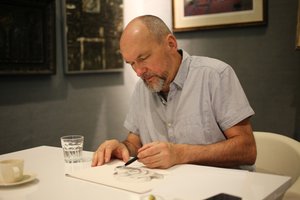
Jacek Yerka
1952 - , Lengyelország
Érmeradatok
- Artistic Movement Or Style: Surrealista
- Artists Or Movements Influenced By This Artist: ['Flemish Painting']
- Artists Who Influenced This Artist:
- Hieronymus Bosch
- Pieter Bruegel
- Jan van Eyck
- Date Of Birth: 1952
- Full Name: Jacek Yerka
- Nationality: Lengyel
- Notable Artworks:
- An Angels' Kitchen
- Wegener's Theory
- Place Of Birth: Toruń, Lengyelország