Prebacite na printove
 Prikaži više







































 Za umjetnička djela ili reprodukcije veće od 105 cm (približno 41 inč) na bilo kojoj strani, okvir će biti isporučen u obliku rastavljenog seta za montažu. Ovaj način osigurava sigurnu dostavu i sprječava oštećenja tijekom transporta.


The Enigmatic Figure: A Portrait of Quiet Strength
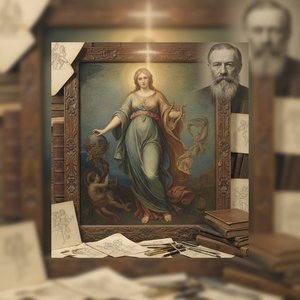
George Frederic Watts’ “She Shall be Called Woman,” painted circa 1875-92, is not a portrait in the conventional sense. It's an arresting study in stillness and profound contemplation, capturing a woman seemingly lost within her own thoughts. The figure, rendered with a deliberate lack of explicit detail – her face obscured by a veil of dark hair – immediately invites speculation and projection. She stands bathed in a diffused light, reminiscent of a northern sky, suggesting both vulnerability and an inner resilience. The composition is carefully balanced; the verticality of her form contrasts subtly with the horizontal sweep of the landscape behind her, creating a sense of groundedness despite the ethereal quality of the scene.
Watts’ masterful use of oil paint allows for a remarkable depth of texture and color. The muted palette – predominantly blues, greens, and browns – evokes a mood of melancholy and introspection. Notice how he builds up layers of pigment to create subtle gradations in tone, particularly around the folds of her dress and the suggestion of foliage behind her. This technique isn’t merely decorative; it contributes significantly to the painting's overall sense of atmosphere and emotional resonance.
A Symbolist Vision: Echoes of Myth and Philosophy
“She Shall be Called Woman” firmly establishes Watts as a key figure within the Symbolist movement, a European artistic current that flourished in the late 19th century. Rejecting the realism and materialism prevalent in much of 19th-century art, Symbolists sought to express inner states of mind, spiritual truths, and mythological themes through evocative imagery and suggestive forms. This painting is deeply rooted in this philosophy; it’s less about depicting a specific individual and more about embodying an abstract concept – womanhood itself.
The veiled face, a recurring motif in Watts' work, symbolizes the hidden depths of the female psyche, the mysteries that lie beneath the surface. The landscape behind her is not merely a backdrop but a symbolic representation of the inner world—a suggestion of nature’s wisdom and the cyclical rhythms of life. Watts drew heavily on classical mythology and philosophy for inspiration, particularly Plato's concept of the “Allegory of the Cave,” which explores the journey from ignorance to enlightenment. The woman in this painting can be interpreted as a figure emerging from darkness into a realm of greater understanding.
Historical Context: Victorian Sensibilities and Spiritual Yearning
To understand "She Shall be Called Woman," it’s crucial to consider the social and intellectual climate of Victorian England. The era was marked by rapid industrialization, social upheaval, and a growing sense of spiritual unease. Many Victorians felt alienated from the materialism of the age and yearned for something more meaningful—a connection to nature, spirituality, and the timeless values of antiquity. Watts’ art reflects this yearning, offering a refuge from the anxieties of modern life.
Watts himself was deeply influenced by his travels in Italy, where he encountered the works of Michelangelo and Giotto, which profoundly shaped his artistic vision. His interest in classical mythology and philosophy further informed his work, leading him to explore themes of beauty, truth, and the human condition with a profound sensitivity.
Emotional Resonance: A Portrait of Inner Strength
Despite her obscured features, “She Shall be Called Woman” radiates an undeniable sense of strength and dignity. The painting’s power lies not in its literal depiction but in its ability to evoke a feeling—a quiet contemplation, a profound awareness of the mysteries of existence. It's a portrait that invites viewers to project their own hopes, fears, and aspirations onto the figure, creating a deeply personal and resonant experience.
Reproductions of this iconic work offer an opportunity to bring Watts’ evocative vision into any space, serving as a reminder of the enduring power of art to illuminate the human spirit. Consider framing it in a manner that complements its muted palette and contemplative mood – perhaps against a neutral wall or within a room filled with natural light.
Pitanja i odgovori
Na koji način se preporučuje tisak djela "She Shall be Called Woman" – koja je preporučena veličina i orijentacija?
Za "She Shall be Called Woman", preporučena veličina za print je Large i Tall orijentacija.
Koje boje i koja dominantna boja definiraju "She Shall be Called Woman"?
Koloristički identitet djela "She Shall be Called Woman" autora George Frederic Watts: paleta u nijansama Dark, s dominantnom bojom Espresso (#583a2f).
Na koji način "She Shall be Called Woman" autora George Frederic Watts povezuje Symbolist Movement s domovinom umjetnika?
Djelo u stilu Symbolist Movement pod nazivom "She Shall be Called Woman" djelo je umjetnika rođenog u Ujedinjeno Kraljevstvo.
 Pregledaj u realnoj veličini
 Pošalji
 Podijeli
 Detalji o umjetničkom djelu
 Vodič
Vodič

 Preuzmi umjetničko djelo
 Slični predmeti
 Rentgenska snimka
 Slide show
 Pitanja i odgovori
 Statistika