A Life Formed by Metal and Earth
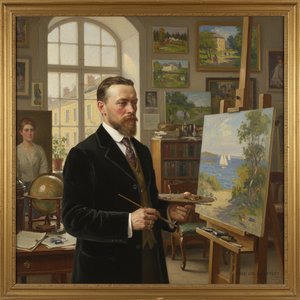
Reijo Juhani Hukkanen lived his life in the quiet strength of Oulu, Finland. Born on May 4, 1946, he was an artist whose hands were as comfortable with a paintbrush as they were with a welding torch. His early years in the north shaped a vision that would eventually move from the canvas to the heavy, industrial reality of scrap metal. After completing his studies at the Academy of Applied Arts in 1971, he began a career that would span decades, moving through different modes of expression with a steady, deliberate hand.
In the 1970s, his work was defined by the softer edges of painting. These early pieces often drew from the landscapes of Lappland, ranging in style from the simple clarity of Naïf art to the more distorted realities of surrealism. He taught at the University of Oulu’s architecture department between 1981 and 1989, a period that likely deepened his understanding of structure and form. By 1982, however, the paint gave way to something more tactile. He began to find beauty in the discarded, turning toward found-object works and sculptures built from the remnants of the world around him.
The Alchemy of the Discarded
Hukkanen’s later work was a study in transformation. He possessed a particular talent for taking materials stripped by nature or industry and reassembling them into something entirely new. He used metal sheets torn from roofs during storms, welding aluminum and steel to create three-dimensional compositions that felt like collages expanded into space. His sculptures were not merely objects but assemblies of history, where a piece of scrap could carry the weight of its previous life into a new, metallic form.
One of his most significant public contributions arrived in 2012 with the installation of Laulupuut, or Song Trees, outside the Helsinki Music Center. This massive work, measuring 13 meters high and 6 meters wide, featured a central pike made of aluminum and steel, entwined with alder branches. The sculpture incorporated unexpected elements like piles of firewood and towers constructed from the lids of concert grand pianos. It was a heavy, physical presence in the city, weighing an immense amount and requiring intense technical skill to assemble.
Recognition and Finality
The honors bestowed upon him reflected a career of sustained impact within the Finnish art community. He received the State Prize in Visual Arts in 1987 and was named Artist of the Year at the Helsinki Festival in 1991. In 2012, he was awarded the Pro Finlandia Medal of the Order of the Lion of Finland, a high distinction for his contributions to the nation's culture. His works found homes in various public and private spaces, from the Oulu Cathedral to the Espoo Museum of Modern Art.
Hukkanen passed away on January 29, 2024, at the age of 77. He left behind a body of work that refused to stay within the boundaries of a single medium. Whether through the delicate motifs of his early paintings or the heavy, welded pike of his later years, he remained focused on the intersection of the natural and the manufactured.
Questions et réponses
Où et en quelle année Reijo Juhani Hukkanen est-il né ?
Reijo Juhani Hukkanen est né à Oulu en 1946.
Sous quels autres noms Reijo Juhani Hukkanen est-il/elle connu(e) ?
Reijo Juhani Hukkanen est également connu sous les noms suivants : Reijo Hukkanen.
Puis-je visiter un musée virtuel des œuvres de Reijo Juhani Hukkanen ?
Retrouvez les œuvres de Reijo Juhani Hukkanen dans une galerie 3D sur la page Musée en 3D de l'artiste.