Frederick William MacMonnies: The Sculptor Who Bridged Tradition and Innovation
Frederick William MacMonnie’s artistic journey began in Brooklyn Heights, New York, where he was born in 1863—a son of an importer whose business suffered a devastating blow during the Civil War (1861–65). This early hardship instilled in him a resilience that would characterize his entire life and profoundly shape his creative pursuits. Despite limited formal schooling, MacMonnie demonstrated exceptional talent from a young age, mastering stone carving at seventeen—a skill he honed through an apprenticeship with Augustus Saint-Gaudens, arguably the most prominent sculptor of his era. This formative relationship proved instrumental in establishing MacMonnie’s artistic principles and fostering enduring friendships.Early Influences & Artistic Training
Saint-Gaudens' unwavering conviction that sculpture possessed transformative power propelled MacMonnie’s artistic trajectory. Recognizing Saint-Gaudens’ genius, he eagerly accepted an invitation to join his studio—a decision that would prove pivotal in shaping his sculptural technique and fostering a collaborative spirit. Alongside Saint-Gaudens, MacMonnie studied diligently at night academies and the Art Students League of New York, immersing himself in artistic exploration alongside fellow artists destined for considerable success—most notably Stanford White, who entrusted Saint-Gaudens’ expertise to monumental commissions. This shared dedication to Beaux-Arts ideals—a synthesis of classical grandeur with modern dynamism—became a cornerstone of MacMonnie's artistic vision.Parisian Engagement & Artistic Recognition
Driven by an ardent desire to refine his craft and absorb the vibrant energy of European artistic culture, MacMonnie embarked on a transformative voyage to Paris in 1884. Immediately upon arrival, he enrolled at the École des Beaux-Arts—a bold step for a foreign student—securing the highest honor awarded to those venturing abroad: a testament to his unwavering commitment and burgeoning talent. The Parisian Salon served as an annual crucible for showcasing MacMonnie’s work—drawing considerable acclaim from critics and establishing him as a respected voice within the artistic milieu. He diligently pursued classical studies at Munich’s Royal Academy, mastering life drawing alongside fellow artists who would soon become luminaries of their respective fields.Notable Sculptures & Artistic Style
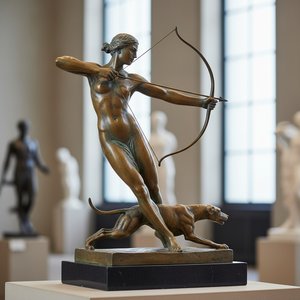
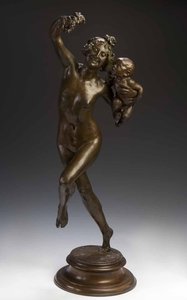
MacMonnie's sculptural output is characterized by remarkable versatility—ranging from monumental public commissions to intimate portraits capturing the essence of human emotion. Among his most enduring achievements are Nathan Hale (1890), commemorating the American Revolutionary War hero and embodying stoicism and patriotism; Diana (circa 1893), a graceful depiction of the Roman goddess reflecting classical beauty and dynamism; and Infant Faun (1894), conveying innocence and pastoral charm. These sculptures exemplify MacMonnie’s masterful command of bronze casting techniques—a medium he embraced wholeheartedly, recognizing its ability to convey both strength and subtlety. Copies of his works are found in museums across America, demonstrating the lasting impact of his artistic vision.Legacy & Historical Significance
Frederick William MacMonnie's contribution to American sculpture transcends mere aesthetic achievement; he championed accessibility through reproductions—ensuring that his masterpieces reached a wider audience. His influence extended beyond his own lifetime, inspiring subsequent sculptors and shaping the trajectory of Beaux-Arts art in America. He remains an exemplar of artistic ambition coupled with intellectual curiosity—a sculptor who successfully navigated the complexities of his time while forging an indelible mark on the canon of Western art.Questions et réponses
Où trouver les œuvres de Frederick William MacMonnies classées par couleur ?
Les œuvres de Frederick William MacMonnies peuvent être explorées par couleur sur la page Index spectral de l'artiste.
Où puis-je voir toutes les œuvres de Frederick William MacMonnies ?
Chaque œuvre de Frederick William MacMonnies sur ce site web peut être consultée depuis la page Toutes les œuvres de l'artiste.
Puis-je explorer les œuvres de Frederick William MacMonnies par mot-clé ?
Pour trouver des œuvres de Frederick William MacMonnies sur un thème spécifique, utilisez la page Par mots-clés de l'artiste, qui regroupe les œuvres par mot-clé.
À quelle période historique Frederick William MacMonnies a-t-il exercé ?
Frederick William MacMonnies a œuvré durant la période XIXe siècle. Cette période situe l'activité de l'artiste dans l'histoire.
D'où vient Frederick William MacMonnies ?
Frederick William MacMonnies est né(e) en États-Unis.
Combien d'œuvres de Frederick William MacMonnies sont disponibles à la consultation ?
Vous pouvez parcourir 23 œuvres d'art œuvres de Frederick William MacMonnies sur la page Toutes les œuvres.
Quel est le degré de popularité des œuvres de Frederick William MacMonnies ?
Une page Statistiques est disponible pour Frederick William MacMonnies, présentant des statistiques sur les œuvres de l'artiste sur ce site web.