Peinture à l'huile
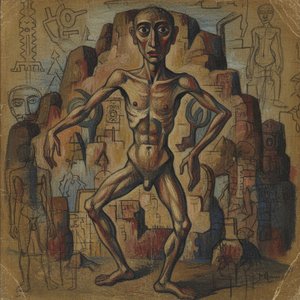
 Tout sur Study for Kites







































 Pour les œuvres ou reproductions dont un côté mesure plus de 105 cm (environ 41 pouces), le cadre sera expédié sous forme de kit démonté. Cette méthode garantit une livraison sécurisée et prévient tout dommage pendant le transport.


William Roberts is a British painter of figure compositions and portraits. He was a pioneer of abstract art before the First World War. Roberts worked outside the mainstream. Later in his career he would describe himself as an English Cubist. In 1914 Roberts joined the short-lived art movement the Vorticists, founded by the artist and writer Wyndam Lewis. The Vorticists believed that British art at this time was in a decayed state. Their aesthetic combined the geometrical fragmentation of Cubism with Futurist machine-like imagery. During the First World War, Roberts was a gunner on the Western Front. Later he became a war artist, a position he held in both world wars. He is best remembered for his large complex and colourful compositions.Roberts has marked this reference picture with a grid to help him to transfer it to canvas. The canvas is marked with a corresponding grid allowing the picture to be enlarged and transferred one square at a time.
Questions et réponses
Est-ce que Study for Kites est peint à la main ou est-ce une impression ?
Peint à la main : un peintre professionnel reproduit Study for Kites à l'huile sur une toile en lin.
Quelle taille choisir pour Study for Kites ?
Les tailles vont de 30.4 x 32.9 cm (€178) à 230.3 x 249.3 cm (€1843) ; le tableau sur cette page présente les principales étapes et leurs prix respectifs.
Quel est le délai de livraison ?
La livraison prend 4 à 5 semaines, avec une expédition express mondiale gratuite ; une option de production urgente est proposée sur cette page. Vous pouvez la retourner sous 100 jours pour un remboursement intégral, sans condition.
Où se trouve l'original de Study for Kites ?
L'original fait partie de la collection du Royal Albert Memorial Museum - Galerie d’art, à Exeter.
Quelle technique William Roberts a-t-il utilisée pour Study for Kites ?
Watercolor
 Aperçu en situation

 Envoyer
 Partager
 Détails de l'œuvre
 Fiche pédagogique


 Télécharger l'image
 Articles similaires
 Radiographie
 Diaporama
 Questions et réponses

 Statistiques