
 Aperçu en situation
 Partager
 Partager
 Détails
 Guide imprimable

 Télécharger
 Articles similaires
 Radiographie
 Voir le diaporama
 Statistiques
The Awakening Conscience
 Oil On Canvas
- WallArt
- Pre-Raphaelite Brotherhood
 1853
1853 55.0 x 76.0 cm
 Tate Britain
 Afficher la suite
Reproduction à l'huile faite à la main
Huile sur toile peinte à la main, avec cadre et dimensions personnalisés, réalisée sur commande par nos artistes. ( Passer au format impression Passer au format image numérique)




P118B €10

P118H €10

P118W €10

P438Z €10

P508JH €12

P508YH €12

P805H €10

P805Z €10

P919BZ €10

P919G €10

P919XJ €10

P959ZH €10

P968JZ €12

W106C €8

W218G €10

W218JH €8

W218Y €10

W307PJ €10

W316G €10

W316PJ €8

W316Y €10

W398PJ €8

W4111J €10

W500HY €15

W500JH €15

W692G €12

W849H €8

W940BG €15

W953PJ €8




Choisissez parmi nos formats prédéfinis qui respectent les proportions originales de l’œuvre.

Saisissez la largeur et la hauteur souhaitées, pour s'adapter à votre cadre ou à votre mur. Cette œuvre est peinte à la main ; ainsi, pour un format de forme différente, l'artiste peut peindre un peu plus autour du tableau ou réduire légèrement les bords — c'est vous qui choisissez. Nous vous envoyons une maquette numérique pour approbation avant que la peinture ne commence. L'image présentée sur cette page ne reflète pas le résultat réel — seule la maquette le fait.
Après la commande, l’équipe OriginalUniqueArt.com contactera le client par e-mail pour recueillir ses instructions et lui fournira une maquette d’aperçu
Livraison dans le monde entier () en 3 à 4 semaines au lieu des 5 semaines habituelles. (22 octobre). Aucun compromis sur la qualité.

Livraison express gratuite dans le monde entier

Toile de lin de haute qualité

Assurance transport complète

Garantie de remboursement des droits de douane

Garantie de fidélité des couleurs

Garantie de retour de 100 jours (uniquement en cas de défaut)

Garantie de remboursement à 100%

Tarifs dégressifs sur quantité
 L'option verre n'est disponible que pour les dimensions inférieures à 110 cm.

The Awakening Conscience
Technique de reproduction
Format de la reproduction
-


Prix total final
€ 263
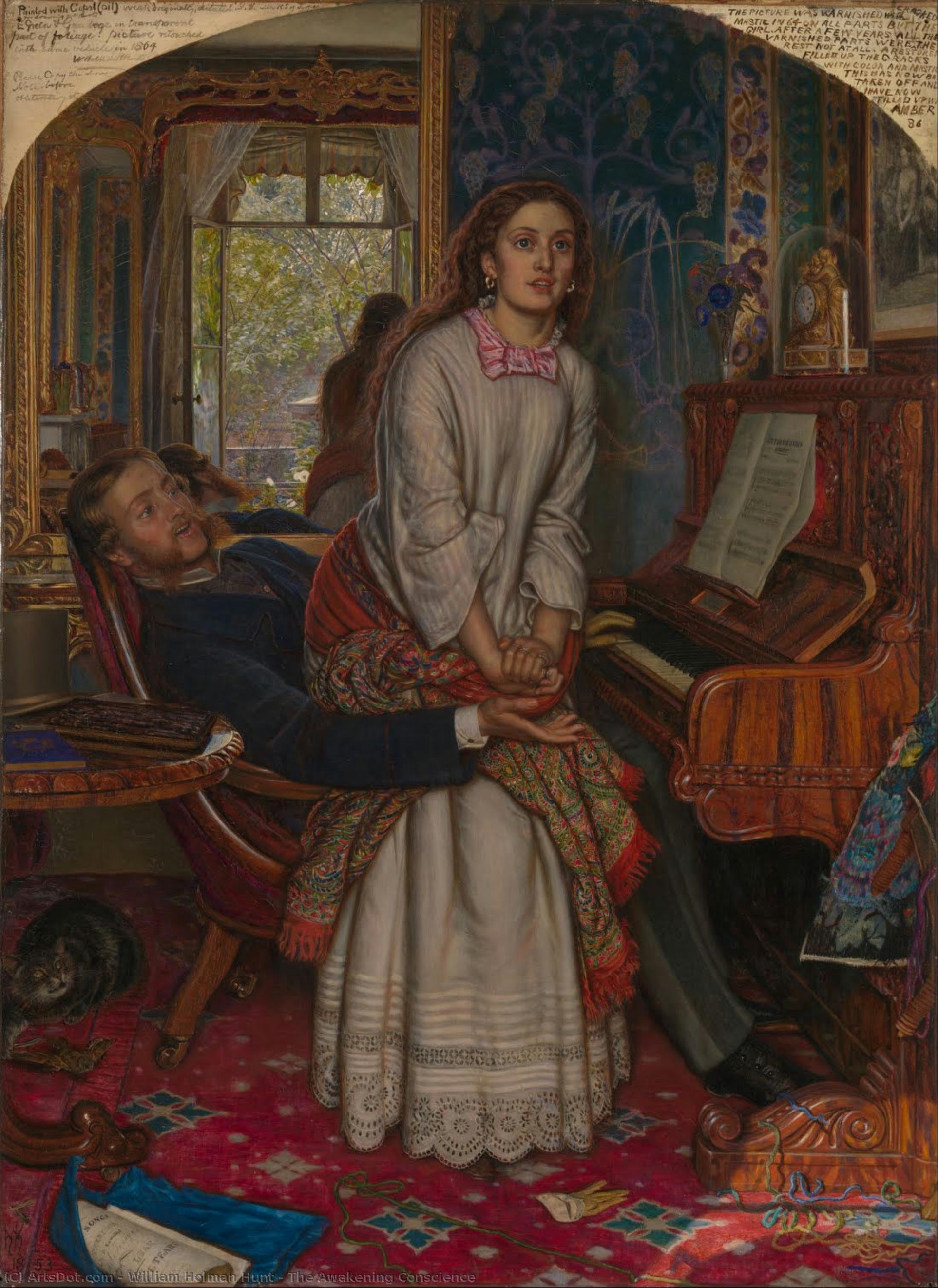
The Awakening Conscience: A Victorian Portrait of Moral Reckoning
William Holman Hunt’s “The Awakening Conscience,” painted in 1853, isn't merely a depiction of a clandestine rendezvous; it’s a meticulously crafted tableau of moral crisis and spiritual awakening, a profound exploration of Victorian sensibilities. This oil-on-canvas masterpiece transcends the conventions of portraiture, offering a window into the anxieties and aspirations of a society grappling with rapid social change and burgeoning religious introspection. Hunt, a founding member of the Pre-Raphaelite Brotherhood, deliberately eschewed the polished idealism of academic art, instead embracing a radical commitment to realism, symbolism, and emotional truth – qualities powerfully evident in this arresting work.
A Scene of Disquiet: Narrative and Composition
At first glance, the painting presents a seemingly straightforward domestic scene: a woman, identified as a fallen woman, sits in the lap of her lover within a lavishly furnished room. However, Hunt’s genius lies in layering multiple narratives and symbolic elements that quickly unravel this initial impression. The setting itself—a recently decorated apartment filled with new furniture, an elaborate tapestry, and gleaming objects—immediately signals a disruption of established order and a transgression against Victorian ideals of domesticity. The woman's posture, initially relaxed, subtly shifts as she turns her head towards the window, drawing the viewer’s eye to the stark contrast between the interior world of temptation and the promise of redemption represented by the vibrant spring garden visible beyond.
- The Lover: Represents worldly indulgence and a source of moral corruption.
- The Woman: Embodies vulnerability, regret, and the potential for spiritual rebirth.
- The Room: Symbolizes the artificiality and superficiality of a life lived outside of genuine faith.
- The Window: Represents an escape from earthly constraints and a pathway to moral awakening.
Symbolism Woven into Reality: Details of Moral Weight
Hunt’s meticulous attention to detail is paramount, imbuing the painting with layers of symbolic meaning. The discarded items scattered around the room—a broken glove, a top hat, a partially finished tapestry—speak volumes about wasted opportunities and shattered dreams. The clock concealed beneath glass serves as a potent reminder of time slipping away, while the music on the piano – Thomas Moore’s “Oft in the Stilly Night” – echoes the woman's lost innocence and longing for a simpler past. The presence of various objects—bells, marigolds, and a star—further reinforces the painting’s moral weight, suggesting both warning and hope. Notably, the mirror reflects not just the room but also the garden outside, emphasizing the allure of a life beyond earthly constraints.
Pre-Raphaelite Vision: Light, Color, and Emotional Resonance
“The Awakening Conscience” is a quintessential example of Pre-Raphaelite aesthetics. Hunt employed rich, saturated colors—deep indigoes, vibrant reds, and luminous greens—to create an intensely atmospheric effect. The use of light is particularly significant; it streams dramatically through the window, illuminating the woman’s face and casting long shadows across the room, highlighting the contrast between darkness and enlightenment. The painting's meticulous detail, achieved through painstaking brushwork and a commitment to naturalistic representation, reflects the Pre-Raphaelites’ desire to capture the beauty and complexity of the world with unprecedented accuracy. The overall effect is one of heightened emotional intensity, inviting viewers to contemplate the profound questions of morality, redemption, and the human condition.
This painting continues to resonate today as a powerful meditation on personal responsibility, spiritual yearning, and the enduring struggle between earthly desires and moral conscience. Reproductions offer a remarkable opportunity to experience the depth and complexity of Hunt’s vision, bringing this poignant portrait into any space with an appreciation for art's ability to provoke thought and inspire reflection.
Questions et réponses
À quelle étape de la carrière de William Holman Hunt « The Awakening Conscience » appartient-elle ?
«The Awakening Conscience» appartient à la période Mature Period de la carrière de William Holman Hunt. Cette classification relie l'œuvre à l'évolution de l'artiste.
Quelle technique a été utilisée pour «The Awakening Conscience» de William Holman Hunt ?
Le médium de «The Awakening Conscience» de William Holman Hunt est Oil On Canvas. Les reproductions visent à restituer l'aspect de cette technique.
Quelle émotion «The Awakening Conscience» de William Holman Hunt dégage-t-il ?
«The Awakening Conscience» de William Holman Hunt dégage une tonalité émotionnelle Melancholic.
Biographie de l'artiste
Premières années et carrière
William Holman Hunt, peintre anglais de renom, est né le 2 avril 1827 à Cheapside, Londres. Il est surtout connu pour être l'un des fondateurs de la Confrérie Préraphaélite, un groupe qui cherchait à revitaliser l'art en mettant l'accent sur l'observation détaillée du monde naturel.Œuvres notables et style
Les peintures de Holman Hunt se caractérisent par leur souci du détail, leurs couleurs vives et leur symbolisme élaboré. Parmi ses œuvres les plus remarquables figurent :- La Lumière du Monde (1851-1853), actuellement dans le chapelier du Keble College, Oxford, en Angleterre
- Le Berger Engagé, une scène de vie rurale moderne
- L'Éveil de la Conscience, qui met en évidence son succès précoce avec des scènes naturalistes intenses
- Le Bouc Emissaire, La Trouvaille du Sauveur dans le Temple et L'Ombre de la Mort, peintes pendant ses voyages en Terre Sainte à la recherche d'un matériel topographique et ethnographique précis.
Vie personnelle et dernières années
Holman Hunt a épousé deux fois, Fanny Waugh dans un premier temps, qui a posé pour plusieurs de ses œuvres, dont Isabelle et le pot de basilic. Après sa mort, il a sculpté son tombeau à Fiesole. Sa seconde épouse était Edith, la sœur de Fanny, qu'il a épousée à l'étranger en raison des lois britanniques contre le mariage avec la sœur d'une femme décédée. Les dernières années de Holman Hunt ont été marquées par une perte de vue progressive, ce qui l'a obligé à renoncer à la peinture. Il a achevé ses œuvres majeures finales avec l'aide de son assistant, Edward Robert Hughes. Holman Hunt est décédé le 7 septembre 1910 et a été enterré dans la cathédrale Saint-Paul, Londres.Héritage
Holman Hunt a publié ses mémoires en 1905 et a été nommé à l'Ordre du Mérite par le roi Édouard VII cette même année. Sa vie personnelle a ensuite été documentée dans le livre de Diana Holman-Hunt, Mon grand-père, sa vie et ses amours. Découvrez les œuvres de William Holman Hunt sur OriginalUniqueArt Dates clés :- 2 avril 1827 : né à Cheapside, Londres
- 1851-1853 : a peint La Lumière du Monde
- 7 septembre 1910 : décédé et enterré dans la cathédrale Saint-Paul, Londres

William Holman Hunt
1827 - 1910 , Royaume-Uni
En bref
- Artistes Influents:
- John Ruskin
- Dante Gabriel Rossetti
- Date De Décès: 7 septembre 1910
- Date De Naissance: 2 avril 1827
- Lieu De Naissance: Cheapside, Royaume-Uni
- Mouvement Artistique: Prérraphaélisme
- Nationalité: Britannique
- Nom Complet: William Holman Hunt
- Œuvres Notables:
- La Lumière du Monde
- Le Berger Engagé
- L'Éveil de la Conscience
Articles connexes

Dante Gabriel Rossetti : Les 25 Œuvres Maîtresses du Préraphaélisme à Redécouvrir
Plongez dans l'univers fascinant de Dante Gabriel Rossetti ! Découvrez les 25 œuvres majeures du préraphaélisme : symbolisme, poésie et beauté victorienne. Reproductions d'art exceptionnelles sur OriginalUniqueArt.com.

Sir John Everett Millais: Pre-Raphaelite Rebellion & Victorian Narrative Detail
Explore the revolutionary art of Sir John Everett Millais & the Pre-Raphaelite Brotherhood. Discover their radical realism, symbolic narratives, and lasting impact on Victorian aesthetics. A deep dive into 19th-century masterpieces.
La Confrérie des Préraphaélites : Rébellion Esthétique et Renaissance Médiévale
Explorez la Confrérie des Préraphaélites : une rébellion artistique anglaise fascinante. Découvrez leur philosophie, leurs œuvres majeures et l'influence durable de ce mouvement pictural. Guide d'achat et conseils d'experts sur OriginalUniqueArt.
The Pre-Raphaelite Brotherhood: Reclaiming Beauty, Nature, and Truth in Victorian Art History
Explore the revolutionary Pre-Raphaelite Brotherhood. Discover how these visionary artists rejected academic tradition to reclaim beauty, nature, and truth through luminous detail and literary depth in Victorian art history.

Pre-Raphaelite Romanticism: A Guide to Vivid Detail and Medieval Beauty in Victorian Art
Explore the vivid detail and medieval beauty of Pre-Raphaelite Romanticism. Discover the history of masters like Rossetti and Millais through our expert guide to Victorian art, perfect for collectors and professionals seeking authentic, museum-quality reproductions.


