Aperçu en situation
 Envoyer
 Partager
 Détails de l'œuvre
 Guide
Guide

 Télécharger l'image
 Articles similaires
 Radiographie
 Diaporama
 Q&A
Q&A Statistiques
Sans titre
 Acrylique sur toile
- Décoration murale
- Expressionnisme
 1944
1944 2.0 x 46.0 cm
 Centre Pompidou
 Lire la suite
Giclées et impressions d'art
Impressions giclées ou sur toile de qualité musée, avec une production rapide et des finitions au choix. ( Commander la reproduction peinte à la main Passer au format numérique)




P118B €10

P118H €10

P118W €10

P438Z €10

P508JH €12

P508YH €12

P805H €10

P805Z €10

P919BZ €10

P919G €10

P919XJ €10

P959ZH €10

P968JZ €12

W106C €8

W218G €10

W218JH €8

W218Y €10

W307PJ €10

W316G €10

W316PJ €8

W316Y €10

W398PJ €8

W4111J €10

W500HY €15

W500JH €15

W692G €12

W849H €8

W940BG €15

W953PJ €8




Choisissez parmi nos formats prédéfinis qui respectent les proportions originales de l’œuvre.

Saisissez la largeur et la hauteur souhaitées pour qu'elles s'adaptent à votre cadre ou à votre mur. Une impression peut être recadrée, mais jamais agrandie au-delà de l'image originale ; ainsi, un format de forme différente entraînera la perte d'une partie de l'image. Nous vous envoyons une maquette numérique pour approbation avant toute impression. L'image présentée sur cette page ne montre pas le recadrage réel — seule la maquette le permet.
Livraison dans le monde entier () en 2 semaines au lieu des 4/5 semaines habituelles. (29 octobre)

Livraison express gratuite dans le monde entier

Toile de lin de qualité supérieure

Assurance transport complète

Garantie de remboursement des droits de douane

Garantie de fidélité des couleurs

Politique de retour de 100 jours (uniquement en cas de défaut)

Garantie de remboursement à 100%

Offre de tarifs dégressifs
 L'option verre n'est disponible que pour les dimensions inférieures à 110 cm.

Sans titre
Giclées et impressions d'art
Format de la reproduction
-


Prix total
€ 71
Wassily Kandinsky’s “Picture With A White Border”: A Journey Into Inner Space
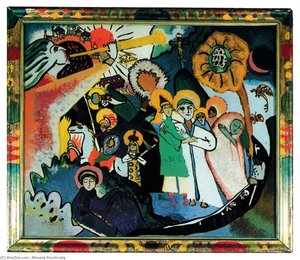
The year 1944 marked a pivotal moment in the trajectory of Wassily Kandinsky, a Russian painter and theorist whose work profoundly shaped the course of modern art. “Picture With A White Border,” a seemingly simple composition rendered in watercolor on paper, is far more than a mere depiction; it’s an invitation into the artist's intensely personal and spiritual world. This piece, housed within a striking white border – a detail that immediately draws the eye and elevates its significance – embodies Kandinsky’s late-career exploration of abstract forms as conduits for emotional expression and symbolic resonance. It represents a culmination of decades spent refining his unique approach to art, moving beyond representational imagery towards a purely subjective language of color and shape.
Kandinsky's artistic evolution is inextricably linked to his belief that art should transcend the limitations of objective reality and tap directly into the viewer’s subconscious. He envisioned painting as a means of communicating spiritual truths, utilizing geometric forms – circles, lines, triangles – not for their literal representation but for their inherent vibrational qualities. “Picture With A White Border” exemplifies this philosophy perfectly. The dominant presence of circles, arranged with deliberate asymmetry and varying sizes, evokes a sense of dynamic equilibrium, suggesting the interplay between order and chaos, stability and movement. These aren’t simply decorative elements; they are carefully considered building blocks in a visual symphony.
Decoding the Symbolism Within
The strategic placement of two small figures within the composition adds another layer of complexity to the artwork's meaning. These ambiguous forms – often interpreted as male and female, or perhaps simply representing humanity – appear to be observing, interacting with, or even being absorbed by the swirling patterns of color and shape. Their presence isn’t about depicting a specific scene; rather, they serve as anchors for the viewer, inviting us to contemplate our own relationship to the abstract forms surrounding them. Some scholars suggest these figures represent the artist's own soul engaging with his creative process, while others see them as symbols of introspection and self-awareness.
The white border itself is a crucial element, acting as both a frame and a symbolic barrier. It isolates the artwork from the surrounding environment, creating a sense of intimacy and encouraging focused contemplation. It also subtly echoes the circular forms within the painting, reinforcing the overall feeling of wholeness and unity. Kandinsky frequently employed borders in his work to emphasize the importance of the image itself, separating it from the mundane world and elevating its spiritual significance.
Technique and Late-Career Style
“Picture With A White Border” is a quintessential example of Kandinsky’s late-career style. He favored watercolor as his medium of choice during this period, appreciating its fluidity and ability to capture subtle tonal variations. The loose brushstrokes and washes of color create a sense of spontaneity and immediacy, reflecting the artist's intuitive approach to painting. Unlike earlier works characterized by more structured compositions, this piece feels remarkably free-flowing, almost improvisational – a testament to Kandinsky’s willingness to embrace chance and allow his emotions to guide his hand.
The color palette is deliberately restrained, dominated by muted blues, greens, and yellows. These colors are not used in a representational manner; instead, they evoke specific emotional responses—a sense of tranquility, introspection, or perhaps even melancholy. Kandinsky believed that color possessed inherent psychological qualities, and he meticulously studied the effects of different hues on the human psyche. The careful selection of these tones contributes significantly to the painting’s overall mood and resonance.
A Legacy of Inner Vision
“Picture With A White Border” stands as a powerful testament to Kandinsky's pioneering role in abstract art. It is not merely a beautiful image; it’s an invitation to engage with the inner landscape of the human soul, a journey into the realm of pure feeling and spiritual expression. Reproductions of this artwork offer a remarkable opportunity to experience firsthand the depth and complexity of Kandinsky’s vision—a vision that continues to inspire artists and viewers alike.
Questions et réponses
À qui offrir «Sans titre» de Wassily Wassilyevich Kandinsky en cadeau ?
Pour un cadeau, «Sans titre» de Wassily Wassilyevich Kandinsky est une excellente idée pour Anniversaire. D'autres occasions peuvent également convenir.
L'œuvre « Sans titre » est-elle disponible en tirage d'art ?
Vous pouvez commander une impression de «Sans titre» de Wassily Wassilyevich Kandinsky directement sur sa page Tirage d'art fine art : une impression d'art sur toile de coton ou sur papier canvas d'archive.
L'artiste Wassily Wassilyevich Kandinsky, créateur de « Sans titre », est-il connu sous d'autres noms ?
Wassily Wassilyevich Kandinsky est également connu sous le nom de Kandinsky.
Biographie de l'artiste
Wassily Wassilyevich Kandinsky : Pionnier de l'Abstraction
- Né : 16 décembre 1866, Moscou, Russie
- Décédé : 13 décembre 1944
- Nationalité : Russe
Jeunesse et Développement Artistique
- La jeunesse de Kandinsky a été marquée par une éducation diversifiée, étudiant initialement le droit et l'économie à l'Université de Moscou.
- À l’âge de 30 ans, il s’est tourné vers l’art, s’inscrivant à l’Académie de Munich sous la direction de Franz von Stuck. Ce changement a marqué un engagement profond envers l’expression artistique.
- Ses premières œuvres ont été influencées par l'art populaire russe, notamment lors d'un voyage ethnographique dans la région de Vologda en 1889.
- Il a développé un intérêt pour le symbolisme des couleurs et la psychologie, qui sont devenus des éléments fondamentaux de ses compositions abstraites ultérieures.
Périodes Artistiques Clés et Styles
- Expressionnisme Précoce : Caractérisé par des couleurs vibrantes et une intensité émotionnelle, comme on le voit dans "Papeln (Poplars)" (1902).
- Transition vers l'Abstraction : Kandinsky s’est progressivement éloigné de l’art représentatif, explorant la relation entre la couleur, la forme et l’émotion.
- Abstraction Géométrique : Cette période a vu un intérêt accru pour les formes géométriques et les compositions, illustré par "Several Circles" (140 x 140 cm).
- Abstraction Spirituelle : Kandinsky croyait que l'art pouvait exprimer des vérités spirituelles à travers des formes non représentatives. Ses œuvres visaient à évoquer des émotions et des expériences intérieures plutôt qu’à dépeindre la réalité externe.
Influence et Héritage
- Influence du Bauhaus : En tant que membre de faculté de l'école Bauhaus en Allemagne, Kandinsky a profondément influencé des générations d'artistes grâce à ses théories sur la couleur, la forme et l’abstraction.
- Écrits Théoriques : Ses écrits, notamment "De lo Spirituel dans l'Art", ont articulé sa philosophie artistique et ont contribué de manière significative au développement de la théorie de l'art abstrait.
- Impact sur l'Art Moderne : Kandinsky est largement reconnu comme un pionnier de l'art abstrait, ouvrant la voie à de nombreux mouvements et artistes ultérieurs.
- Collections Muséales : Ses œuvres sont conservées dans les principaux musées du monde entier, notamment la Galerie Tretyakov à Moscou, qui abrite sa "Composition VII" monumentale.
Œuvres Notables
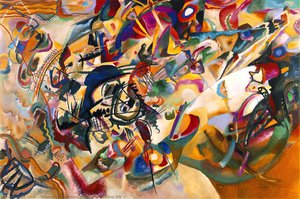
- Composition VII : Une œuvre abstraite de grande envergure considérée comme l'aboutissement du développement artistique de Kandinsky.
- Carré Noir (en collaboration avec Kazimir Malevitch) : Une œuvre fondamentale dans l’histoire de l’abstraction, représentant un départ radical des formes artistiques traditionnelles.
- Several Circles : Démontre son utilisation innovante de formes géométriques et de couleurs vibrantes pour créer des compositions dynamiques.
- Murnau avec une Église : Équilibre les éléments abstraits avec l'imagerie représentative, mettant en valeur son style en évolution.
- Un Bal Intime : Une œuvre ultérieure présentant une abstraction géométrique et un empâtement superposé, reflétant son exploration continue des thèmes spirituels.

Wassily Wassilyevich Kandinsky
1866 - 1944 , Russie
L'essentiel de l'artiste
- Artistic Movement Or Style: Expressionnisme abstrait
- Date De Décès: 13 décembre 1944
- Date De Naissance: 16 décembre 1866
- Full Name: Wassily Wassilyevich Kandinsky
- Lieu De Naissance: Moscou, Russie
- Nationalité: Russe
- Notable Artworks:
- Composition VII
- Carré noir
- Plusieurs cercles
- Murnau avec une église
- Un après-midi intime
Articles connexes

Kandinsky : Les 25 Œuvres Maîtresses d'un Pionnier de l'Art Abstrait | OriginalUniqueArt
Plongez dans l'univers vibrant de Kandinsky ! Découvrez les 25 œuvres majeures du pionnier de l'art abstrait. Explorez son expressionnisme, ses couleurs audacieuses et l'histoire fascinante derrière chaque tableau. Reproductions d'exception sur OriginalUniqueArt.com.

Expressionnisme Abstrait : Les 10 Chefs-d'Œuvre Incontournables pour Décorer avec Art et Histoire
Plongez au cœur de l'Expressionnisme Abstrait avec ! Découvrez les 10 œuvres majeures de Pollock, Rothko et De Kooning. Histoire, techniques & inspiration déco. Explorez la collection complète en ligne.

Les 10 Chefs-d'œuvre de l'Aquarelle qui ont Révolutionné l'Art | OriginalUniqueArt
Plongez dans l'univers fascinant des 10 chefs-d'œuvre de l'aquarelle qui ont marqué l'histoire de l'art. Découvrez Turner, Monet, Goya et bien d'autres ! Retrouvez ces œuvres emblématiques en reproductions exceptionnelles sur OriginalUniqueArt.com.

Ephemeral Visions: Exploring the Artistic Legacy & Contemporary Practice of Watercolor Painting
Explore the captivating world of watercolor painting! Discover its rich history, essential techniques, influential artists & collecting tips. A comprehensive guide for art enthusiasts from OriginalUniqueArt.

Éphémères Visions : L'Aquarelle, Histoire et Résonance Émotionnelle d'un Art Intemporel
Explorez l'histoire fascinante de l'aquarelle, des origines à nos jours. Découvrez les techniques, les artistes emblématiques et nos conseils d'experts pour collectionner ces œuvres éphémères. OriginalUniqueArt.