Menu

() ·

A painting made for you, by hand

Sans titre

Reproduction à l'huile faite à la main

Huile sur toile peinte à la main, avec cadre et dimensions personnalisés, réalisée sur commande par nos artistes. ( Passer au format impression Passer au format numérique)

Description de la pièce

Découvrez « Sans titre » de Wassily Kandinsky, une aquarelle abstraite vibrante de 1944 pleine de formes symboliques et d'énergie dynamique. Explorez sa composition unique et l'approche révolutionnaire de l'artiste.

Biographie de l'artiste

Découvrez Kandinsky (1866-1944), pionnier de l'art abstrait ! Explorez son expressionnisme vibrant, ses thèmes spirituels et son héritage Bauhaus à travers des reproductions exceptionnelles.

from ·

Chapter 1

How large should it be?

Slide to change the size; the picture on the left shows the frame at its real width. The proportions of the original are kept.

Format standard
sur mesure
CM
INCH

Choisissez parmi nos formats prédéfinis qui respectent les proportions originales de l’œuvre.

largeur
hauteur

Saisissez la largeur et la hauteur souhaitées, pour s'adapter à votre cadre ou à votre mur. Cette œuvre est peinte à la main ; ainsi, pour un format de forme différente, l'artiste peut peindre un peu plus autour du tableau ou réduire légèrement les bords — c'est vous qui choisissez. Nous vous envoyons une maquette numérique pour approbation avant que la peinture ne commence. L'image présentée sur cette page ne reflète pas le résultat réel — seule la maquette le fait.

Chapter 2

How should it arrive?

Choose the edges of the stretched canvas

Choose your frame

Corner sample of the WhiteWrap canvas edge finish, stretched on bois massif bars
White €1
Corner sample of the BlurSideWrap canvas edge finish, stretched on bois massif bars
Blurside €1
Corner sample of the ExtendedWrap canvas edge finish, stretched on bois massif bars
Extended €1
Corner sample of the P118B picture frame: polystyrène moulé, 5 cm wide and 3 cm thick
P118B €10
Corner sample of the P118H picture frame: polystyrène moulé, 5 cm wide and 3 cm thick
P118H €10
Corner sample of the P118W picture frame: polystyrène moulé, 5 cm wide and 3 cm thick
P118W €10
Corner sample of the P438Z picture frame: polystyrène moulé, 5.5 cm wide and 3.5 cm thick
P438Z €10
Corner sample of the P508JH picture frame: polystyrène moulé, 7 cm wide and 3.5 cm thick
P508JH €12
Corner sample of the P508YH picture frame: polystyrène moulé, 7 cm wide and 3.5 cm thick
P508YH €12
Corner sample of the P805H picture frame: polystyrène moulé, 5 cm wide and 3.5 cm thick
P805H €10
Corner sample of the P805Z picture frame: polystyrène moulé, 5 cm wide and 3.5 cm thick
P805Z €10
Corner sample of the P919BZ picture frame: polystyrène moulé, 7 cm wide and 3.5 cm thick
P919BZ €10
Corner sample of the P919G picture frame: polystyrène moulé, 7 cm wide and 3.5 cm thick
P919G €10
Corner sample of the P919XJ picture frame: polystyrène moulé, 7 cm wide and 3.5 cm thick
P919XJ €10
Corner sample of the P959ZH picture frame: polystyrène moulé, 5 cm wide and 3 cm thick
P959ZH €10
Corner sample of the P968JZ picture frame: polystyrène moulé, 6 cm wide and 4 cm thick
P968JZ €12
Corner sample of the W106C picture frame: bois massif, 5 cm wide and 3 cm thick
W106C €8
Corner sample of the W218G picture frame: bois massif, 5 cm wide and 3 cm thick
W218G €10
Corner sample of the W218JH picture frame: bois massif, 5 cm wide and 3 cm thick
W218JH €8
Corner sample of the W218Y picture frame: bois massif, 5 cm wide and 3 cm thick
W218Y €10
Corner sample of the W307PJ picture frame: bois massif, 6 cm wide and 3 cm thick
W307PJ €10
Corner sample of the W316G picture frame: bois massif, 6 cm wide and 3 cm thick
W316G €10
Corner sample of the W316PJ picture frame: bois massif, 6 cm wide and 3 cm thick
W316PJ €8
Corner sample of the W316Y picture frame: bois massif, 6 cm wide and 3 cm thick
W316Y €10
Corner sample of the W398PJ picture frame: bois massif, 5 cm wide and 3 cm thick
W398PJ €8
Corner sample of the W4111J picture frame: bois massif, 6.5 cm wide and 3.5 cm thick
W4111J €10
Corner sample of the W500HY picture frame: bois massif, 7 cm wide and 5 cm thick
W500HY €15
Corner sample of the W500JH picture frame: bois massif, 7 cm wide and 5 cm thick
W500JH €15
Corner sample of the W692G picture frame: bois massif, 8 cm wide and 4 cm thick
W692G €12
Corner sample of the W849H picture frame: bois massif, 5 cm wide and 3 cm thick
W849H €8
Corner sample of the W940BG picture frame: bois massif, 7.5 cm wide and 4.5 cm thick
W940BG €15
Corner sample of the W953PJ picture frame: bois massif, 6 cm wide and 3.5 cm thick
W953PJ €8
Corner sample of the H24-GOLD picture frame: bois sculpté et apprêté au gesso, 10 cm wide and 6 cm thick
H24-GOLD €30
Corner sample of the H24-SILVER picture frame: bois sculpté et apprêté au gesso, 10 cm wide and 6 cm thick
H24-SILVER €30
Corner sample of the H36-GOLD picture frame: bois sculpté et apprêté au gesso, 15 cm wide and 6.5 cm thick
H36-GOLD €45
Corner sample of the H36-SILVER picture frame: bois sculpté et apprêté au gesso, 15 cm wide and 6.5 cm thick
H36-SILVER €45
Aperçu du cadre
Sous cadre

Moulding: . Overall size with the frame: .

Chapter 3

Who paints it, and should anything change?

Examples of what can be changed: Replace face with customer photo; Add pet (e.g., replace cat with dog); Include hidden message in background; Change background landscape or elements.
After order, OriginalUniqueArt.com team will email client for instructions and provide a mockup preview

Livraison dans le monde entier () en 3 à 4 semaines au lieu des 5 semaines habituelles. (31 octobre). Aucun compromis sur la qualité.

Chapter 4

The finishing touches

A nameplate, as in a museum?

Détails de la plaque en bronze gravée

This elegant plaque features the artist's name and the title of the artwork, finely engraved for a timeless presentation.

It is made from bronze with a refined, elegant finish. The text is precisely laser-engraved for a sharp and permanent result. Measuring 9x2 cm, the plaque is compact yet easy to read. It's built to be durable and scratch-resistant, offering a professional, museum-quality look. Mounting is simple thanks to the included adhesive backing.

Détails de la plaque en acrylique transparent

The plaque includes essential engraved details such as the artist's name, the title of the artwork, the date it was created, the type of media used-like oil on canvas or watercolor-a brief description of the piece, and a QR code that links to the complete artwork information.

It is crafted from clear acrylic, offering a sleek, modern appearance. The text is UV-engraved in black to ensure strong visual contrast. With a size of 10x15 cm, it ensures optimal readability. It comes equipped with two metal hooks for secure wall mounting. The plaque is designed to be weather-resistant, making it suitable for various environments, and it includes interactive features that work seamlessly with smartphone scanning.

Détails de la plaque en acrylique noir

This elegant plaque includes engraved information such as the artist's name, the title of the artwork, the date it was created, the type of media used (like oil on canvas or watercolor), a short description of the artwork, and a QR code for quick access to more information.

The plaque itself is made from refined black acrylic with a premium finish. The text is laser-engraved in white for high contrast and readability. Its size is 10x15 cm, designed to be easy to read. It comes with two metal hooks for professional mounting. The design is sleek and fits any interior style. It is also weather-resistant and durable, with built-in digital integration for mobile compatibility.

A protective varnish?

When do you need it?

Chapter 5

Your painting, as you ordered it

Sans titre

Technique de reproduction

Format de la reproduction

-

Artiste de prestige

Plus de détails, de finesse et un temps de production accru

-

Cadre de reproduction

-

-

Pour les œuvres ou reproductions dont un côté mesure plus de 105 cm (environ 41 pouces), le cadre sera expédié sous forme de kit démonté. Cette méthode garantit une livraison sécurisée et prévient tout dommage pendant le transport.

Assemblage professionnel requis - ce produit n'est pas destiné au bricolage (DIY).
Le kit doit être assemblé et la toile tendue par un encadreur professionnel expérimenté, en utilisant de la colle à bois (non fournie), une pince à tendre la toile et des serre-joints pour maintenir les traverses d'équerre pendant le séchage de la colle. Un assemblage incorrect ou une tension inégale de la toile peut endommager l'œuvre de manière irréversible et n'est pas couvert par notre garantie.

  • Toutes les baguettes en bois massif sont incluses, découpées avec précision à la taille requise.

  • À assembler avec les vis fournies, ainsi qu'avec de la colle à bois pour les assemblages d'angles (non fournie), à prévoir par votre encadreur.

  • L'utilisation d'outils professionnels est requise et non incluse : une pince à tendre la toile (tendeur) et des serre-joints pour maintenir les baguettes bien d'équerre pendant le séchage de la colle.

Important :
L'assemblage des angles nécessite de la colle à bois, les barres doivent être maintenues avec des serre-joints jusqu'au séchage complet de la colle, et le tendage de la toile sur le châssis assemblé nécessite une pince à tendre la toile. Aucun de ces éléments n'est inclus dans le kit. Veuillez consulter un encadreur professionnel expérimenté avant de commander ce format.

Cartel

-

-

Vernis de protection

Vernis brillant (intensifie les couleurs, protège de la lumière et de l'humidité)

-

Personnaliser mon œuvre

Exemples de personnalisation : remplacer le visage par une photo du client ; ajouter un animal de compagnie (par exemple, remplacer un chat par un chien) ; inclure un message caché en arrière-plan ; modifier le paysage ou les éléments d'arrière-plan.

-

Livraison urgente

Livraison dans le monde entier () en 3 à 4 semaines au lieu des 5 semaines habituelles. (31 octobre). Aucune concession sur la qualité.

-

Livraison express

Livraison dans le monde entier () sous 5 semaines. (7 novembre).

Inclus

Prix total

€ 266

Prix total € 266

L'option verre n'est disponible que pour les dimensions inférieures à 110 cm.

Included with every order

  • Livraison express gratuite dans le monde entier
  • Toile de lin de qualité supérieure
  • Assurance transport complète
  • Garantie de remboursement des droits de douane
  • Garantie de fidélité des couleurs
  • Politique de retour de 100 jours (uniquement en cas de défaut)
  • Garantie de remboursement à 100%
  • Offre de tarifs dégressifs

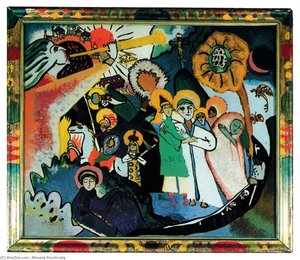
Wassily Kandinsky’s “Picture With A White Border”: A Journey Into Inner Space

The year 1944 marked a pivotal moment in the trajectory of Wassily Kandinsky, a Russian painter and theorist whose work profoundly shaped the course of modern art. “Picture With A White Border,” a seemingly simple composition rendered in watercolor on paper, is far more than a mere depiction; it’s an invitation into the artist's intensely personal and spiritual world. This piece, housed within a striking white border – a detail that immediately draws the eye and elevates its significance – embodies Kandinsky’s late-career exploration of abstract forms as conduits for emotional expression and symbolic resonance. It represents a culmination of decades spent refining his unique approach to art, moving beyond representational imagery towards a purely subjective language of color and shape.

Kandinsky's artistic evolution is inextricably linked to his belief that art should transcend the limitations of objective reality and tap directly into the viewer’s subconscious. He envisioned painting as a means of communicating spiritual truths, utilizing geometric forms – circles, lines, triangles – not for their literal representation but for their inherent vibrational qualities. “Picture With A White Border” exemplifies this philosophy perfectly. The dominant presence of circles, arranged with deliberate asymmetry and varying sizes, evokes a sense of dynamic equilibrium, suggesting the interplay between order and chaos, stability and movement. These aren’t simply decorative elements; they are carefully considered building blocks in a visual symphony.

Decoding the Symbolism Within

The strategic placement of two small figures within the composition adds another layer of complexity to the artwork's meaning. These ambiguous forms – often interpreted as male and female, or perhaps simply representing humanity – appear to be observing, interacting with, or even being absorbed by the swirling patterns of color and shape. Their presence isn’t about depicting a specific scene; rather, they serve as anchors for the viewer, inviting us to contemplate our own relationship to the abstract forms surrounding them. Some scholars suggest these figures represent the artist's own soul engaging with his creative process, while others see them as symbols of introspection and self-awareness.

The white border itself is a crucial element, acting as both a frame and a symbolic barrier. It isolates the artwork from the surrounding environment, creating a sense of intimacy and encouraging focused contemplation. It also subtly echoes the circular forms within the painting, reinforcing the overall feeling of wholeness and unity. Kandinsky frequently employed borders in his work to emphasize the importance of the image itself, separating it from the mundane world and elevating its spiritual significance.

Technique and Late-Career Style

“Picture With A White Border” is a quintessential example of Kandinsky’s late-career style. He favored watercolor as his medium of choice during this period, appreciating its fluidity and ability to capture subtle tonal variations. The loose brushstrokes and washes of color create a sense of spontaneity and immediacy, reflecting the artist's intuitive approach to painting. Unlike earlier works characterized by more structured compositions, this piece feels remarkably free-flowing, almost improvisational – a testament to Kandinsky’s willingness to embrace chance and allow his emotions to guide his hand.

The color palette is deliberately restrained, dominated by muted blues, greens, and yellows. These colors are not used in a representational manner; instead, they evoke specific emotional responses—a sense of tranquility, introspection, or perhaps even melancholy. Kandinsky believed that color possessed inherent psychological qualities, and he meticulously studied the effects of different hues on the human psyche. The careful selection of these tones contributes significantly to the painting’s overall mood and resonance.

A Legacy of Inner Vision

“Picture With A White Border” stands as a powerful testament to Kandinsky's pioneering role in abstract art. It is not merely a beautiful image; it’s an invitation to engage with the inner landscape of the human soul, a journey into the realm of pure feeling and spiritual expression. Reproductions of this artwork offer a remarkable opportunity to experience firsthand the depth and complexity of Kandinsky’s vision—a vision that continues to inspire artists and viewers alike.

Questions et réponses

À qui offrir «Sans titre» de Wassily Wassilyevich Kandinsky en cadeau ?

Pour un cadeau, «Sans titre» de Wassily Wassilyevich Kandinsky est une excellente idée pour Anniversaire. D'autres occasions peuvent également convenir.

L'œuvre « Sans titre » est-elle disponible en tirage d'art ?

Vous pouvez commander une impression de «Sans titre» de Wassily Wassilyevich Kandinsky directement sur sa page Tirage d'art fine art : une impression d'art sur toile de coton ou sur papier canvas d'archive.

L'artiste Wassily Wassilyevich Kandinsky, créateur de « Sans titre », est-il connu sous d'autres noms ?

Wassily Wassilyevich Kandinsky est également connu sous le nom de Kandinsky.

More about this painting

Aperçu en situation Visualiser en RA Passer au format impression Passer au format numérique Envoyer
Détails de l'œuvre Guide Ajouter aux favoris Télécharger l'image Articles similaires Radiographie Diaporama Q&A Statistiques

In numbers

  • 1944the year it was painted
  • 29frames to choose from
  • standard sizes, in its own proportions
  • 5weeks to paint and deliver it
Wassily Wassilyevich Kandinsky

Wassily Wassilyevich Kandinsky

1866 - 1944, Russie

Quick facts about Wassily Wassilyevich Kandinsky

  • Artistic Movement Or Style: Expressionnisme abstrait
  • Date De Décès: 13 décembre 1944
  • Date De Naissance: 16 décembre 1866
  • Full Name: Wassily Wassilyevich Kandinsky
  • Lieu De Naissance: Moscou, Russie
  • Nationalité: Russe
  • Notable Artworks:
    • Composition VII
    • Carré noir
    • Plusieurs cercles
    • Murnau avec une église
    • Un après-midi intime

Biographie de l'artiste

Wassily Wassilyevich Kandinsky : Pionnier de l'Abstraction

  • Né : 16 décembre 1866, Moscou, Russie
  • Décédé : 13 décembre 1944
  • Nationalité : Russe

Jeunesse et Développement Artistique

  • La jeunesse de Kandinsky a été marquée par une éducation diversifiée, étudiant initialement le droit et l'économie à l'Université de Moscou.
  • À l’âge de 30 ans, il s’est tourné vers l’art, s’inscrivant à l’Académie de Munich sous la direction de Franz von Stuck. Ce changement a marqué un engagement profond envers l’expression artistique.
  • Ses premières œuvres ont été influencées par l'art populaire russe, notamment lors d'un voyage ethnographique dans la région de Vologda en 1889.
  • Il a développé un intérêt pour le symbolisme des couleurs et la psychologie, qui sont devenus des éléments fondamentaux de ses compositions abstraites ultérieures.

Périodes Artistiques Clés et Styles

  • Expressionnisme Précoce : Caractérisé par des couleurs vibrantes et une intensité émotionnelle, comme on le voit dans "Papeln (Poplars)" (1902).
  • Transition vers l'Abstraction : Kandinsky s’est progressivement éloigné de l’art représentatif, explorant la relation entre la couleur, la forme et l’émotion.
  • Abstraction Géométrique : Cette période a vu un intérêt accru pour les formes géométriques et les compositions, illustré par "Several Circles" (140 x 140 cm).
  • Abstraction Spirituelle : Kandinsky croyait que l'art pouvait exprimer des vérités spirituelles à travers des formes non représentatives. Ses œuvres visaient à évoquer des émotions et des expériences intérieures plutôt qu’à dépeindre la réalité externe.

Influence et Héritage

  • Influence du Bauhaus : En tant que membre de faculté de l'école Bauhaus en Allemagne, Kandinsky a profondément influencé des générations d'artistes grâce à ses théories sur la couleur, la forme et l’abstraction.
  • Écrits Théoriques : Ses écrits, notamment "De lo Spirituel dans l'Art", ont articulé sa philosophie artistique et ont contribué de manière significative au développement de la théorie de l'art abstrait.
  • Impact sur l'Art Moderne : Kandinsky est largement reconnu comme un pionnier de l'art abstrait, ouvrant la voie à de nombreux mouvements et artistes ultérieurs.
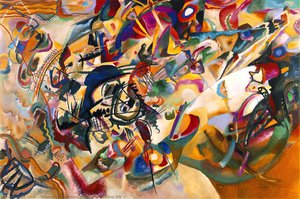
  • Collections Muséales : Ses œuvres sont conservées dans les principaux musées du monde entier, notamment la Galerie Tretyakov à Moscou, qui abrite sa "Composition VII" monumentale.

Œuvres Notables

  • Composition VII : Une œuvre abstraite de grande envergure considérée comme l'aboutissement du développement artistique de Kandinsky.
  • Carré Noir (en collaboration avec Kazimir Malevitch) : Une œuvre fondamentale dans l’histoire de l’abstraction, représentant un départ radical des formes artistiques traditionnelles.
  • Several Circles : Démontre son utilisation innovante de formes géométriques et de couleurs vibrantes pour créer des compositions dynamiques.
  • Murnau avec une Église : Équilibre les éléments abstraits avec l'imagerie représentative, mettant en valeur son style en évolution.
  • Un Bal Intime : Une œuvre ultérieure présentant une abstraction géométrique et un empâtement superposé, reflétant son exploration continue des thèmes spirituels.

Informations clés

  • Artist: Wassily Kandinsky
  • Artistic style: Abstrait, Spirituel
  • Medium: Aquarelle sur papier
  • Notable elements or techniques: Abstraction biomorphique
  • Location: Collection privée
  • Subject or theme: Monde intérieur, Spiritualité

Quiz d'art

Chaque question ne comporte qu'une seule bonne réponse.

Question 1:
Quel est le style principal du tableau « Sans titre » de Wassily Kandinsky ?
Question 2:
D'après la description, quelle est une caractéristique marquante de la composition du tableau ?
Question 3:
En quelle année Wassily Kandinsky est-il né ?
Question 4:
La taille du tableau (2 x 46 cm) suggère qu'il est mieux décrit comme :
Question 5:
D'après la biographie de l'artiste, qu'est-ce qui a initialement inspiré le parcours artistique de Kandinsky ?