Passer au format impression
 Lire la suite







































 Pour les œuvres ou reproductions dont un côté mesure plus de 105 cm (environ 41 pouces), le cadre sera expédié sous forme de kit démonté. Cette méthode garantit une livraison sécurisée et prévient tout dommage pendant le transport.


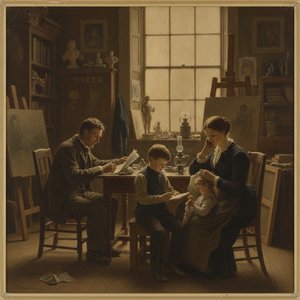
A Portrait of Loss and Remembrance: Sir John Everett Millais’s ‘The North-West Passage’
Sir John Everett Millais’s “The North-West Passage,” completed in 1874, stands as a cornerstone of the Pre-Raphaelite Brotherhood’s artistic vision—a movement that vehemently rejected academic conventions and championed meticulous observation alongside profound emotional resonance. More than just a depiction of a landscape, it's an exquisitely crafted tableau conveying grief, remembrance, and the enduring power of familial love against the backdrop of Victorian anxieties surrounding exploration and mortality.
- Subject Matter: The painting portrays a grieving mother holding her deceased infant son—a poignant meditation on bereavement rendered with unparalleled realism. Millais deliberately chose this subject matter to explore themes of maternal sorrow and the fragility of life, aligning powerfully with Victorian sensibilities regarding death and mourning rituals.
- Style & Technique: Characteristic of Pre-Raphaelite art, “The North-West Passage” employs a technique rooted in detailed botanical illustration—a hallmark of Millais’s scientific pursuits. He painstakingly recreated the interior of a cottage, capturing every nuance of texture and color with painstaking accuracy. The muted palette—dominated by earthy browns and greens—contributes to the painting's melancholic atmosphere.
- Historical Context: Created during an era obsessed with imperial expansion and scientific discovery, “The North-West Passage” reflects anxieties about venturing into uncharted territories. However, Millais subtly subverts this narrative of heroic ambition by portraying a scene of quiet domesticity—a deliberate rejection of the grandiose depictions favored by academic artists.
- Symbolism: The infant’s pallid skin symbolizes death and decay, while the mother's sorrowful gaze embodies universal grief. Millais utilizes symbolic imagery to elevate the painting beyond mere representation, inviting viewers to contemplate profound philosophical questions about life, loss, and the enduring bonds of family.
- Emotional Impact: “The North-West Passage” achieves its remarkable emotional impact through Millais’s masterful manipulation of light and shadow—creating a sense of intimacy and vulnerability. The painting compels contemplation on themes of mortality and remembrance, leaving an indelible impression on the viewer's psyche.
Displayed prominently at Tate Britain since its unveiling, “The North-West Passage” continues to captivate audiences with its breathtaking realism and evocative storytelling—a testament to Millais’s artistic genius and the enduring legacy of the Pre-Raphaelite Brotherhood. Its serene composition and subtle symbolism offer a poignant reflection on human experience, making it an invaluable addition to any discerning collection.
Questions et réponses
Quelle ambiance "The North-West Passage" apporterait-elle à une pièce ?
Avec son atmosphère Romantique, « The North-West Passage » est idéal pour une Salon.
Quelle ambiance et quelle émotion «The North-West Passage» de Sir John Everett Millais exprime-t-il ?
«The North-West Passage» de Sir John Everett Millais dégage un sentiment Mélancolique au sein d'une atmosphère globalement Romantique.
L'œuvre « The North-West Passage » dispose-t-elle d'un aperçu en réalité augmentée ?
« The North-West Passage » dispose d'un aperçu en réalité augmentée : la page Aperçu en RA de l'œuvre vous permet de la visualiser dans votre propre espace sur un appareil compatible.
 Aperçu en situation
 Envoyer
 Partager
 Détails de l'œuvre
 Guide
Guide

 Télécharger l'image
 Articles similaires
 Radiographie
 Diaporama
 Questions et réponses
 Statistiques