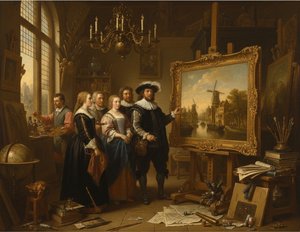
Art-lovers in a Painter's Studio
Oil
WallArt
Dutch Golden Age
1630
Early Modern
38.0 x 49.0 cm
Staatsgalerie
Reproduction à l'huile faite à la main
Huile sur toile peinte à la main, avec cadre et dimensions personnalisés, réalisée sur commande par nos artistes. ( Commander l'impression
Télécharger l'image haute résolution)
P118B $10
P118H $10
P118W $10
P438Z $10
P508JH $12
P508YH $12
P805H $10
P805Z $10
P919BZ $10
P919G $10
P919XJ $10
P959ZH $10
P968JZ $12
W106C $8
W218G $10
W218JH $8
W218Y $10
W307PJ $10
W316G $10
W316PJ $8
W316Y $10
W398PJ $8
W4111J $10
W500HY $15
W500JH $15
W692G $12
W849H $8
W940BG $15
W953PJ $8
Choisissez parmi nos formats prédéfinis qui respectent les proportions originales de l’œuvre.
Vous pouvez saisir vos propres dimensions pour l'adapter à un cadre ou à un espace spécifique. Si la taille sélectionnée ne correspond pas aux proportions de l'image d'origine, nous recadrerons l'œuvre ou prolongerons la peinture avec des éléments peints à la main supplémentaires. Une maquette numérique vous sera envoyée pour approbation avant le début de la production.
Veuillez noter que l'aperçu à l'écran ne reflète pas le recadrage ou l'extension réels. Seule la maquette montrera fidèlement la composition finale.
Bien que des tailles personnalisées soient disponibles, nous vous recommandons de sélectionner une dimension dans la liste prédéfinie afin de préserver les proportions d'origine.
Après la commande, l’équipe OriginalUniqueArt.com contactera le client par e-mail pour recueillir ses instructions et lui fournira une maquette d’aperçu
Livraison dans le monde entier () en 3 à 4 semaines au lieu des 5 semaines habituelles. (16 août). Aucun compromis sur la qualité.
Livraison express gratuite dans le monde entier
Toile de lin de qualité supérieure
Assurance transport complète
Garantie de remboursement des droits de douane
Garantie de fidélité des couleurs
Politique de retour de 60 jours (uniquement en cas de défaut)
Garantie de remboursement à 100%
Offre de tarifs dégressifs
Art-lovers in a Painter's Studio
Technique de reproduction
Format de la reproduction
-
Prix total
$ 300
Description de l'œuvre
A Symphony of Light and Shadow in the Dutch Golden Age
In the quiet, amber-hued atmosphere of 1630, Pieter Jacobsz Codde invites us into an intimate sanctuary of creativity and camaraderie. Art-lovers in a Painter's Studio is not merely a depiction of a room; it is a window into the soul of the Dutch Golden Age, capturing a moment where music, conversation, and visual art converge. As we gaze upon this masterful composition, we find ourselves standing amongst a group of enthusiasts, perhaps fellow artists or cultured patrons, gathered around a large canvas that serves as the silent protagonist of the scene. The air in the studio feels thick with the scent of oil paint and the resonant notes of a violin, creating a sensory experience that transcends the boundaries of the frame.
Codde, a pupil of the legendary Frans Hals, brings a profound psychological depth to this gathering. The arrangement of the figures—some seated in contemplative repose, others standing in animated discussion—creates a rhythmic flow that guides the viewer's eye through the studio. There is a palpable sense of chiaroscuro at play here; the dramatic interplay between deep, velvety shadows and soft, directional light illuminates the textures of fabric, the sheen of wooden instruments, and the focused expressions of the men. This technique does more than provide dimension; it imbues the scene with a sense of drama and importance, elevating a casual social gathering into a monumental study of human connection.
The Harmony of Art and Melody
Beyond the visual spectacle, the painting explores the profound symbolic link between music and the visual arts. The presence of the violin and guitar suggests that the pursuit of beauty is a multi-sensory endeavor. In the seventeenth century, music was often viewed as a metaphor for cosmic harmony and social order; by placing these instruments within the artist's studio, Codde suggests that the act of painting is itself a form of composition, requiring balance, rhythm, and resonance. The easel, positioned toward the edge of the light, stands ready to translate this auditory harmony into visual form, bridging the gap between the ephemeral sound and the permanent image.
For the discerning collector or interior designer, this piece offers an unparalleled opportunity to introduce a sense of historical grandeur and intellectual depth into a space. The muted palette of earth tones, deep ochres, and rich shadows allows the artwork to integrate seamlessly into sophisticated environments, providing a focal point that sparks conversation and invites lingering contemplation. A high-quality reproduction of this work does more than decorate a wall; it anchors a room with the prestige of the Dutch masters, offering a timeless elegance that celebrates the enduring human passion for beauty, culture, and the shared joy of artistic discovery.
Biographie de l'artiste
Pieter Jacobsz Codde: A Master of Dutch Genre Painting
Pieter Jacobsz Codde (1599 – October 12, 1678) stands as a prominent figure in the Dutch Golden Age artistic landscape. Born in Haarlem, Codde’s career spanned over four decades and produced an impressive body of work characterized by meticulous detail and a masterful grasp of chiaroscuro—the dramatic interplay between light and shadow—techniques that cemented his reputation as one of the era's foremost genre painters. His canvases offer glimpses into everyday life, capturing moments of social interaction and domestic tranquility with remarkable sensitivity and realism. ### Early Life and Artistic Training Information about Codde’s formative years remains somewhat sparse, primarily gleaned from records pertaining to Haarlem’s guild system. He apprenticed under Frans Hals, a celebrated portraitist whose influence undoubtedly shaped Codde's artistic sensibilities. Hals championed naturalism and psychological insight—qualities that would become hallmarks of Codde’s own oeuvre. This apprenticeship instilled in him not only technical proficiency but also an understanding of the importance of capturing human emotion within a visual narrative. Despite limited biographical data, Codde’s connection to Hals underscores the prevailing artistic ethos of the time – prioritizing observation and emotional resonance over idealized representations. ### Artistic Style and Technique Codde’s distinctive style is immediately recognizable by its unwavering commitment to realism. Unlike some contemporaries who favored stylized depictions or mythological subjects, Codde meticulously rendered textures—fabric folds, skin surfaces, musical instruments—with astonishing accuracy. His compositions are often carefully balanced, employing geometric principles to create harmonious visual arrangements. Crucially, he skillfully utilized chiaroscuro to sculpt forms and heighten dramatic impact, as exemplified in works like ‘The Merry Company’ and ‘Gallant Company,’ where subtle gradations of light illuminate faces and gestures, conveying a palpable sense of atmosphere. This masterful manipulation of light and shadow—a technique perfected by Hals himself—became Codde's signature stylistic hallmark, elevating his genre paintings beyond mere visual representation to profound explorations of human psychology and social dynamics. ### Notable Works: Capturing Moments of Domestic Life Codde’s artistic output encompassed a diverse range of subjects, but he achieved particular renown for his genre scenes depicting domestic interiors—particularly musical gatherings and lessons—and guardroom portraits. ‘The Merry Company,’ commissioned by the Amsterdam crossbow civic guard, exemplifies Codde’s ability to convey social dynamics with nuanced observation. The painting portrays officers engaged in conversation and music-making, bathed in soft light that captures the warmth of camaraderie. Similarly, ‘Gallant Company,’ featuring officers of the Amsterdam crossbow civic guard under captain reynier reael and lieutenant cornelis michielsz. blaeuw, showcases a similar level of detail and psychological depth. Codde’s meticulous attention to detail—from the folds of clothing to the expressions on faces—reveals an artist deeply attuned to capturing the subtleties of human experience. Perhaps his most celebrated piece is ‘Dancing Lesson,’ currently housed in the Louvre—a luminous depiction of a young woman instructing her pupils that embodies Codde’s signature style and artistic vision. The painting's serene atmosphere and graceful composition underscore Codde’s mastery of chiaroscuro, creating an illusion of depth and enhancing the emotional impact of the scene. ### Influence and Legacy Codde's influence extended beyond his immediate contemporaries, shaping subsequent generations of Dutch artists who admired his technical prowess and expressive power. His meticulous approach to observation and rendering contributed significantly to the development of realism within Dutch painting—a movement that would profoundly impact European art history. He stands alongside Frans Hals as one of the foremost practitioners of naturalism in Haarlem during the Golden Age, cementing his place among the most influential artists of his time. Today, Codde’s paintings continue to resonate with audiences worldwide, serving as enduring reminders of the artistic brilliance achieved during the Dutch Golden Age. They are displayed prominently in institutions such as the Rijksmuseum and the Louvre, ensuring his legacy as a master of genre painting persists through time. You can explore more about his life and work on https://OriginalUniqueArt.com.Pieter Jacobsz Codde

1599 - 1678 , Pays-Bas
L'essentiel de l'artiste
- Artistic Movement Or Style: Dutch Golden Age
- Artists Who Influenced This Artist: ['Frans Hals']
- Date Of Birth: December 11, 1599
- Date Of Death: October 12, 1678
- Full Name: Pieter Jacobsz Codde
- Nationality: Dutch
- Notable Artworks:
- The Music Lesson
- Dancing Lesson
- Merry Company
- Place Of Birth: Amsterdam, Netherlands

L'option verre n'est disponible que pour les dimensions inférieures à 110 cm.