
 Aperçu en situation
 Envoyer
 Partager
 Détails de l'œuvre
 Guide
Guide

 Télécharger l'image
 Articles similaires
 Radiographie
 Diaporama
 Questions et réponses
 Statistiques
Shipwreck

- 58.0 x 81.0 cm


 Lire la suite
Giclées et impressions d'art
Impressions giclées ou sur toile de qualité musée, avec une production rapide et des finitions au choix. ( Commander la reproduction peinte à la main Passer au format numérique)




P118B €10

P118H €10

P118W €10

P438Z €10

P508JH €12

P508YH €12

P805H €10

P805Z €10

P919BZ €10

P919G €10

P919XJ €10

P959ZH €10

P968JZ €12

W106C €8

W218G €10

W218JH €8

W218Y €10

W307PJ €10

W316G €10

W316PJ €8

W316Y €10

W398PJ €8

W4111J €10

W500HY €15

W500JH €15

W692G €12

W849H €8

W940BG €15

W953PJ €8




Choisissez parmi nos formats prédéfinis qui respectent les proportions originales de l’œuvre.

Saisissez la largeur et la hauteur souhaitées pour qu'elles s'adaptent à votre cadre ou à votre mur. Une impression peut être recadrée, mais jamais agrandie au-delà de l'image originale ; ainsi, un format de forme différente entraînera la perte d'une partie de l'image. Nous vous envoyons une maquette numérique pour approbation avant toute impression. L'image présentée sur cette page ne montre pas le recadrage réel — seule la maquette le permet.
Livraison dans le monde entier () en 2 semaines au lieu des 4/5 semaines habituelles. (6 novembre)

Livraison express gratuite dans le monde entier

Toile de lin de qualité supérieure

Assurance transport complète

Garantie de remboursement des droits de douane

Garantie de fidélité des couleurs

Politique de retour de 100 jours (uniquement en cas de défaut)

Garantie de remboursement à 100%

Offre de tarifs dégressifs
 L'option verre n'est disponible que pour les dimensions inférieures à 110 cm.

Shipwreck
Giclées et impressions d'art
Format de la reproduction
-


Prix total
€ 72
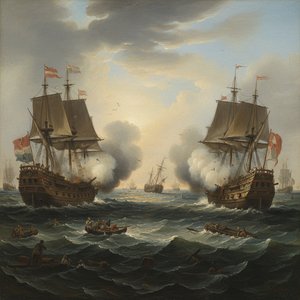
A Tempestuous Vision: Philip James de Loutherbourg’s “Shipwreck”
Philip James de Loutherbourg's "Shipwreck," painted in 1793, isn’t merely a depiction of maritime disaster; it’s a visceral exploration of human vulnerability against the overwhelming power of nature. This dramatic landscape, now housed within the Southampton City Art Gallery, transcends simple realism to become a potent allegory for survival, desperation, and the precariousness of existence – themes that resonated deeply with the burgeoning Romantic movement of the late 18th century.
The painting immediately commands attention through its turbulent composition. A colossal wave, rendered in thick, swirling brushstrokes of indigo, ochre, and grey, dominates the scene, threatening to engulf a shattered vessel – the remnants of a once-proud ship now reduced to splintered wood and clinging figures. Loutherbourg masterfully employs chiaroscuro, utilizing stark contrasts between light and shadow to heighten the drama and emphasize the immediate threat. The dark, brooding sky, pregnant with impending storm, mirrors the despair etched on the faces of those struggling for survival amidst the wreckage.
The Baroque Influence & Dramatic Lighting
While firmly rooted in the Romantic sensibility, "Shipwreck" reveals a clear debt to the Baroque tradition, particularly in its theatrical use of light and shadow. Loutherbourg, who had trained under Charles-André van Loo, inherited a penchant for dramatic effects – a skill he honed not only as a painter but also as a stage designer for London’s Drury Lane Theatre. This influence is evident in the painting's heightened emotional intensity and its carefully orchestrated composition, designed to draw the viewer directly into the heart of the scene.
The figures themselves are illuminated from the left, casting long, dramatic shadows that accentuate their vulnerability and heighten the sense of urgency. Loutherbourg’s technique is particularly noteworthy in his rendering of water – not as a smooth, reflective surface, but as a chaotic, dynamic force, teeming with movement and energy. The artist's attention to detail extends to the depiction of the ship itself, meticulously rendered with a sense of both grandeur and impending doom. The use of layered textures—the rough splintered wood, the slickness of the waves, the ragged clothing of the survivors—adds considerable depth and realism to the scene.
Symbolism & The Romantic Spirit
Beyond its immediate depiction of a shipwreck, “Shipwreck” is rich in symbolic meaning. The storm represents not just a natural event but also the unpredictable forces that govern human life – fate, adversity, and the limitations of control. The survivors, huddled together on the rocks, embody the resilience of the human spirit in the face of overwhelming odds. Their desperate struggle for survival speaks to our shared vulnerability and our innate desire to endure.
The inclusion of bandits attacking the lifeboat adds another layer of complexity, suggesting a broader theme of exploitation and injustice. It’s a subtle but powerful commentary on the darker aspects of human nature – the willingness to prey upon the weak in times of crisis. This painting perfectly encapsulates the Romantic spirit's fascination with both the sublime beauty and terrifying power of the natural world, alongside its exploration of profound emotional experiences.
A Legacy of Dramatic Art
Philip James de Loutherbourg’s “Shipwreck” stands as a testament to his artistic versatility and his ability to capture the drama and intensity of human experience. It's a work that continues to resonate with viewers today, prompting reflection on our own vulnerabilities and our capacity for both despair and resilience. The painting’s enduring appeal lies in its masterful composition, its evocative use of light and shadow, and its profound exploration of timeless themes – all rendered with the skill and passion characteristic of a true Romantic artist.
Questions et réponses
Comment "Shipwreck" équilibre-t-il l'ombre et la lumière ?
Les valeurs enregistrées pour «Shipwreck» de Philippe Jacques de Loutherbourg sont : une luminosité de deep_shadow, une luminance de Dark.
Quelles sont les dimensions de l'œuvre originale « Shipwreck » ?
«Shipwreck» mesure 58 x 81 cm dans sa forme originale. Les dimensions originales constituent une référence utile lors du choix de la taille d'une reproduction.
À quelle étape de la carrière de Philippe Jacques de Loutherbourg s'inscrit « Shipwreck », compte tenu de sa date ?
«Shipwreck», créé en 1767, appartient à la période Mature Period de la carrière de Philippe Jacques de Loutherbourg.
Biographie de l'artiste
Première Vie et Formation
- Né : Strasbourg, France (1740)
- Décédé : 1812
- Philip James de Loutherbourg, également connu sous le nom de Philip Jacques de Loutherbourg, était un peintre franco-britannique.
- Il a commencé sa formation artistique à un jeune âge et s'est rapidement fait connaître pour ses compétences en peinture.
- Il est devenu membre de la Royal Academy en 1781.
- Son père était graveur et miniaturiste, ce qui a influencé sa première exposition à l'art.
- Initialement destiné au ministère, il a rejeté cette voie pour se consacrer à la peinture.
- Il a étudié sous Charles-André van Loo et Francesco Giuseppe Casanova à Paris.
Œuvres Notables et Style Artistique
- Action de Lord Howe, ou le Premier Juin Glorieux : Commémore les victoires navales britanniques (1795).
- La Destruction de l'Armada : Montrait ses compétences pour capturer des scènes dramatiques.
- Coalbrookdale la Nuit : Souligne son intérêt pour la Révolution Industrielle.
- Cavalier et Bétail dans un Orage : Une représentation dramatique de la puissance de la nature (1780).
- Paysage avec Bétail et Figures Un Orage Approchant : Une magnifique scène pastorale rendue en style de peinture à l'huile (1781).
- Ses peintures comportaient souvent des sujets historiques, navals et paysagers.
- Il était connu pour ses compositions dramatiques et son souci du détail.
- Le style de Loutherbourg est associé au Romantisme, mettant l'accent sur l'émotion et la grandeur.
L’Eidophusikon et Innovations Théâtrales
- En 1789, Loutherbourg a temporairement abandonné la peinture pour explorer l'alchimie et le surnaturel.
- Il a rencontré Alessandro di Cagliostro et a voyagé avec lui avant la condamnation de Cagliostro.
- Loutherbourg a inventé l’Eidophusikon, un théâtre mécanique qui combinait des décors peints avec des effets d'éclairage et des figures animées.
- L’Eidophusikon était une innovation significative dans la conception théâtrale et le divertissement.
- Il a conçu de superbes décors pour les théâtres londoniens, dont Drury Lane, mettant en valeur ses compétences inventives.
Carrière Ultérieure et Héritage
- Loutherbourg est retourné à la peinture après son implication avec Cagliostro.
- Ses œuvres ultérieures comprenaient des peintures historiques et des sujets bibliques.
- Il a publié deux collections de gravures : Picturesque Scenery of Great Britain (1801) et The Romantic and Picturesque Scenery of England and Wales (1805).
- Son travail peut être trouvé dans des musées du monde entier, dont le National Maritime Museum et le British Museum.
- L'influence de Loutherbourg s'est étendue à d'autres artistes comme J.M.W. Turner.
- Il est rappelé pour ses contributions à la fois à la peinture et à la conception théâtrale.
Signification Historique
- Loutherbourg a joué un rôle important dans le développement de l'art britannique romantique.
- Ses peintures navales ont contribué à populariser les représentations d'événements maritimes.
- L’Eidophusikon a démontré son esprit innovant et a contribué aux progrès de la technologie théâtrale.
- Il a comblé le fossé entre la peinture, la conception théâtrale et l'exploration scientifique.
- L'héritage de Loutherbourg réside dans sa capacité à combiner des compétences artistiques avec une innovation technologique et une fascination pour le monde naturel.

Philippe Jacques de Loutherbourg
1740 - 1812 , France
L'essentiel de l'artiste
- Artistes Influents:
- Charles-André van Loo
- Francesco Casanova
- Date De Décès: 11 mars 1812
- Date De Naissance: 31 octobre 1740
- Influence Sur Les Artistes: ['J.M.W. Turner']
- Lieu De Naissance: Strasbourg, France
- Mouvement Artistique: Romantisme
- Nationalité: Franco-Britannique
- Nom Complet: Philip James de Loutherbourg
- Oeuvres Notables:
- Lord Howe's action
- Destruction de l’Armada
- Coalbrookdale par nuit
Articles connexes
Masterpieces of Maritime Warfare: The Artistry and Intensity of Naval Combat in Historical Painting
Explore the dramatic intensity of naval combat through art history. From Romanticism to classical maritime masterpieces, discover how legendary painters captured the chaos, light, and heroism of sea battles in breathtaking oil paintings.

À propos de nous
Découvrez notre univers artistique ! Nous mettons l’art de renommée mondiale à portée de main grâce à une sélection pointue, des créations sur mesure et des conseils personnalisés. Apprécié des particuliers et des professionnels depuis plus de 20 ans.

Willem van de Velde the Elder: Master of Maritime Painting & Chronicler of the Dutch Golden Age
Discover the captivating maritime paintings of Willem van de Velde the Elder, a master chronicler of the Dutch Golden Age. Explore his unparalleled realism and lasting influence on naval art history.

Philip James de Loutherbourg: Romantic Visions of Maritime Life & the Sublime
Explore the dramatic naval scenes & landscapes of Philip James de Loutherbourg (1740-1812), a key figure in Romantic painting. Discover his legacy, theatrical innovations & iconic works like 'The Battle of the Nile' at OriginalUniqueArt.

Maîtriser l'ombre : les 25 chefs-d'œuvre puissants de Francisco Goya
Explorez les 25 chefs-d'œuvre de Goya, entre ombre et lumière. Trouvez l'art ultime sur OriginalUniqueArt.com.


