

 Aperçu en situation
 Envoyer
 Partager
 Détails de l'œuvre

 Télécharger
 Articles similaires
 Radiographie
 Diaporama
Abstract Composition (Composition abstraite)
 1934
1934 27.0 x 35.0 cm
 Lire la suite
Acquérez une image numérique haute résolution et optimisée, d'une qualité bien supérieure à l'aperçu en ligne.
Chaque fichier est méticuleusement préparé par nos spécialistes internes à l'aide d'outils avancés et d'une retouche manuelle experte. Nous garantissons que chaque image possède une clarté exceptionnelle, une précision des couleurs irréprochable et un niveau de détail fin.
Le fichier final est livré par e-mail sous 72 heures, optimisé pour une utilisation immédiate dans des contextes professionnels, éditoriaux et d'impression. Il offre la même qualité de confiance que celle utilisée par les plus grands studios de création, éditeurs et galeries.
Image numérique
Téléchargez un fichier haute résolution pour votre usage personnel, l'impression et vos projets créatifs. ( Commander l'impression Commander la reproduction peinte à la main)
Inclus avec chaque commande d'image numérique
Livraison numérique experte, garantie.
En choisissant OriginalUniqueArt.com, vous n'obtenez pas seulement une simple image : vous recevez une œuvre numérique sublimée avec professionnalisme, conçue avec précision et accompagnée d'une garantie de satisfaction. Voici tout ce qui accompagne automatiquement votre commande :

Envoi rapide par e-mail
Votre fichier d'image numérique haute résolution vous sera envoyé par e-mail sous 72 heures après votre commande — prêt à un usage immédiat.

Fichier numérique optimisé par l'IA
Votre œuvre d'art bénéficie d'une optimisation professionnelle grâce à des outils d'IA avancés et une retouche manuelle, garantissant un niveau maximal de détail, de clarté et de fidélité chromatique.

Réexpédition gratuite à vie
Vous avez accidentellement supprimé ou perdu votre fichier ? Pas d'inquiétude — nous vous le renverrons gratuitement, quand vous le souhaitez.

Aucuns frais de douane — À jamais
Profitez de votre œuvre d'art instantanément sans frais de douane ni de livraison — les téléchargements numériques sont toujours exonérés de taxes.

Garantie de fidélité des couleurs
Nous garantissons que votre image numérique reproduit les couleurs de l'original aussi fidèlement que possible grâce à des outils professionnels et une gestion rigoureuse des couleurs.

Garantie satisfaction 60 jours
Si vous n'êtes pas satisfait de votre image numérique, nous la retoucherons ou vous rembourserons 100% sous 60 jours — sans poser de questions.

Garantie de remboursement à 100%
Pas satisfait ? Obtenez un remboursement intégral dans les 60 jours suivant la réception de votre fichier numérique — sans aucune question posée.

Réductions sur les commandes groupées
Achetez 3 images, économisez 10% - Achetez 5, économisez 15% - Achetez 10+, économisez 20%. Idéal pour les projets créatifs, les galeries et les agences.
Biographie de l'artiste
Early Life and Artistic Awakening
Jean Hélion, born Jean Bichier in 1904 in the rural Normandy village of Couterne, embarked on a path far removed from the world of fine art during his formative years. His childhood was initially marked by separation from his parents, spending eight years with his grandmother before rejoining them in Amiens. Though he dabbled in painting as a schoolboy—simple compositions on cardboard—poetry held his primary fascination. This early inclination towards lyrical expression would subtly inform his later visual work. A burgeoning interest in chemistry led him to enroll at the Institut Industriel du Nord in Lille, but this scientific pursuit proved short-lived; Hélion abandoned his studies in 1921 for Paris, drawn by a different kind of exploration—one focused on form and color rather than molecules and reactions. He supported himself as an architectural apprentice while continuing to write poetry, yet it was a profound encounter at the Louvre that irrevocably altered his trajectory. Immersing himself in the works of Nicolas Poussin and Philippe de Champaigne, he experienced what he termed a “great turning point,” abandoning his literary ambitions for the life of a painter. He enrolled at the Académie Adler to hone his skills, initially producing figurative paintings reminiscent of Soutine’s expressive intensity.The Embrace of Abstraction and Art Concret
The mid-1920s proved pivotal in Hélion's artistic development. A meeting with Otto Freundlich introduced him to the very concept of abstract art—a revelation that expanded his understanding of visual possibilities. The following year, he encountered Cubism through Joaquín Torres-García, a Uruguayan painter who became an important mentor. His first public exhibition in 1928 showcased still lifes bearing the hallmarks of Torres-García’s style: simplified forms and bold outlines. However, it was his involvement with Theo van Doesburg that truly propelled him towards abstraction. In 1930, Hélion co-founded Art Concret, a group dedicated to pure, non-objective art—a radical departure from representational traditions. The movement’s manifesto explicitly rejected any inspiration derived from nature or sentimentality, advocating for a universal visual language based on geometric principles. While initially aligning with this austere aesthetic, Hélion soon found himself questioning its limitations, sensing a disconnect between the rigid formalism and his own deeply felt need to connect art with reality. He became a leading figure in Abstraction-Création, further solidifying his reputation as an influential theorist and practitioner of abstract painting during the 1930s.A Transatlantic Journey and the Search for Modernity
In July 1936, Hélion embarked on a new chapter, relocating to the United States with his American wife, Jean Blair. He settled initially in New York before moving to Rockbridge Baths, Virginia, where he built a studio. This transatlantic journey marked not only a geographical shift but also a profound artistic one. While continuing to explore abstraction, Hélion increasingly felt drawn towards representation, recognizing that his work was evolving in that direction. His intellectual curiosity led him to the writings of Baudelaire, whose concept of modernity—a synthesis of the ephemeral and the eternal—deeply resonated with him. He identified Seurat and Léger as exemplars of this Baudelairian ideal, artists who successfully captured the fleeting essence of contemporary life within a timeless geometric framework. This realization triggered a radical transformation in his artistic approach, confounding expectations and setting him on a new course.The Rejection of Abstraction and Figurative Renaissance
By the late 1930s, Hélion had decisively rejected abstraction, embarking on a nearly five-decade-long exploration of figuration. This wasn’t merely a stylistic shift but a fundamental reorientation of his artistic philosophy. He sought to reconcile the geometric rigor he had embraced during the Art Concret period with the complexities and nuances of human experience. His paintings began to incorporate elements of everyday life—street scenes, interiors, portraits—rendered in a distinctive style characterized by flattened perspectives, bold colors, and a deliberate sense of artifice. During World War II, Hélion served in the French army, was captured by the Germans, and dramatically escaped. He eventually made his way to the United States again, where he lectured on his wartime experiences and published They Shall Not Have Me, a bestselling memoir that further cemented his reputation as an intellectual and artist of integrity.Legacy and Historical Significance
Jean Hélion’s artistic journey stands as a testament to the power of intellectual curiosity and the courage to challenge established norms. His early contributions to abstract art were significant, shaping the development of movements like Art Concret and influencing a generation of artists. However, his most enduring legacy lies in his bold rejection of abstraction and his subsequent exploration of figuration—a path that allowed him to synthesize geometric principles with the complexities of human experience. He was not only a gifted painter but also an eloquent critic and theorist whose writings continue to offer valuable insights into the challenges and possibilities of modern art. Hélion’s work remains a compelling example of artistic evolution, demonstrating the importance of intellectual rigor, emotional depth, and unwavering commitment to personal vision. His influence can be seen in the work of numerous contemporary artists who seek to bridge the gap between abstraction and representation, form and content, intellect and emotion.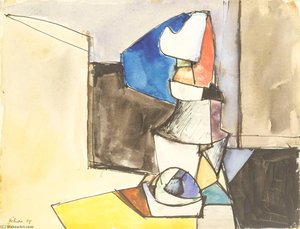
jean hélion
1904 - 1987

