

 Aperçu en situation
 Partager
 Partager
 Détails
 Guide imprimable

 Télécharger
 Articles similaires
 Radiographie
 Voir le diaporama
 Statistiques
Bright House
 Watercolor
- WallArt
- Orphism
 1914
1914- Modern
 20.0 x 26.0 cm
 Afficher la suite
Giclées et impressions d'art
Impressions giclées ou sur toile de qualité musée, avec une production rapide et des finitions au choix. ( Acheter la peinture faite à la main Passer au format image numérique)




P118B €10

P118H €10

P118W €10

P438Z €10

P508JH €12

P508YH €12

P805H €10

P805Z €10

P919BZ €10

P919G €10

P919XJ €10

P959ZH €10

P968JZ €12

W106C €8

W218G €10

W218JH €8

W218Y €10

W307PJ €10

W316G €10

W316PJ €8

W316Y €10

W398PJ €8

W4111J €10

W500HY €15

W500JH €15

W692G €12

W849H €8

W940BG €15

W953PJ €8




Choisissez parmi nos formats prédéfinis qui respectent les proportions originales de l’œuvre.

Saisissez la largeur et la hauteur souhaitées pour qu'elles s'adaptent à votre cadre ou à votre mur. Une impression ne peut être que découpée, elle ne peut jamais être agrandie au-delà de l'image originale ; ainsi, un format de forme différente entraînera la perte d'une partie de l'image. Nous vous envoyons une maquette numérique pour approbation avant toute impression. L'image présentée sur cette page ne montre pas le recadrage réel — seule la maquette le permet.
Livraison dans le monde entier () en 2 semaines au lieu des 4/5 semaines habituelles. (21 octobre)

Livraison express gratuite dans le monde entier

Toile de lin de haute qualité

Assurance transport complète

Garantie de remboursement des droits de douane

Garantie de fidélité des couleurs

Garantie de retour de 100 jours (uniquement en cas de défaut)

Garantie de remboursement à 100%

Tarifs dégressifs sur quantité
 L'option verre n'est disponible que pour les dimensions inférieures à 110 cm.

Bright House
Giclées et impressions d'art
Format de la reproduction
-


Prix total final
€ 70
August Macke’s ‘Bright House’: A Window into Orphism's Vibrant Soul
August Macke’s “Bright House,” painted in 1914, is more than just a depiction of a tropical dwelling; it’s a potent distillation of the artistic currents swirling around him – specifically, the burgeoning movement of Orphism. Created during a period of intense experimentation and a yearning for new forms of expression, this watercolor offers a captivating glimpse into Macke's innovative approach to color and composition. Measuring 20 x 26 cm, the painting’s compact scale belies its powerful impact, drawing the viewer into a world of geometric simplification and luminous hues.
- Subject Matter: The scene is deceptively simple – a house with a striking red roof nestled amongst swaying palm trees. This wasn't merely a representation of a physical location; it was an exploration of essential forms, stripped down to their purest elements.
- Orphism’s Influence: Macke was deeply involved in the Orphic movement, which sought to break free from traditional representational art by emphasizing geometric shapes and intense color relationships. The painting's bold blocks of red, white, and green are hallmarks of this style.
- Technique: Macke’s masterful use of watercolor is evident in the layering of translucent washes, creating a shimmering effect that captures the light and atmosphere of the tropical setting. The deliberate lack of detail further emphasizes the geometric forms.
A Pioneer of German Expressionism
August Macke's work falls squarely within the realm of German Expressionism, a movement characterized by its emotional intensity and subjective interpretation of reality. As a member of Der Blaue Reiter (The Blue Rider), a group of artists who sought to revolutionize art through experimentation with color and form, Macke was at the forefront of artistic innovation. His brief but impactful career – tragically cut short by the First World War – left an indelible mark on modern art. The painting’s creation in 1914 reflects this period of intense creative ferment, a time when artists were grappling with new ideas about space, color, and perception.
The influence of Impressionism and Post-Impressionism is readily apparent in Macke's early work, but he quickly moved beyond these influences to develop his own distinctive style. His use of bold colors and simplified forms was a deliberate rejection of academic conventions, paving the way for future generations of artists.
Symbolic Resonance and Emotional Impact
"Bright House" isn’t simply a pretty picture; it's imbued with symbolic resonance. The house itself can be interpreted as representing shelter, stability, and perhaps even a retreat from the anxieties of the modern world. The palm trees, symbols of paradise and exoticism, evoke a sense of tranquility and escape. Macke’s deliberate use of color – particularly the vibrant red – adds to the painting's emotional intensity, creating a feeling of energy and movement.
The presence of a solitary figure near the house suggests contemplation or enjoyment of the scene, inviting the viewer to share in this moment of serenity. The overall effect is one of profound peace and beauty, capturing the essence of a timeless landscape.
A Legacy of Innovation
August Macke’s “Bright House” stands as a testament to his artistic vision and technical skill. It's a prime example of Orphism at its most compelling, demonstrating the movement’s emphasis on geometric forms and vibrant color relationships. Reproductions of this artwork offer an opportunity to experience firsthand the power and beauty of Macke’s unique style – a style that continues to inspire artists and art lovers today.
Questions et réponses
Où puis-je voir un aperçu de « Bright House » ?
Pour prévisualiser une reproduction de «Bright House» de August Macke, ouvrez la page Aperçu de l'œuvre.
Combien de personnes consultent « Bright House » ?
La page Statistiques de «Bright House» de August Macke présente les statistiques de visites publiques : le nombre de visites mensuelles de cette œuvre, une comparaison avec les œuvres les plus consultées de l'artiste, ainsi que la provenance des visiteurs.
Comment puis-je visionner «Bright House» de August Macke sous forme de diaporama ?
Vous pouvez visionner «Bright House» de August Macke sous forme de diaporama sur la page Diaporama de l'œuvre.
Biographie de l'artiste
Premières années et carrière artistique
August Robert Ludwig Macke, un peintre expressionniste allemand renommé, est né le 3 janvier 1887 à Meschede, en Westphalie. Son parcours artistique a débuté à la Kunstakademie de Düsseldorf (1904-1906), sous la direction d'Adolf Maennchen. Le style de Macke a été façonné par l’impressionnisme français et le post-impressionnisme, influencé plus tard par le fauvisme.Influences artistiques et style
La rencontre avec Robert Delaunay à Paris (1912) a initié Macke au cubisme chromatique, également connu sous le nom d'orphisme. Cette influence se manifeste dans sa peinture "Les fenêtres de la boutique", une interprétation personnelle du style de Delaunay combinée à la simultanéité des images que l’on retrouve dans le futurisme italien. Macke a fait partie du groupe expressionniste allemand *Der Blaue Reiter* (Le Cavalier bleu), aux côtés de Wassily Kandinsky, Franz Marc et Paul Klee. Ses peintures, telles que "Jeunes filles se baignant avec la ville en arrière-plan" (100 x 80 cm, Staatsgalerie moderner Kunst, Munich, Allemagne), illustrent son style unique caractérisé par des couleurs vives et un dessin audacieux.Œuvres notables et héritage
- “Femme à la veste verte” (1913, Museum Ludwig Cologne, Allemagne), une pièce exemplaire de l'expressionnisme.
- "Paysage avec des vaches et un chameau" (1914, Kunsthaus Zürich, Suisse), un exemple essentiel du style de Macke.
- “Türkisches Café” (1914), un chef-d’œuvre mettant en valeur son approche luministe pendant sa dernière période.
Fin tragique et impact durable
La vie de Macke a été brutalement interrompue lorsqu'il est décédé le 26 septembre 1914, au front à Champagne, en France. Sa dernière peinture, "Adieu", capture l’ambiance de morosité qui s’est abattue sur l’Europe pendant la Première Guerre mondiale. Explorez davantage les œuvres d'August Macke et le mouvement expressionniste allemand sur OriginalUniqueArt :- Femme à la veste verte
- Formes combattantes de Franz Marc (montrant la collaboration au sein du *Der Blaue Reiter*)
- Page de l'artiste August Macke sur OriginalUniqueArt
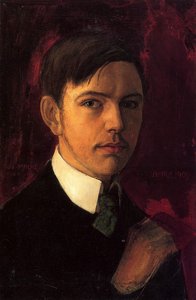
August Macke
1887 - 1914 , Allemagne
En bref
- Artistes Influents:
- Robert Delaunay
- Wassily Kandinsky
- Franz Marc
- Paul Klee
- Date De Décès: 26 septembre 1914
- Date De Naissance: 3 janvier 1887
- Lieu De Naissance: Meschede, Allemagne
- Mouvement Artistique: Expressionnisme allemand
- Nationalité: Allemande
- Nom Complet: August Macke
- Œuvres Notables:
- Femme avec une veste verte
- Paysage avec des vaches et un chameau
- Jeunes filles se baignant
- La Boutique de Chapeaux
- Türkisches Café
Articles connexes

OriginalUniqueArt.com F.A.Q.: Elevate Your Decor with Premium Textured Giclée Prints
Discover the distinction of OriginalUniqueArt.com premium textured Giclée prints. Expertly crafted with archival 12-color pigments and museum-grade substrates, our prints offer unparalleled vividness for the discerning collector seeking luxury, durability, and timeless elegance.


