

 Aperçu en situation
 Partager
 Partager
 Détails
 Guide imprimable

 Télécharger
 Articles similaires
 Radiographie
 Voir le diaporama
 Statistiques
Le Centaure regardant les poissons
 Huile sur toile
- Décoration murale
- Symbolisme
 1878
1878- XIXe siècle
 43.0 x 70.0 cm
 Kunsthaus Zürich
 Afficher la suite
Giclées et impressions d'art
Impressions giclées ou sur toile de qualité musée, avec une production rapide et des finitions au choix. ( Acheter la peinture faite à la main Passer au format image numérique)




P118B €10

P118H €10

P118W €10

P438Z €10

P508JH €12

P508YH €12

P805H €10

P805Z €10

P919BZ €10

P919G €10

P919XJ €10

P959ZH €10

P968JZ €12

W106C €8

W218G €10

W218JH €8

W218Y €10

W307PJ €10

W316G €10

W316PJ €8

W316Y €10

W398PJ €8

W4111J €10

W500HY €15

W500JH €15

W692G €12

W849H €8

W940BG €15

W953PJ €8




Choisissez parmi nos formats prédéfinis qui respectent les proportions originales de l’œuvre.

Saisissez la largeur et la hauteur souhaitées pour qu'elles s'adaptent à votre cadre ou à votre mur. Une impression ne peut être que découpée, elle ne peut jamais être agrandie au-delà de l'image originale ; ainsi, un format de forme différente entraînera la perte d'une partie de l'image. Nous vous envoyons une maquette numérique pour approbation avant toute impression. L'image présentée sur cette page ne montre pas le recadrage réel — seule la maquette le permet.
Livraison dans le monde entier () en 2 semaines au lieu des 4/5 semaines habituelles. (23 octobre)

Livraison express gratuite dans le monde entier

Toile de lin de haute qualité

Assurance transport complète

Garantie de remboursement des droits de douane

Garantie de fidélité des couleurs

Garantie de retour de 100 jours (uniquement en cas de défaut)

Garantie de remboursement à 100%

Tarifs dégressifs sur quantité
 L'option verre n'est disponible que pour les dimensions inférieures à 110 cm.

Le Centaure regardant les poissons
Giclées et impressions d'art
Format de la reproduction
-


Prix total final
€ 70
A Silent Meditation on Nature and Mortality
In the quietude of Arnold Böcklin’s 1878 masterpiece, “Centaur Watching Fish,” the viewer is invited into a realm where the boundaries between the mythological and the terrestrial dissolve. This evocative oil on canvas, currently held in the prestigious Kunsthaus Zürich, serves as a profound gateway into the Symbolist movement—a period of art history dedicated to exploring the hidden psychological depths of the human soul. Rather than presenting a mere scene from ancient legend, Böcklin crafts an immersive experience that speaks to the universal themes of solitude and the silent, rhythmic pulse of the natural world. The centaur, a creature of dual nature, reclines upon a serene shoreline, his gaze fixed upon the movement beneath the water's surface, creating a moment of suspended animation that feels both eternal and fleeting.
The composition is masterfully orchestrated to evoke a sense of Romantic reverie. Utilizing a horizontal format, Böcklin emphasizes the reclining posture of the centaur, grounding the mythological figure within a landscape of soft sands and swaying grasses. The artist deliberately eschews the rigid precision of strict realism in favor of an emotional truth. Through the use of diffused lighting and gentle shadows, he establishes an atmosphere of melancholic stillness. This technique allows the viewer to feel the weight of the silence, as if the very air around the creature is heavy with contemplation. It is a painting that does not demand attention through spectacle, but rather earns it through a subtle, haunting intimacy.
The Mastery of Texture and Atmosphere
Technically, “Centaur Watching Fish” is a triumph of texture and perspective. Böcklin employs the impasto technique with remarkable skill, applying thick, deliberate layers of paint to render the coarse fur of the centaur’s equine half. This tactile richness provides a palpable sense of physicality, making the creature feel present and breathing within the frame. To balance this heavy texture, the artist utilizes atmospheric perspective to create an illusion of infinite depth. By reducing color saturation and softening the details of the distant horizon, he simulates a hazy, dreamlike distance that reinforces the theme of isolation. This method draws a direct lineage from the Romantic masters like Caspar David Friedrich, using the landscape as a mirror for spiritual introspection.
The color palette is a sophisticated arrangement of earthy tones—ochres, deep browns, and muted beiges—which lends the work an organic, timeless quality. These warm, grounded hues are contrasted by the subtle, shimmering light reflecting off the water, drawing the eye toward the focal point of the centaur’s quiet observation. For the collector or interior designer, this piece offers a unique aesthetic versatility; its somber yet tranquil mood provides a sophisticated anchor for a room, offering a sense of historical depth and intellectual gravity that more contemporary works may lack.
Symbolism: The Intersection of Myth and Being
Beyond its visual splendor, the painting functions as a complex symbolic tapestry. The centaur itself—a hybrid of human intellect and animal instinct—serves as a powerful metaphor for the duality of existence. As he watches the fish, there is a profound sense of the relationship between humanity and the untamed elements of nature. The act of watching becomes a meditation on mortality; the stillness of the figure suggests a resignation to the cycles of life and death that govern both man and beast. There is a touch of sadness in his solitude, yet it is a beautiful, dignified melancholy that celebrates the quiet dignity of existence.
For those seeking to bring a piece of this profound emotional landscape into their personal spaces, a high-quality reproduction of this work offers more than just decoration. It provides a window into a bygone era of artistic exploration, a constant reminder of the beauty found in silence and the enduring power of myth. Whether placed in a library, a study, or a curated gallery space, “Centaur Watching Fish” continues to provoke thought, inviting all who encounter it to pause, breathe, and reflect upon the silent wonders of the world.
Questions et réponses
Quelle atmosphère se dégage de « Le Centaure regardant les poissons » ?
«Le Centaure regardant les poissons» de Arnold Böcklin est décrit comme ayant une atmosphère Romantique. Cette classification peut aider à harmoniser l'œuvre avec un décor.
Puis-je voir «Le Centaure regardant les poissons» de Arnold Böcklin sur mon propre mur avant de l'acheter ?
Vous pouvez prévisualiser «Le Centaure regardant les poissons» de Arnold Böcklin sur votre propre mur grâce à la page Aperçu RA de l'œuvre, en utilisant la réalité augmentée sur un appareil compatible.
L'œuvre « Le Centaure regardant les poissons » est-elle plutôt claire ou plutôt sombre dans l'ensemble ?
«Le Centaure regardant les poissons» de Arnold Böcklin présente une luminosité de équilibrée, avec une luminance de Ombre douce.
Biographie de l'artiste
Premières années et formation
Arnold Böcklin, peintre symboliste suisse, est né le 16 octobre 1827 à Bâle, en Suisse. Son père, Christian Frederick Böcklin, descendait d'une vieille famille de Schaffhouse et exerçait dans le commerce de la soie. Sa mère, Ursula Lippe, était originaire de la même ville. Il a étudié à l’Académie de Düsseldorf sous Schirmer, devenant ami avec Anselm Feuerbach. Böcklin est associé à l'École de peinture de Düsseldorf.Carrière artistique et symbolisme
Le parcours artistique de Böcklin l'a mené dans diverses villes, dont Paris, où il a travaillé au Louvre, et Rome, où il a été influencé par ses paysages. Son œuvre présentait souvent des figures allégoriques et mythologiques dans des décors comprenant une architecture classique, explorant les thèmes de la mort et de la mortalité.- Le Grand Parc, l'une de ses premières œuvres, mettait en scène l’ancienne mythologie.
- La Nymphe et le Satyre (1858) et Sappho (1859) étaient des œuvres notables de cette période.
- Son autoportrait avec la Mort jouant du violon (1872) exemplifiait son style unique.
Héritage et influence
Böcklin est surtout connu pour ses cinq versions de l’Île des morts (1880-1886), qui évoquaient le cimetière anglais à Florence, où sa fille était enterrée. Son œuvre a influencé les artistes plus jeunes comme Hans Thoma et a inspiré plusieurs compositeurs romantiques tardifs.- Clement Greenberg a décrit l'œuvre de Böcklin comme "l'une des expressions les plus accomplies" de son époque.
- Le style de Böcklin se superposait aux préraphaélites, mettant l’accent sur le monde des rêves et du mysticisme.
Collections et musées
L'œuvre de Böcklin peut être trouvée dans divers musées, notamment :- Öffentliche Kunstsammlung (Bâle, Suisse)
- Kunstmuseum Basel (Suisse)
- Museum Kunsthaus Zürich (Zurich, Suisse)
Développement et influences ultérieures
Au fil de sa carrière, Böcklin a exploré une variété de thèmes et de styles. Son intérêt pour la mythologie classique, combiné à son exploration des émotions humaines profondes, a conduit à un style unique qui a influencé les mouvements artistiques ultérieurs. Il a été particulièrement influent sur le symbolisme allemand et a inspiré des compositeurs comme Gustav Mahler, dont l'œuvre "Kindertotenlieder" est directement inspirée par ses peintures de l’Île des morts. Böcklin a également contribué à la popularisation de l'art symboliste auprès du grand public grâce à la production de gravures et de reproductions de ses œuvres. Son approche mélancolique et son esthétique sombre ont trouvé un écho dans une société en proie aux angoisses liées à la modernité et à la perte des valeurs traditionnelles.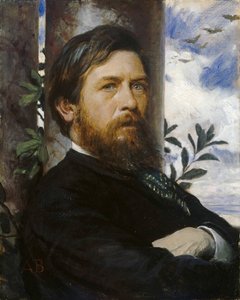
Arnold Böcklin
1827 - 1901 , Suisse
En bref
- Artistes Influents:
- Caspar David Friedrich
- Anselm Feuerbach
- Date De Décès: 16 janvier 1901
- Date De Naissance: 16 octobre 1827
- Influences Artistiques:
- Hans Thoma
- Préraphaélites
- Lieu De Naissance: Bâle, Suisse
- Mouvement Artistique: Symbolisme
- Nationalité: Suisse
- Nom Complet: Arnold Böcklin
- Oeuvres Notables:
- Île des morts
- La Guerre
- Nymphe et satyre
Articles connexes

10 chefs-d'œuvre du Réalisme Romantique qui capturent l'âme humaine
Plongez dans l'émotion du Réalisme Romantique. Explorez 10 chefs-d'œuvre iconiques, de Constable à Homer, mêlant vérité et passion. Trouvez l'inspiration pour votre décor avec nos reproductions de qualité musée sur OriginalUniqueArt.com. Découvrez toute la collection en ligne.

The Enduring Power of Painting: A Historical & Contemporary Exploration of Form and Emotion
Explore the rich history & enduring techniques of oil painting with OriginalUniqueArt. Discover masterpieces, learn about art collecting, and find authentic handmade reproductions crafted by skilled artists.

The Enduring Legacy of Oil on Canvas: Technique, History & Aesthetic Impact
Explore the rich history & techniques of oil painting – from Renaissance masters to Impressionism. Discover pigments, layering methods, and why this timeless medium endures. Expert insights for artists & art enthusiasts.

L'Huile sur Toile : Exploration Historique et Technique d'un Médium Artistique Intemporel
Explorez l'histoire fascinante de la peinture à l'huile, des techniques ancestrales aux maîtres flamands comme Van Eyck. Découvrez les secrets des pigments, liants et glacis pour comprendre cet art intemporel.

L'héritage durable de la peinture à l'huile : technique, histoire et pratique contemporaine
Explorez l'histoire fascinante de la peinture à l'huile, des techniques ancestrales aux pratiques contemporaines. Découvrez les maîtres, apprenez et trouvez votre œuvre d'art idéale chez .


