

 Aperçu en situation
 Envoyer
 Partager
 Détails de l'œuvre
 Guide
Guide

 Télécharger l'image
 Articles similaires
 Radiographie
 Diaporama
 Statistiques
Self portrait
 Oil On Canvas
- WallArt
- Venetian Grand Manner
 1684
1684- Early Modern
 49.0 x 40.0 cm
 Musée Ashmolean d’Art et d’Archéologie
 Lire la suite
Reproduction à l'huile faite à la main
Huile sur toile peinte à la main, avec cadre et dimensions personnalisés, réalisée sur commande par nos artistes. ( Passer au format impression Passer au format numérique)




P118B €10

P118H €10

P118W €10

P438Z €10

P508JH €12

P508YH €12

P805H €10

P805Z €10

P919BZ €10

P919G €10

P919XJ €10

P959ZH €10

P968JZ €12

W106C €8

W218G €10

W218JH €8

W218Y €10

W307PJ €10

W316G €10

W316PJ €8

W316Y €10

W398PJ €8

W4111J €10

W500HY €15

W500JH €15

W692G €12

W849H €8

W940BG €15

W953PJ €8




Choisissez parmi nos formats prédéfinis qui respectent les proportions originales de l’œuvre.

Saisissez la largeur et la hauteur souhaitées, pour s'adapter à votre cadre ou à votre mur. Cette œuvre est peinte à la main ; ainsi, pour un format de forme différente, l'artiste peut peindre un peu plus autour du tableau ou réduire légèrement les bords — c'est vous qui choisissez. Nous vous envoyons une maquette numérique pour approbation avant que la peinture ne commence. L'image présentée sur cette page ne reflète pas le résultat réel — seule la maquette le fait.
Après la commande, l’équipe OriginalUniqueArt.com contactera le client par e-mail pour recueillir ses instructions et lui fournira une maquette d’aperçu
Livraison dans le monde entier () en 3 à 4 semaines au lieu des 5 semaines habituelles. (26 octobre). Aucun compromis sur la qualité.

Livraison express gratuite dans le monde entier

Toile de lin de qualité supérieure

Assurance transport complète

Garantie de remboursement des droits de douane

Garantie de fidélité des couleurs

Politique de retour de 100 jours (uniquement en cas de défaut)

Garantie de remboursement à 100%

Offre de tarifs dégressifs
 L'option verre n'est disponible que pour les dimensions inférieures à 110 cm.

Self portrait
Technique de reproduction
Format de la reproduction
-


Prix total
€ 263
Antonio Bellucci’s Self Portrait: A Window Into Venetian Rococo Soul
Antonio Bellucci’s “Self Portrait,” completed around 1684, stands as an emblem of the Venetian Grand Manner style—a movement that sought to elevate painting beyond mere representation into a vehicle for conveying profound emotion and intellectual contemplation. Executed in oil on canvas, this artwork transcends its formal dimensions, offering a glimpse into the artist’s psyche and reflecting the broader cultural currents shaping Baroque Europe.
The portrait depicts Bellucci seated before a mirror, bathed in soft light that illuminates his face with an almost unnerving clarity. His gaze is direct, unwavering—a challenge to the viewer to confront oneself. The artist’s attire – a simple white shirt – underscores a deliberate austerity, contrasting sharply with the opulent fabrics and decorative motifs characteristic of Venetian aristocratic interiors at the time.
- Style: Bellucci adheres rigorously to the principles of Venetian Grand Manner, prioritizing idealized form and meticulous detail. The composition is balanced and symmetrical, reflecting the humanist ideals prevalent in artistic circles during his era.
- Technique: Bellucci’s masterful brushwork demonstrates an exceptional command of chiaroscuro—the dramatic interplay between light and shadow—creating a palpable sense of depth and realism. He employs glazing techniques to achieve luminous surfaces and subtle tonal variations, capturing the nuances of skin texture and drapery folds with remarkable precision.
- Historical Context: Created during Bellucci’s prolific period in Venice, “Self Portrait” aligns perfectly with the artistic fervor surrounding the patronage of wealthy families like Palazzo Mocenigo and reflects the influence of artists such as Ricci and Tiepolo. The painting embodies the Venetian preoccupation with portraying human dignity and intellect amidst a turbulent political landscape.
- Symbolism: The mirror serves as a potent symbol—not merely reflecting physical appearance but also representing introspection and self-awareness. Bellucci’s gaze directly engages the viewer, prompting contemplation on identity and mortality – themes central to Baroque art’s exploration of human experience.
Displayed prominently at the Ashmolean Museum of Art and Archaeology in Oxford, “Self Portrait” continues to captivate audiences with its psychological depth and artistic brilliance. Its enduring appeal lies in its ability to communicate a timeless message about confronting oneself—a feat achieved through Bellucci’s unparalleled technical skill and unwavering commitment to conveying emotion.
Additional Research Links:
Recommended Reproduction: Consider commissioning a museum-quality reproduction of “Self Portrait” from OriginalUniqueArt.com to bring this iconic masterpiece into your home and experience its captivating beauty firsthand.
Questions et réponses
Quelle intensité et quelle saturation «Self portrait» de Antonio Bellucci présente-t-il ?
Les couleurs de «Self portrait» de Antonio Bellucci présentent une saturation Muted et une intensité Monochromatic.
L'œuvre « Self portrait » est-elle plutôt claire ou plutôt sombre dans l'ensemble ?
«Self portrait» de Antonio Bellucci présente une luminosité de bright, avec une luminance de Bright Balance.
Existe-t-il des œuvres similaires à « Self portrait » ?
Retrouvez les œuvres similaires à «Self portrait» de Antonio Bellucci sur la page Œuvres similaires.
Biographie de l'artiste
La Grandeur de l'Esprit Vénitien
Antonio Bellucci s'impose comme une figure lumineuse au sein de la tradition artistique vénitienne, un maître dont le pinceau a su capturer la transition entre l'intensité dramatique du Baroque et l'élégance aérienne du Rococo. Né en 1654 à Pieve di Soligo, en Italie, Bellucci a reçu une formation initiale rigoureuse sous la direction de Domenico Difnico à Sébénico, lui inculquant les fondements des principes classiques. Cependant, c'est son arrivée à Venise qui a véritablement embrasé son esprit créatif. Dès 1675, il apportait déjà des contributions significatives aux espaces sacrés de la cité, notamment à travers ses fresques monumentales pour San Pietro di Castello. Dans ces œuvres, illustrant les prières ferventes de Saint Lorenzo Giustiniani lors de la peste de 1447, Bellucci a fait preuve d'une capacité extraordinaire à entrelacer dévotion religieuse et émotion humaine, créant un sentiment de drame divin qui résonna profondément auprès du public vénitien.
Son talent ne se limitait pas au domaine spirituel ; Bellucci possédait une maîtrise polyvalente de divers genres, allant de la tendresse intime des scènes de la Nativité pour l'église de l'Ascension aux récits grandioses de la mythologie classique. Une caractéristique déterminante de son évolution fut son esprit de collaboration. Il travailla en étroite harmonie avec le paysagiste Antonio Tempesta, apportant par son talent de peintre de figures humaines une vie et une complexité narrative nouvelles aux vastes panoramas de Tempesta. Cette synergie entre la figure et le paysage est devenue l'une des marques de fabrique de son style mature, mêlant mouvement et grâce à une profondeur structurelle.
Une Ascension à la Cour et un Héritage Européen
À mesure que sa réputation grandissait, les ambitions de Bellucci le portèrent bien au-delà des frontières de la République de Venise, l'amenant au cœur même du pouvoir européen. Ses séjours à Vienne, à la fin du XVIIe et au début du XVIIIe siècle, marquèrent l'apogée de sa carrière, puisqu'il obtint le prestigieux patronage de la cour des Habsbourg. Sous le regard de l'empereur Charles VI, Bellucci entreprit des projets monumentaux qui témoignaient de ses prouesses techniques à une échelle impériale. Les quatre retables qu'il créa pour Klosterneuburg demeurent des témoignages éternels de sa capacité à diriger des compositions religieuses de grande envergure avec autant de majesté que de clarté.
Le zénith de sa peinture architecturale est peut-être mieux illustré par les fresques de plafond époustouflantes du Palais Liechtenstein. En dépeignant le Triomphe d'Hercule, Bellucci utilisa le "grand manner" pour créer une expérience immersive, où l'héroïsme mythologique rencontre l'esthétique sophistiquée de l'ère Rococo naissante. Cette aptitude à synthétiser la grandeur classique avec une touche plus légère et décorative lui permit de naviguer avec aisance parmi les goûts changeants de l'aristocratie européenne.
Au-delà de ses accomplissements individuels, l'importance historique de Bellucci est consolidée par son rôle de mentor et de force d'influence dans la lignée de l'art italien. Par l'enseignement qu'il prodigua à des élèves talentueux tels qu'Antonio Balestra et potentiellement Jacopo Amigoni, il s'assura que les techniques sophistiquées de l'école vénitienne perdurent et évoluent. Son héritage reste gravé dans les plafonds des palais et les autels des cathédrales, représentant une période d'un splendeur artistique inégalée où la lumière, le mouvement et le mythe convergeaient pour célébrer l'humain et le divin.

Antonio Bellucci
1654 - 1726 , Italie
L'essentiel de l'artiste
- Artistic Movement Or Style: Rococo
- Artists Who Influenced This Artist: ['Domenico Difnico']
- Date Of Birth: 1654
- Date Of Death: 1726
- Full Name: Antonio Bellucci
- Nationality: Venetian
- Notable Artworks:
- Saint Lorenzo Giustiniani Praying
- Nativity
- Hercules Triumph
- Place Of Birth: Pieve di Soligo, Italie
Articles connexes

L'Huile sur Toile : Exploration Historique et Technique d'un Médium Artistique Intemporel
Explorez l'histoire fascinante de la peinture à l'huile, des techniques ancestrales aux maîtres flamands comme Van Eyck. Découvrez les secrets des pigments, liants et glacis pour comprendre cet art intemporel.

L'héritage durable de la peinture à l'huile : technique, histoire et pratique contemporaine
Explorez l'histoire fascinante de la peinture à l'huile, des techniques ancestrales aux pratiques contemporaines. Découvrez les maîtres, apprenez et trouvez votre œuvre d'art idéale chez .

The Enduring Legacy of Oil on Canvas: Technique, History & Aesthetic Impact
Explore the rich history & techniques of oil painting – from Renaissance masters to Impressionism. Discover pigments, layering methods, and why this timeless medium endures. Expert insights for artists & art enthusiasts.

Les 10 Chefs-d'œuvre Baroques qui ont Révolutionné l'Art |
Plongez au cœur du baroque avec les 10 chefs-d'œuvre de Caravaggio, Rembrandt et Rubens. Découvrez l'histoire fascinante de ces artistes et leurs tableaux célèbres. Reproductions d'art de qualité muséale sur – Explorez la collection !
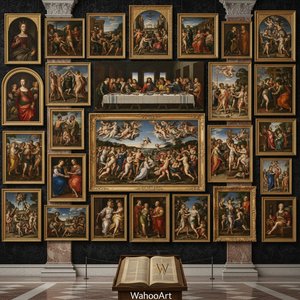
Jacopo Tintoretto : Les 25 Chefs-d'œuvre du Maître Vénitien | OriginalUniqueArt
Plongez dans l'univers dramatique de Jacopo Tintoretto ! Découvrez les 25 œuvres incontournables du maître vénitien, ses techniques uniques et son style baroque. Reproductions de qualité muséale sur OriginalUniqueArt.com.


