

 Aperçu en situation
 Partager
 Partager
 Détails
 Guide imprimable

 Télécharger
 Articles similaires
 Radiographie
 Voir le diaporama
 Statistiques
Black Sun


 Afficher la suite
Giclées et impressions d'art
Impressions giclées ou sur toile de qualité musée, avec une production rapide et des finitions au choix. ( Acheter la peinture faite à la main Passer au format image numérique)




P118B €10

P118H €10

P118W €10

P438Z €10

P508JH €12

P508YH €12

P805H €10

P805Z €10

P919BZ €10

P919G €10

P919XJ €10

P959ZH €10

P968JZ €12

W106C €8

W218G €10

W218JH €8

W218Y €10

W307PJ €10

W316G €10

W316PJ €8

W316Y €10

W398PJ €8

W4111J €10

W500HY €15

W500JH €15

W692G €12

W849H €8

W940BG €15

W953PJ €8




Choisissez parmi nos formats prédéfinis qui respectent les proportions originales de l’œuvre.

Vous pouvez saisir vos propres dimensions pour vous adapter à un cadre ou à un espace spécifique. Si la taille sélectionnée ne correspond pas aux proportions de l'image originale, nous recadrerons l'œuvre ou étendrons l'image avec une bordure en miroir ou une couleur unie. Une maquette numérique vous sera envoyée pour approbation avant le début de la production.
Veuillez noter que l'aperçu à l'écran ne reflète pas le recadrage ou l'extension réelle. Seule la maquette montrera avec précision la composition finale.
Bien que des tailles personnalisées soient disponibles, nous vous recommandons de choisir une dimension dans la liste prédéfinie afin de préserver les proportions originales.
Livraison dans le monde entier () en 2 semaines au lieu des 4/5 semaines habituelles. (30 septembre)

Livraison express gratuite dans le monde entier

Toile de lin de haute qualité

Assurance transport complète

Garantie de remboursement des droits de douane

Garantie de fidélité des couleurs

Garantie de retour de 100 jours (uniquement en cas de défaut)

Garantie de remboursement à 100%

Tarifs dégressifs sur quantité
 L'option verre n'est disponible que pour les dimensions inférieures à 110 cm.

Black Sun
Giclées et impressions d'art
Format de la reproduction
-


Prix total final
€ 69
Alexander Milne Calder’s “Black Sun”: A Dance of Darkness and Light
Alexander Milne Calder's "Black Sun," painted in 1953, isn’t merely a depiction of abstract forms; it’s an invitation to contemplate the interplay between chaos and order, darkness and light. Born in Aberdeen, Scotland, and later establishing himself as a pivotal figure in American sculpture alongside his son Alexander Stirling Calder and grandson Alexander ‘Sandy’ Calder, Milne Calder possessed a singular vision – one that sought to capture dynamic movement and inherent instability within static forms. This piece exemplifies that philosophy perfectly, presenting a swirling vortex of black acrylic paint against a stark white canvas, creating an immediate sense of both tension and serenity.
The artwork's core is defined by its curvilinear shapes: elongated ribbons and sweeping curves dominate the composition, reminiscent of waves in perpetual motion or the currents of a turbulent stream. These forms are interwoven with sharp, geometric elements – triangles and circles – that introduce a counterpoint of structure to the fluidity. This juxtaposition immediately establishes a dynamic tension; the organic curves seem poised to collide with the rigid angles, suggesting an ongoing negotiation between opposing forces. The thick application of paint contributes significantly to this effect, lending a tactile quality to the forms and emphasizing their weight and presence within the space.
A Symbol Rooted in Mystery
The “Black Sun” motif itself carries a complex and layered history, extending far beyond Calder’s artistic intentions. Initially conceived as a symbol by SS officer Wilhelm Landig during the Nazi era, it was intended to replace the swastika – a potent emblem of Aryan supremacy. The Wewelsburg mosaic, where this design first appeared, became a clandestine center for occult practices and esoteric beliefs within the Nazi regime. Calder, however, remained largely unaware of this symbolic context during the creation of his painting. The symbol’s association with the occult has since been embraced by neo-Nazis and far-right groups, adding another layer of intrigue to its visual language.
Interestingly, the “Black Sun” also found resonance within esoteric traditions, particularly in alchemy and Hermeticism. It represents a solar deity associated with transformation, rebirth, and the cyclical nature of time. This connection speaks to Calder’s broader interest in exploring universal themes through his art – themes that transcend specific historical contexts. The painting, therefore, can be interpreted as a meditation on these enduring concepts, inviting viewers to consider their own relationship to cycles of destruction and renewal.
Technique and Emotional Resonance
Calder’s technique is characterized by its directness and immediacy. He employed acrylic paint applied directly onto the canvas with broad brushstrokes and, potentially, other tools like palette knives, creating a textured surface that enhances the sense of movement. The lack of traditional perspective—depth is implied through overlapping forms rather than linear recession—further contributes to the artwork’s dynamic quality. There's no attempt at realistic representation; instead, Calder focuses on capturing the *feeling* of motion and energy.
“Black Sun” evokes a powerful emotional response. The stark contrast between black and white creates a dramatic visual impact, while the swirling forms generate a sense of unease and dynamism. Yet, there’s also an underlying feeling of balance and harmony—a suggestion that even within chaos, order can be found. It's a piece that demands contemplation, inviting viewers to lose themselves in its intricate patterns and ponder the mysteries it holds. The painting’s enduring appeal lies in its ability to simultaneously fascinate and unsettle, prompting us to confront our own perceptions of beauty, darkness, and the cyclical nature of existence.
A Legacy of Motion and Form
Alexander Milne Calder's legacy extends far beyond this single masterpiece. His pioneering work with mobiles—kinetic sculptures that respond to air currents—revolutionized sculpture and continues to inspire artists today. His son, Alexander Stirling Calder, further developed these concepts, while his grandson, Alexander ‘Sandy’ Calder, created monumental public art installations around the world. “Black Sun” stands as a testament to their collective vision – a celebration of movement, form, and the enduring power of abstract expression.
Biographie de l'artiste
Introduction à Alexander Milne Calder
Alexander Milne Calder était un sculpteur américano-écossais né à Aberdeen, en Écosse, en 1846. Il est surtout connu pour ses sculptures architecturales du Philadelphia City Hall, et tant son fils, Alexander Stirling Calder, que son petit-fils, Alexander 'Sandy' Calder, sont devenus des sculpteurs importants au XXe siècle.Jeunesse et carrière
Alexander Milne Calder a commencé sa carrière en Écosse, travaillant pour le sculpteur John Rhind tout en étudiant à la Royal Academy d'Édimbourg. Il a déménagé à Londres et travaillé sur le mémorial Albert. Calder a immigré aux États-Unis en 1868 et s’est installé à Philadelphie, où il a étudié avec Joseph A. Bailly et a suivi des cours avec Thomas Eakins à la Pennsylvania Academy of the Fine Arts.Œuvres notables
Voici quelques-unes des œuvres notables d’Alexander Milne Calder :- Philadelphia City Hall : une commande impliquant plus de 250 pièces en marbre et en bronze, qui a pris à Calder 20 ans pour être achevée.
- William Penn : une statue en bronze colossale qui devait couronner la tour de l’hôtel de ville.
- Figure indienne : une sculpture avant son installation sur l'hôtel de ville.
- Portail sud et portail ouest : illuminés de lumières colorées, mettant en valeur l’attention aux détails de Calder.
Héritage et influence familiale
L'héritage d’Alexander Milne Calder s’étend au-delà de son propre travail, car tant son fils que son petit-fils sont devenus des sculpteurs renommés. Son influence est visible dans divers musées, notamment le Smithsonian American Art Museum et la Galleria Civica di Arte Moderna e Contemporanea Torino. Son œuvre a jeté les bases pour l'innovation artistique de ses descendants, contribuant à une lignée familiale d’artistes sculpturaux reconnus.Signification historique
Alexander Milne Calder a laissé une marque durable sur l’histoire de l’art américain, en particulier grâce à son travail monumental sur le Philadelphia City Hall. Son attention aux détails et sa maîtrise des matériaux ont fait de lui un sculpteur respecté de son époque. Son héritage continue d'inspirer les artistes et les amateurs d'art aujourd'hui, témoignant de l’importance durable de ses contributions au monde de la sculpture.
Alexander Milne Calder
1898 - 1976 , Royaume-Uni
En bref
- Artists Or Movements Influenced By This Artist:
- Alexander Stirling Calder
- Alexander 'Sandy' Calder
- Artists Who Influenced This Artist: ['John Rhind']
- Date Of Birth: 23 août 1846
- Date Of Death: 4 juin 1923
- Full Name: Alexander Milne Calder
- Nationality: Écossais-Américain
- Notable Artworks:
- Philadelphia City Hall
- Statue de William Penn
- Figure Indienne
- Portail Sud et Portail Ouest
- Place Of Birth (City And Country): Aberdeen, Royaume-Uni
Articles similaires
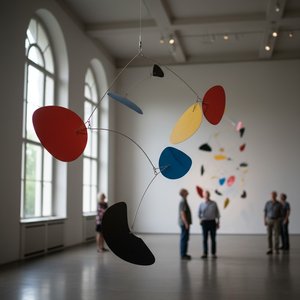
Alexander Calder: Kinetic Sculpture, Mobile Art & the Poetics of Chance
Explore the revolutionary world of Alexander Calder's kinetic sculptures & mobiles. Discover insights for collectors, acquisition advice, and the enduring legacy of this modern master. Expert analysis & art valuation.

Neo-Abstract Art: The High-Impact Evolution of Modern Visual Energy and Geometric Sophistication
Discover the power of Neo-Abstract art. Explore how bold geometric forms and high-impact visual energy are redefining modern design. Learn to curate sophisticated, high-energy spaces with the latest trends in contemporary abstraction and structural color.

Kandinsky : Les 25 Œuvres Maîtresses d'un Pionnier de l'Art Abstrait | OriginalUniqueArt
Plongez dans l'univers vibrant de Kandinsky ! Découvrez les 25 œuvres majeures du pionnier de l'art abstrait. Explorez son expressionnisme, ses couleurs audacieuses et l'histoire fascinante derrière chaque tableau. Reproductions d'exception sur OriginalUniqueArt.com.

Beyond Form & Color: Geometric Abstraction's Evolution in 20th/21st Century Art
Explore the evolution of geometric abstraction from Cubism to contemporary art. Discover key artists like Malevich & Mondrian, investment insights, and expert collecting advice at OriginalUniqueArt.

Abstraction Géométrique : Les 10 Chefs-d'œuvre qui ont Marqué l'Histoire de l'Art
Plongez au cœur de l'abstraction géométrique avec OriginalUniqueArt.com ! Découvrez les 10 œuvres majeures de Mondrian, Malevitch et Kandinsky qui ont révolutionné l'art moderne. Inspirez votre décoration intérieure avec des reproductions de tableaux exceptionnelles. Explorez la collection en ligne !

